



Air Conditioning Modifications Meet Changing Transportation Needs
Use of new refrigerants to comply with emission standards, lighter weight materials, and electric and roof-mount system designs show the changes that are taking place in the industry.
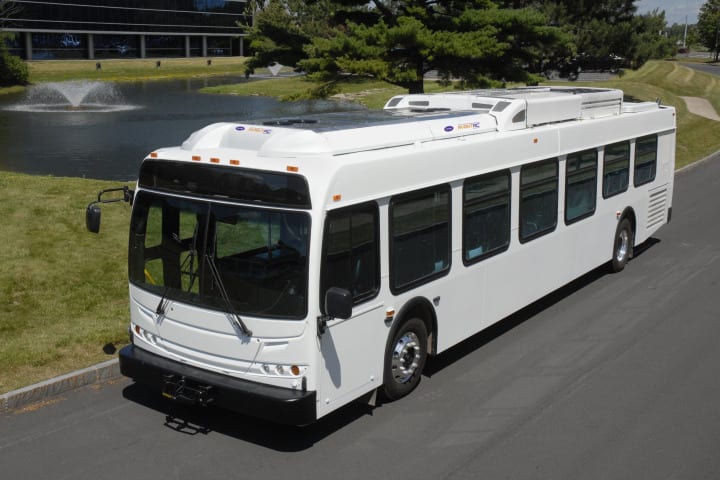
Courtesy Carrier
[IMAGE]carrier.jpg[/IMAGE]Modifications to air conditioning systems, which include the use of new refrigerants to comply with emission standards, lighter weight materials, and electric and roof-mount system designs, show the changes that are taking place in the industry to meet the needs of transportation providers and their fleets. We asked manufacturers to explain the new systems, trends and factors to consider when spec'ing an A/C system.
Spec'ing a System
While transit agencies in the past specified BTU (British Thermal Unit) ratings for A/C systems depending on what capacity system they needed, transit agencies are now more often sending in performance specifications, says Rick Stephens, sales manager for Elkhart, Ind.-based ACC Climate Control.
While the BTU rating system is a good way to get a general idea of system sizes for pricing comparisons, BTU ratings may range for different manufacturers and not provide the desired cooling in different climates. Cheyne Rauber, VP, sales and marketing, for Rifled Air Conditioning in High Point, N.C., says, "The best way to get the best performance system for your bus is to spec it on a performance basis. The manufacturer has to come up with the most economical answer to that performance spec."
System size may depend on the region that the vehicle functions in, with more cooling capacity needed in hotter climates such as the far South and Southwest, says Stephens.
According to an inspector at the University of South Florida Center for Urban Transportation and Research, Florida's pull-down test is the most stringent in the nation. Factoring in the heat and humidity, the fact that it can be 110 degrees on the pavement where passengers are loaded and unloaded and opening of lift doors for extended periods, the system must be able to pull about 93 degrees down to 72 degrees in 30 minutes.
Tech, design improvements
There is an increasing importance being placed on the horsepower draw of the A/C compressor, according to Matt Lish, director of transport sales, North America, for Bitzer US, an Oakwood, Ga.-based company that manufactures compressors. The compressor is a belt-driven pump that determines the system's power and capacity. Technology is available that unloads the compressor, cutting its capacity when the vehicle has reached its ideal temperature, which saves almost 50 percent of horsepower draw. Unloading is triggered by a pressure switch, and Lish estimates that in motorcoach applications, the unloader could be used over 50 percent of the time.
Less horsepower draw results in greater fuel efficiency and more power to drive the bus and for other amenities. Thermo King, based in Minneapolis, Minn., offers a unique screw compressor that has unloading capabilities. The benefits of a screw compressor include fuel savings, 80 percent fewer moving parts, and a reduction in noise and vibration.
Compressors are normally driven by a belt from the diesel engine, called an open-drive piston compressor. As more and more agencies are requesting electric compressors, various manufacturers have begun making products to fill the demand. Electric compressors are normally hermetically sealed and airtight, usually with an orbiting scroll rather than piston technology.
Carrier Corp., based in Syracuse, N.Y., offers its AvantAC all-electric bus air conditioning system, currently in use in California-based transit agencies in Montebello, Torrance, at Napa County Transit, Norwalk and Fresno.
According to Joe Giacona, Carrier's North America bus product manager, the roof-mount unit has its own compressors and evaporator and condenser motors. A dedicated generator supplies power, eliminating the need to worry about engine RPM. "The AvantAC system operates at whatever capacity is required at the time. The system is designed to operate at near-peak performance even when the bus is idling," he explains.
While electric systems have both operational and environmental benefits, Giacona estimates the cost difference can be 30- to 40-percent more than a traditional system. "When federal monies are available, that helps lean the scale toward an all-electric solution," Giacona adds.
In partnership with Germany-based Konvekta Thermosystems, Trans/Air Manufacturing, headquartered in Dallastown, Pa., offers the UltraLight Series rooftop air conditioning units for hybrid and electric heavy-duty transit applications. Lightweight aluminum and foam and recyclable materials used in the construction of the system result in an overall weight reduction of 30 percent, which leads to reduced fuel consumption. According to the company, the system also has reduced noise emission.
In addition to an electric system for hybrid vehicles, Thermo King also offers an all-electric HVAC system for diesel-engine buses. According to the company, this option leads to fuel savings and dramatically improves the reliability of the system. Steve Johnson, product manager for large bus and rail HVAC, explains that this option allows the same all-electric benefits to diesel-engine buses, and the only difference between the systems is the power source. "On a conventional diesel-engine driven bus, the electric power for the HVAC unit comes from the alternator or generator driven by the bus engine and the power electronics needed to convert the alternator-generator output are in the unit," he says. On a hybrid bus, this would come from the hybrid drive system.
Compressors are also available in lightweight options. Bitzer's recently-released, third-generation design F-series compressors for heavy-duty transit vehicles offer a 50-pound weight reduction from traditional compressors and weigh between 51 pounds and 59 pounds.
[PAGEBREAK]
Roof-Mount Systems
Roof-mount A/C systems are increasingly popular in small and heavy-duty bus and rail applications. In the cutaway and small bus market, skirt-mount condensers, located under the chassis, have to be moved to the roof as low-floor buses become more common for accessibility reasons. In addition, a roof-mount design protects the condenser from salted roads and stones that can get into the coils of a skirt-mount design.
Giacona says that in a traditional small bus with the evaporator mounted inside, the condenser along the skirt and the compressor in the engine compartment, wiring and hoses are needed throughout the bus to connect the components. "OEMs are waking up to the fact that it's more efficient to put a roof-mount A/C system on because you don't have to run all the extra interconnecting hoses and wires," he says. In addition, roof-mounts tend to be lighter and distribute weight better along the top of the bus.
Because of 2010 EPA regulations for stricter emissions control, OEMs had to add diesel particulate filters to the back of heavy-duty transit vehicles, taking up the space normally reserved for the A/C unit, says Thermo King's Johnson. "Our unit was in the rear of the bus in most applications, so this change drove most of the OEMs to go to the roof for the A/C."
Railcars, which have had electrically-driven systems for a while now, are also starting to see rooftop systems instead of undercarriage. Bitzer's Lish says the most commonly-requested compressor for the rail side is the horizontal scroll compressor, which has fewer moving parts, is a little more affordable and meets stringent height requirements. In the past, semi-hermetic electric piston compressors were the industry standard.
"The way you mount the compressor on the vehicle engine is a critical part of the system and the package," Lehnert adds. According to Lehnert, Trans/Air is unique in that it provides its own compressor and mount kits, with installation crews that work with bus manufacturers in the small and mid-size bus market. "We take ownership of the whole package," Lehnert explains. This results in clear accountability for the entire climate control system.
Refrigerant use changes
As new technology allows for better and cleaner refrigerants to be used, older refrigerants are continually being phased out. Changes in European regulations, as well as the overall push toward more environmentally-friendly products, mean the next refrigerant blend is up in the air.
On the bus end, R-134a is most commonly used, and ACC's Stephens explains that this is driven by the automotive industry. "Once the automotive industry makes a move, then we as the add-on supplier will make a move to offer the same refrigerant," he says.
R-407c is one of the R-22 replacements and is an alternative that, according to Thermo King, provides more BTU per hour of cooling for each horsepower used. R-22 has long been used in large bus applications, but as of 2010, is banned in new systems.
As Europe prepares to ban the use of refrigerants with a Global Warming Potential (GWP) of higher than 150, many manufacturers predict the U.S. will soon do the same. R-134a has a global warming potential of 1300.
Lehnert sees R-134a phasing out in the next three to five years. One possible alternative is R-1234yf, which is being tested as a drop-in replacement, meaning no major modifications to the A/C system will be necessary to change to this refrigerant. R-1234yf has a GWP of 4.
Another option is R-744, or CO2, with a GWP of 1. Trans/Air and Konvecta offer A/C systems, such as its UltraLight units, that are R-744 compatible. According to the companies, R-744 is natural, doesn't need to be recycled, and results in service cost savings. Using an R-744-compliant system, however, does mean a higher investment up front, the reason Lehnert attributes to the resistance of its use.
On the rail side, most A/C systems previously using the now-banned R-22 are now using R-407c. According to Bitzer's Lish, with a GWP of 1610, it will most likely be outlawed in the next few years. "Our view is that with any new systems, they should be using R-134a," Lish says. He predicts R-1234yf, the drop-in replacement for R-134a, will be the next rail refrigerant.
Maintenance & Support
Regular, scheduled maintenance, both visual and operational, is recommended no matter the type of A/C system. Stephens says the dustier the environment, the more frequently filters should be checked to see if they need to be replaced. Giacona adds that the trend toward rooftop systems result in a cleaner operating environment than the rear and underside systems, which extends the life of the system and reduces maintenance.
Maintenance procedures may include changing filters, checking pressures, checking compressor belt tension, making sure fans and motors are working properly, and cleaning out the condenser, according to Rauber.
Thermo King's Johnson adds that electric units require less maintenance because there are fewer mechanical parts to maintain and replace, and no valves, hoses or pipes that need to be checked for leaks. The unit is easier to install and is more reliable because it is hermetically sealed instead of hooked up to various other components during installation.
Rifled Air is developing systems that are easier to service and access. It has a new condenser, available in summer 2010, that has access and service ports outside the vehicle instead of having to work underneath the chassis, making it easier for technicians to service, Rauber says.
In addition, after-sale support is an important factor when choosing an A/C system. "Different manufacturers have different views on how to handle service and support after the sale," says Rauber. Larger manufacturers may already have a service network, while smaller ones such as Rifled Air may be more flexible in setting up service locations.
"After-sale service is one of the most important things there is to us. If a bus is out of service, it's out of revenue," says the University of South Florida inspector, who mostly works with ACC air conditioning systems. He adds that ACC has contract service centers throughout the state and is prompt with repairs.
In locations with hotter climates, a functioning A/C system is essential for the comfort of transit passengers, hence the importance of preventive maintenance and timely repair. According to Rauber, "A lot of times, one of the biggest problems in A/C systems is: You just turn your A/C on and turn it off whenever you need it and you don't even think about air conditioning — until it breaks."
More Bus

Brian Dickson on Building Stronger, More Resilient Transportation Organizations
Bus Business Consultants Founder Brian Dickson discusses the leadership principles, operational discipline, and strategic planning that separate transportation companies positioned for long-term success from those stuck in survival mode.
Read More →
LA Metro Breaks Ground on Vermont BRT Project
The 12.4-mile corridor is projected to serve 66,200 daily riders, reduce travel times by up to 24%, and create the nation's busiest bus rapid transit corridor.
Read More →
Roman Cornell on ABC Companies’ Evolution and the Future of Passenger Transportation
The company’s CEO discusses carrying forward a third-generation family legacy, ABC’s continued evolution in passenger transportation, support for increasingly complex fleets, and how technology and continued investment could help operators improve uptime.
Read More →
VIA Bus Ridership Grows 10.1% Through August 2026
San Antonio's VIA Metropolitan Transit reported the highest bus ridership growth among major Texas transit systems. Federal Transit Administration data ranked it second among the nation's 50 largest transit systems.
Read More →
LA Metro September Ridership Climbs 3.9%, Led by Rail Growth
The agency recorded more than 27.2 million boardings, with rail ridership increasing 12.4% year over year and the D Line posting the largest gains.
Read More →
Frontrunner Bus Group Introduces XF Low-Floor Bus with Enhanced Accessibility
The new mid-sized bus features a full flat-floor design, eight-inch curbside step-in height, and zero-entry rear ramp to improve passenger access and operational flexibility.
Read More →
Scenes from APTA TRANSform & EXPO 2026
Transit leaders, manufacturers, and industry professionals gathered in Chicago to explore new technologies, share ideas, and discuss the future of public transportation.
Read More →
More Than a Summer Job: Building the Next Generation of Transit Talent
The Delaware River Port Authority and PATCO have transformed their internship program into a hands-on professional development experience that introduces students to the breadth of transportation careers — and creates a pipeline for future employees.
Read More →
LA Metro Board Awards 220 Battery-Electric Bus Contract to ENC
The contract, which is the largest base award of battery-electric buses by a U.S. transit agency, will be built in Southern California, sustaining good jobs as LA prepares to welcome the world in 2028
Read More →
Public Transit Conference Returning to GFX in 2027, Call for Papers Now Open
The Call for Papers is now open, allowing transit agency professionals and industry experts to help shape the PTC educational program by submitting session ideas for consideration.
Read More →