



All Systems Go for Austin Commuter Rail Service
Situated on the Colorado River and the Balcones Fault in Central Texas is one of the fastest growing areas in the country. With a population of approximately 2.1 million, the Austin metropolitan area is the region’s core cultural and economic center. Twenty-one years ago, forward-thinking local officials felt the area’s rapid growth would necessitate a rail passenger service in the future.
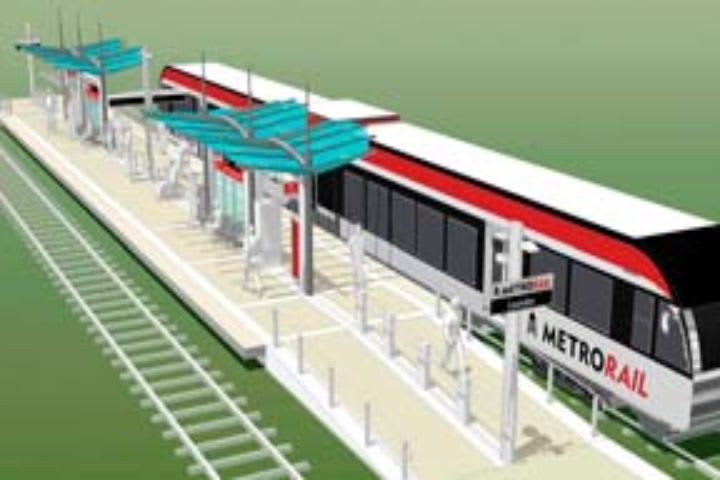
Situated on the Colorado River and the Balcones Fault in Central Texas is one of the fastest growing areas in the country. With a population of approximately 2.1 million, the Austin metropolitan area is the region’s core cultural and economic center. Twenty-one years ago, forward-thinking local officials felt the area’s rapid growth would necessitate a rail passenger service in the future. This vision is set to become a reality with the opening of a new 32-mile, nine-station commuter rail service, known as Capital MetroRail, in late 2008.
Planned under the auspices of the Capital Metropolitan Transportation Authority, the new regional rail transit system will be constructed and operated between downtown Austin, northwest through the residential and commercial areas of Travis and Williamson Counties, and a burgeoning transit-oriented development in Leander, Texas.
Sleek, new trains with high-back seats, bicycle and overhead racks, WiFi connections and tray tables will take suburban and central Austin residents to work in comfort and style. The Capital MetroRail service is the first phase of a broader commuter rail network planned for Central Texas and will interface with local bus, express bus, and park-and-ride interchange facilities to reduce automobile trips.
Responding to local concerns
The Capital MetroRail project was set in motion as a response to the growing transportation needs of Austin’s citizens. In a November 2000 referendum, Austin voters rejected a proposal by the agency to develop a 52-mile regional light rail system due to concerns, such as disruption of neighborhoods, intermodal conflict, frequency of service and cost. Four years later, the agency addressed the community’s concerns by seeking input from thousands of citizens across the service area to help create a new long-range transit plan called “All Systems Go!” The 20-year transit plan included expanded local and express bus service, a new rapid bus service and a 32-mile urban commuter rail starter line along Capital Metro’s existing freight tracks.
With the traffic congestion on I-35 and MoPac Expressway on the rise and the population expected to double in the next 25 years, voters gave the go-ahead for the plan in November 2004 by resoundingly approving the rail project. The approximately $90 million project is being paid for using Capital Metro’s existing one-cent sales tax within the service area and will be operational in late 2008.
Integrated partnership, divided contracts
Buoyed by public approval, the transit system went to work immediately. Within three months, the agency formed the commuter rail project team. Lockwood, Andrews & Newnam Inc. (LAN) was chosen as the program management support consultant. URS was selected for railroad engineering design services. Carter Burgess, Parsons Brinckerhoff, Lopez Garcia Group and Associated Consulting Engineers were chosen for station design. Eight months later, Capital Metro awarded a rail vehicle contract to Stadler Bussnang AG.
The scale and complexity of the project created a unique partnership between Capital Metro and LAN. The project includes major initiatives, such as design and construction of facilities, design and assembly of rail vehicles, operations and maintenance planning, and project controls. To tackle these issues seamlessly, LAN and Capital Metro professionals agreed to work collaboratively on each aspect of the project instead of functioning independently. This tight-knit, fully-integrated team is a hallmark of the project’s success to date.
“We are really integrated with the Capital Metro staff,” says LAN’s Technical Services Manager, Stephen Roth. “We actually look at ourselves as Capital Metro employees and as an extension of its resources. This has enabled us to increase the value added to the project, deliver the different project elements on time and within budget, and function as one team to anticipate and solve problems.”
Capital Metro and LAN have also taken a distinct approach to awarding construction contracts. Traditionally, contractors bid for procurement of materials and installation services under a single contract. Instead, Capital Metro and LAN professionals created separate materials and installation contracts for specific project elements. They also divided some large projects into smaller contracts to achieve small business utilization and encourage competition among prospective bidders.
A case in point: One of the critical elements in transit projects is the signaling system. The proposed commuter rail system utilizes a Capital Metro-owned railroad right-of-way, currently used for freight operations. Consequently, the existing signaling systems operate according to freight rail standards. As the commuter service will be operating at different speeds and times, crossing and wayside signals had to be upgraded along the corridor. To make it cost-effective, the team decided that the signaling system should be divided into four contracts, two for signal materials and two for signal installation.
“The reason we are doing this is to make sure that solicitations are open to as much competition as possible,” says Roth. “We want to break the contracts into smaller pieces and allow more opportunities for smaller contractors to get involved. We also feel this is getting us better prices.”
This strategy has enabled Capital Metro to include local and minority businesses, take advantage of local knowledge and support the local economy.
Unique rail cars
Another innovative aspect of the project is the railcar design. The selected vehicle, called the GTW Type 4 vehicle, is derived from “European light rail designs,” but has been significantly upgraded to more closely resemble a mainline railroad diesel multiple unit (DMU) vehicle. Six railcars, each made from aluminum sections of lightweight construction, will be self-propelled by two diesel-electric engines installed in a single-power module in the center of the unit. The central power module has two diesel-generator sets that provide power for auxiliaries and traction motors. Having the majority of weight on the driving wheels provides maximum traction to negotiate grades and curves as would typically be found on a light rail system.
The vehicles, manufactured by Stadler in Bussnang, Switzerland, also have the ability to navigate tight curves in city streets, making them suitable for future extensions into the Austin Central Business District. Each car has a capacity of 200 passengers, with room for 108 seated and 92 standing passengers, as well as room for passengers with wheelchairs and bicycles.
But the most unique feature of this DMU vehicle design is its compliance to the newest European Crash Energy Management (CEM) standards. The concept of CEM is based on protecting operators and passengers by designing structural components that crush in a controlled manner in the event of a collision. These components take up the force of a crash while the passenger-seating areas are protected.
The design components used in this DMU include couplers, energy-absorbing crash boxes and obstacle deflectors, lateral energy-absorbers, collision wall, front posts and a cabin cover. This design has distinct advantages over conventional equipment, such as surviving a crash at higher speeds, absorbing a larger amount of collision energy, preserving passenger-seating areas and minimizing the consequences of hitting a track obstruction.
“The GTW Type 4 vehicle represents the first commercially offered DMU to meet the new European CEM standards,” says LAN’s Vice President Patrick Jolly. “To this end, Capital Metro is a leader in introducing this technology."
Sharing freight lines
Unlike many other transit projects, the Capital MetroRail passenger and freight services will be controlled by a single entity and operate on the same corridor. On the shared tracks, Capital Metro will utilize a temporal separation of freight and passenger services. Freight and passenger operations will be restricted to separate operating windows, with buffer periods used to effect switchovers.
While this is cost effective, it also presents some challenges. The proposed commuter rail line crosses the Union Pacific (UP) freight line in McNeil, Texas, approximately fourteen miles north of downtown. Also, interchange tracks for the UP and Burlington Northern Santa Fe, as well as a yard for the freight operator, are located at Abbott Yard, just east of McNeil. To solve this problem, Capital Metro deemed it absolutely necessary to construct a grade separation at McNeil to assure passenger service reliability and safety. This overpass structure will be incorporated into a single-track parallel passenger-only mainline around Abbott Yard, which effectively splits the 32 miles into two distinct operating zones, thereby avoiding any conflict between passenger and freight operations.
Another challenge associated with sharing freight and commuter rail lines is preparing the community and educating it about the safety and operational issues related to the two services.
“The commuter line runs through some dense urban and residential areas, and people are accustomed to the slow-moving freight trains,” says Roth. “Soon, a fast-moving, extremely quiet commuter train will be running through the neighborhood. We are working with Capital Metro on educating the public about safe interaction within the corridor.”
Schedule, service and future
Capital Metro is on track to achieve its goal of making the service operational in late 2008. In December 2005, just 13 months after voters gave their approval, the final environmental assessment was completed. In March 2006, Capital Metro awarded contracts for construction of rail sidings. The contract for the first rail stop, Leander Station, was awarded in August 2006.
Currently, the construction of six of the nine planned commuter rail stations, as well as a railcar maintenance facility, is underway. Installation of crossing and wayside signals has also begun. The construction of the commuter rail overpass of the UP railroad is nearing completion. Tie replacement and rail surfacing continues as a multi-year effort to get the entire 32 miles in excellent shape before revenue service begins. In addition, Capital Metro has taken delivery of six railcars and on-system testing is in full swing.
Initially, the service will feature half-hour frequency in the morning and evening rush hours. As the system gains popularity and additional sidings are installed, trains will run every 15 minutes during peak periods and service all day long. In its first year of operation, ridership is expected to exceed 2,000 boardings per day. By 2025, the commuter rail service is estimated to carry 17,000 riders per day.
Looking to the future, Capital Metro is studying potential expansion along its existing freight tracks from downtown Austin to Manor and beyond. The agency is also participating in preliminary discussions about commuter rail service on the abandoned MoKan Rail Corridor between Austin and Georgetown, and on the existing UP railroad between Austin and San Antonio.
Jay Srinivasan is a technical writer with Lockwood, Andrews & Newnam Inc.
More Management

ENC Lands MATA Contract and More in Biz Briefs
In this edition of Biz Briefs, we spotlight the latest developments shaping the future of mobility.
Read More →
From Surviving to Thriving: Building Stronger Transportation Organizations
Bus Business Consultants founder Brian Dickson shares lessons on leadership, organizational health, and creating options for long-term success in a changing transportation industry.
Read More →
Everett Transit, Community Transit Outline Consolidation Agreement
The proposed agreement calls for a 50% increase in bus service in Everett, a new microtransit zone, continued paratransit service, and the transfer of Everett Transit operations to Community Transit.
Read More →

Strada360’s Steve Lassey on Turning Transit Data Into Better Decisions
From breaking down data silos to preparing for AI, Strada360 CEO Steve Lassey discusses how transit agencies can use technology to improve operations, customer information, and long-term decision-making.
Read More →
People Movement: Phil Washington Joins HNTB, Denver RTD Launches CEO Search, and More
In this edition, we also spotlight recent personnel moves at STV, the Eno Center for Transportation, and more, highlighting the people taking on new roles across the transportation industry.
Read More →
SEPTA Details Accelerate Vision for Transit System
The plan outlines investments in trolley modernization, new Metro and Regional Rail vehicles, accessible stations, and more frequent bus and rail service.
Read More →
FTA Ends Direct Oversight of MBTA Safety Actions
The federal agency closed its remaining special directive to the Massachusetts Department of Public Utilities following a safety review that began in 2022.
Read More →
Report: Transit Bus Manufacturing Supports 34,100 Jobs, $5.1B in GDP
The “Buses Mean Business” report examines the transit bus manufacturing industry’s economic footprint, supply chain, and rising demand for vehicle replacements.
Read More →
LIT Marks 10-Year Milestone at Annual Summit
Hosted by the COTA from September 10 to 13, the Summit carried the theme “Celebrating 10 Years of Excellence, Leadership, and Impact,” with every part of the program honoring the people, agencies, and partners who built LIT over its first decade.
Read More →
People Movement: Dan Dipert Coaches Adds Third-Generation Leader, Keolis Names New Valley Metro VP/GM, and More
In this edition, we also cover recent appointments and announcements at the Wabtec, SilverRide, HNTB, and more, showcasing the individuals helping to shape the future of transportation.
Read More →