



Alstom Revamps LRVs to Meet Evolving Mobility Needs
The Citadis X05 features a wider gangway, larger panoramic windows, higher speed, and reduced maintenance costs.

An Alstom Citadis light rail tram making its way through the city center of Reims, France.

An Alstom Citadis light rail tram making its way through the city center of Reims, France.
The French port town of La Rochelle is home to an Alstom Transport production facility that builds high-speed and light rail vehicles (LRV) for cities around the globe. The facility, which encompasses design and manufacturing, as well as a two test tracks, produces Alstom’s Citadis low-floor light rail vehicle — 110 per year. Over 2,400 Citadis trams have been purchased to date by nearly 54 cities around the world (22 in France). More than 60 cities have plans for a tramway system in the next few years, according to Alstom officials.
LRV Redesign
Currently, the facility is manufacturing its newest iteration of the Citadis tram, the X05, for a number of cities, including Nice, France and Casablanca, Morocco. Earlier this year, Alstom began testing and commissioning of the world’s first Alstom Citadis X05 LRV for Sydney’s new 7.4-mile network, currently under construction.
According to the company, the Citadis was upgraded to deliver extra dimensions, capacity, flexibility, speed, and an enhanced passenger experience to allow higher service frequency throughout the day, and thereby, increase the number of people an operator can carry on a network per year.
The new LRVs designed for Sydney, include double-doors for improved access and passenger flows, large balcony style windows, multi-purpose areas, and ambient LED lighting. CCTV monitoring, emergency intercoms, and the latest wayfinding aids for passenger information and real-time travel information are also featured.
The Citadis X05 platform integrates new technologies for lower energy consumption (permanent magnet motors); easier sub-system integration and maintenance; higher speeds of up to 50 mph; operation on existing and new tracks; catenary-free range (besides APS).
The LRV also offers an 11% reduction of maintenance costs based on technical innovations, including an optimized monitoring system; Ethernet network for a quick download of monitoring data from a single access point for the upload of infotainment and passenger information system in manual or automatic wireless mode.
Charging system
Another recent Alstom innovation is its SRS conductive static charging system, which is designed to recharge tramway vehicles equipped with on-board energy storage at ground level, eliminating obtrusive overhead infrastructure equipment. The SRS allows the recharge of on-board equipment (super-capacitors and batteries) by contact in 20 seconds during normal dwell time at passenger stops.
The SRS is an unobtrusive, compact solution offering easy integration into the cityscape. Control of positioning and power supply functions are integrated within the same equipment (no extra signaling devices required).
As a conductive ground-level solution, SRS is compatible with a wide range of vehicle dimensions (width, height, and length), regardless of the manufacturer.
SRS is composed of fixed infrastructure equipment, leading to facilitated maintenance operations and higher availability of charging spots. This technology is derived from Alstom’s APS ground-level system, which supplies power through a third rail. The APS system for catenary-free tramway operation is in installed in seven cities worldwide with more than 20 million miles run, to date, according to the company.
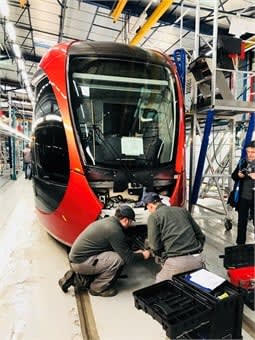
Workers at Alstom’s La Rochelle, France-based production facility work on a Citadis X05 light rail vehicle.
Reims Tramway
The tram system in Reims, France, which launched April 2011, utilizes a catenary-free APS power supply on a portion (one mile) of its seven-mile system, which helps preserve the look of Reims’ historical city center. The system operates 18 Alstom Citadis trams serving 23 stations, with seven electrical substations.
The 105-foot-long low-floor vehicles are designed to suggest the look of a champagne glass to coincide with the city’s status as the “unofficial capital of the Champagne wine-growing region.”
More Rail

New York MTA Advances Final Contract for Second Avenue Subway Expansion
Contract Four is the largest in the Second Avenue Subway Phase 2 project and includes construction of station infrastructure, tracks, and signals for the subway expansion, MTA officials said. Work on Contract Four will begin in 2027.
Read More →
San Diego MTS Breaks Monthly Trolley Ridership Record
Agency officials said July’s ridership indicates MTS’s continued recovery from the pandemic.
Read More →
Report Examines NJ TRANSIT Reliability, Funding Challenges
The Garden State Initiative analysis examines the roles of Amtrak infrastructure, fleet management, and agency operations while recommending a more performance-based approach to improving reliability.
Read More →
Stadler, CapMetro Sign Long-Term Rail Fleet Support Agreement
Beginning in 2027, Stadler will provide on-site technical expertise, spare parts support, training, and obsolescence management to help extend the reliability and longevity of CapMetro’s GTW fleet.
Read More →
Biz Briefs: Alstom Lands Canadian Contract, LYT to Supply California TSP, and More
In METRO's latest installment, we take a look at recent news from Complete Coach Works, Beep, FlixBus, and more partnerships making headlines across the transportation sector.
Read More →
CATS Gold Line Marks 5 Years of Service, 2.8M Passenger Trips
With a six-mile expansion planned, the Charlotte streetcar is positioned to connect more neighborhoods and major transit hubs across the region.
Read More →
Why Simulating Pedestrian Movement Has Become Essential for Modern Rail Stations
Pedestrian microsimulation is helping rail planners identify bottlenecks, test station designs, and prepare complex transit hubs for growing passenger volumes.
Read More →
Amtrak Begins Major Construction at New York’s Sunnyside Yard
The new maintenance facility will support Amtrak’s Airo trainsets while improving maintenance efficiency and turnaround times in New York.
Read More →
Chicago Leaders Unveil Plans for O’Hare Airport Express Train
The privately developed project would offer a 15-minute trip between downtown and O’Hare’s Terminal 2, with trains operating every 15 minutes on a dedicated track. The service would use battery-electric trains and three existing freight rail rights-of-way.
Read More →
OCTA Maps Out 30-Year Strategy to Protect Coastal Rail Corridor
The draft feasibility report identifies strategies to protect the coastal rail line for decades as the agency continues near-term stabilization and sand placement efforts.
Read More →