



California's Santa Maria Transit Focusing on Innovation
METRO spoke to SMRT Transit Manager Gamaliel Anguiano about how the agency is working to build a multimodal transportation system that is more conducive, its quest to go 100% zero emissions, and much more.


Santa Maria Regional Transit is the local fixed-route public transit system for the City of Santa Maria, operating directly out of the City’s Public Works Department.
SMRT
Like many cities around the nation, Calif.’s Santa Maria Regional Transit (SMRT) is working to build back post-pandemic ridership by building new mobility models that will ideally provide more options for the community the agency serves.
How A Smaller Agency is Reinventing Operations
With 12 fixed routes, ADA paratransit service, and intercity bus service, SMRT serves 34 square miles in the City of Santa Maria and adjacent unincorporated communities and is led by Transit Manager Gamaliel Anguiano.
METRO spoke to Anguiano about lessons learned from the pandemic, how the agency is working to build a multimodal transportation system that is more conducive, going 100% zero emissions, and much more.
What would you say are some takeaways for cities from the pandemic?
The pandemic highlighted some very interesting points, particularly for public transit agencies. The foremost important lesson was that with the ‘shutdown,’ and the subsequent scaling back of transit service, there were still people riding the bus. What that says is, whatever may come, we have community members that absolutely rely on the bus for their mobility needs, no matter what. This only further emphasizes just how vital of a lifeline public transit is to our community members.
Next, as an industry, we need to pay much closer attention to how we design all aspects of our public transit system. While tempting to try to make our public transit system ‘all things to all people;’ when faced with severe challenges, like labor shortages, it is serving the most vulnerable where we need to focus. We also need to make the traveling experience much more conducive. And that is what we are addressing in Santa Maria over the next year or so.
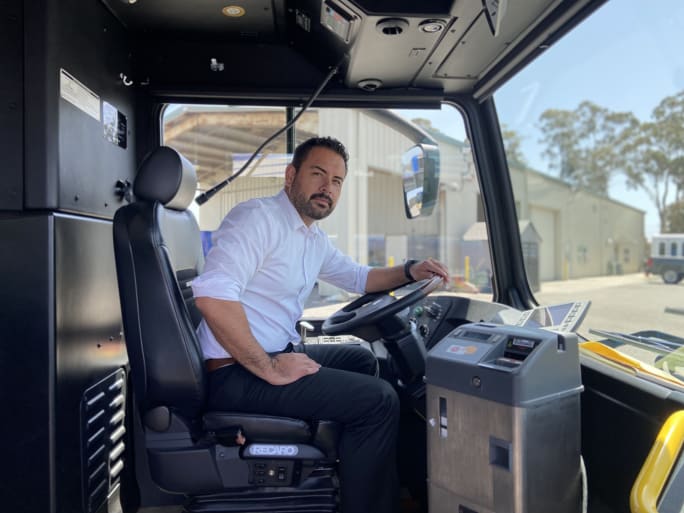
As Transit Manager for the City of Santa Maria, Gamaliel Anguiano continues to build on his success at his previous stops with innovative approaches to public transit and was recognized by the California Transit Association as the 2021 Transit Professional of the Year.
SMRT
What are some of those changes that would make public transit more conducive?
The recent infusion of capital funds, at both the federal and state level, has created opportunities for SMRT to ‘feed multiple birds with one scone.’ Thanks in large part to that funding, our City Council approved an unprecedented $22 million capital investment in our city’s public transit system. This will expedite the city’s transition to a 100% all-electric bus fleet by 2024. Perhaps only the second transit agency in the nation to accomplish this.
This will not only be wonderful for our environment, but just as importantly, will help insulate the transit agency from inflation, global supply chain issues, and the volatile petrol fuel prices of the future. Again, so that we can help ensure that public transit will be there for our riders, even in the most challenging of conditions.
This too has allowed us to review the specifications of our vehicles. Not only will all future SMRT electric buses come outfitted with medical-grade air scrubbing technology, anti-microbial coated surfaces, UV light disinfectant capabilities, hand sanitizer dispensers, and contactless tap-payment options, to continue to reduce the spread of germs, but we will start to offer 5G capable public Wi-Fi, have onboard video infotainment systems with LIVE feed, USB personal-device charging capabilities in every seat, and other upgrades to create a much more welcoming, safer, and conducive public environment.
Why would you say these changes are important and not just a novelty?
The greatest area of growth we are seeing is with students. Certainly, a much more technology-driven group than any other. Safety, comfort, and features are going to be at the forefront of everyone’s mind and we need to put our best face forward if we are going to attract and capture this demographic as long-term riders.
Real-time bus information applications can’t be a luxury. They are an absolute must-have for a transit agency. But along with that, meeting our riders’ real-time transit needs is also a must. SMRT will be supplementing its fixed-route service by implementing a bus rapid transit (BRT) system along our city’s busiest corridor.
This includes architectural BRT transit stations with level boarding, real-time information, hydration stations, and other passenger amenities to compliment the 15- to 20-minute headways, dedicated bus lanes, cue-jump lanes that are paired with traffic signal prioritization technology, and other transit-first technologies.
This too will be supplemented with the introduction of app-based on-demand microtransit so that our passengers are only a few clicks away from addressing their mobility needs. Along with this, we will be expanding our service regionally and even introducing autonomous shuttles to key locations over the next two years.
The objective is to make Santa Maria’s public transit system ready to support our city. So that whatever may come, our residents will be able to count on us when they need it the most because we are prepared to deal with any challenges that may affect our operations.
More New Mobility

From Hardware to Digital Partner: Luminator Charts Its Next Chapter
CEO Magnus Friberg discusses Luminator’s shift toward becoming a digital partner, the growing importance of software and interoperability, and how AI can help agencies improve operations and passenger experience.
Read More →
Biz Briefs: Alstom Lands Canadian Contract, LYT to Supply California TSP, and More
In METRO's latest installment, we take a look at recent news from Complete Coach Works, Beep, FlixBus, and more partnerships making headlines across the transportation sector.
Read More →
CharterUP’s Armir Harris on Technology, AI, and the Future of Group Mobility
In a recent episode of METROspectives, CharterUP Founder/CEO Armir Harris discussed the company’s evolution from an online charter bus marketplace into a technology platform supporting public- and private-sector mobility and much more.
Read More →
Jacksonville’s NAVI Project Charts a New Course for Autonomous Public Transportation
Through its NAVI program, JTA is showing how autonomous vehicles, intelligent infrastructure, and coordinated operations can work together to deliver everyday public transportation.
Read More →
Biz Briefs: Luminator Marks Milestone and More
From manufacturers and suppliers to transit agencies and motorcoach operators, these updates offer a snapshot of the projects, partnerships and business moves driving the industry forward.
Read More →
New Tricks for Old Bureaucracies: Joshua Schank on Making Transit Innovation Stick
Former LA Metro Chief Innovation Officer Joshua Schank discusses why good ideas aren't enough, how transit agencies can overcome resistance to change, and why today's challenges demand more innovation.
Read More →
How DART's GoPass Is Redefining Regional Mobility
Serving 14 transit agencies, GoPass simplifies multimodal travel by allowing riders to plan, pay for, and manage an entire trip through one app.
Read More →
Biz Briefs: OCTA Taps Clean Energy for Hydrogen Station, Stadler to Supply Via Rail Vehicles, and More
From manufacturers and suppliers to transit agencies and motorcoach operators, these updates offer a snapshot of the projects, partnerships and business moves driving the industry forward.
Read More →CharterUP Expands Into New Mobility and Autonomous Transportation
Vice President of New Mobility Stephen Joos discusses how CharterUP is leveraging its nationwide transportation network, technology platform, and autonomous vehicle partnerships to expand into workforce mobility, campus shuttles, and transit solutions.
Read More →
METRO Magazine Announces 2026 Innovative Solutions Awards Winners
Projects Recognized for Advancing Mobility Through Technology, Accessibility, Workforce Innovation, and Operational Excellence
Read More →