



Consensus emerging on streamlining federal project reviews
Cliff Henke, a contributing editor to METRO, is senior analyst at PB. His views herein are solely his own.
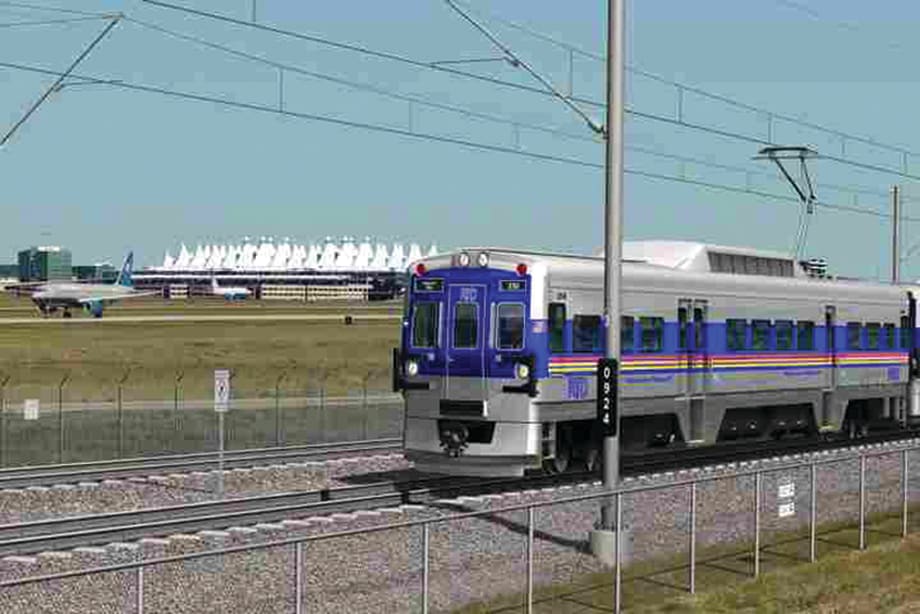
Congressional leaders are attracted to expanded private sector participation concepts for transit and high-speed rail projects such as the Denver Eagle P3 commuter rail project (rendering shown) in FTA's Penta-P program.

Whether next fiscal year's levels of federal capital public transport projects are closer to President Obama's, the relevant Senate committees' proposals or that proposed in the House-passed budget resolution, there seems to be an emerging consensus that the length of time and number of steps in the federal project evaluation process need to be reduced. This may be the only bright spot in an otherwise darkening prospect for obtaining a long-term reauthorization bill, which is now more than two years late.
Fail to keep pace
According to FTA and industry data, the process for obtaining a Full Funding Grant Agreement for a New Start project can consume as many as a dozen years, and that's before groundbreaking. Adding in feasibility and strategy analyses to support, or at least test, the local project commitment on the early end and the construction, testing and commissioning, a rail project can take two decades or more prior to service opening. Not only is this costly, it is almost guaranteed to fail to keep pace with the rapid growth of the past half century, which is expected to continue well into the current one.
To address this situation, the Obama Administration is proposing to reduce the number of FTA approvals that a project must receive from the current four to two. Under this proposal, a project would not have to enter an Alternatives Analysis process with a separate environmental review. Instead, after receiving a locally preferred alternative status, a project would seek permission to enter the New Starts program; at that point FTA's evaluation would begin. So far, both the House Transportation and Infrastructure Committee leadership under Chairman John Mica as well as the Senate Banking Committee leadership agree with these ideas.
In addition to eliminating the FTA's time-consuming and costly alternative analysis process, FTA as well as congressional leaders want to eliminate or severely compress FTA approvals to enter the Preliminary Engineering and Final Design stages, and instead, require only that FTA monitor the project through these stages until approval for a Full Funding Grant Agreement, or a project construction agreement in Small Starts.
Expand eligibility
The administration also proposes to expand eligibility for Small Starts to $100 million in federal program funding from $75 million, currently, and raise the eligible project size from $250 million to 10 percent of the total. Congressional leaders are also attracted to expanded private sector participation concepts for transit and high-speed rail projects advocated by administration officials and others that would be facilitated by more flexible and accelerated project reviews. The Denver Eagle P3 commuter rail project in FTA's Penta-P program is an example.
While the Senate, Administration and House leaders continue their three-party dance out of step with one another, regarding the level of funding, a streamlined federal project review process may be the last refuge of transit policy bipartisanship.
More Rail
FRA Announces $5.3B in Rail Investments, Including $2B for Amtrak
Funding will support grade-crossing improvements, infrastructure upgrades, and new Amtrak equipment in 23 states.
Read More →
Finding the ‘Happy Medium’: Optimizing Maintenance Without Sacrificing Reliability
The key to maintenance optimization isn’t doing less work—it’s doing the right work at the right time on the right assets.
Read More →
OKC Streetcar Makes Zero-Fare Service Permanent
Ridership increased an average of 71% compared with the same period a year earlier during the fare-free pilot.
Read More →
DART Customer Satisfaction Reaches Six-Year High
Overall satisfaction rose to 74.9%, while the agency’s Net Promoter Score reached a record 33.7.
Read More →
How DART's GoPass Is Redefining Regional Mobility
Serving 14 transit agencies, GoPass simplifies multimodal travel by allowing riders to plan, pay for, and manage an entire trip through one app.
Read More →
Amtrak Board Advances Plan to Restructure Organization, Seeks Public Input
The proposal, developed by Amtrak management and approved by the board for further consideration, is intended to modernize the organization's structure while improving accountability, operational efficiency, and customer service.
Read More →
Biz Briefs: STV teams with Amtrak, Motorcoach Operators Boost Fleet and Land Contracts, and More
From manufacturers and suppliers to transit agencies and motorcoach operators, these updates offer a snapshot of the projects, partnerships and business moves driving the industry forward.
Read More →
Metra Celebrates 100 Years of Electric Rail, Looks to the Future
The event was also a celebration of recent reforms to public transportation in the Chicago area, changes that could be as transformative in the future as the major civic achievement a century ago, said officials.
Read More →
LA Metro Marks Banner Year, Sets Ambitious Goals for New Fiscal Year
Incoming LA Metro Board Chair and Los Angeles Mayor Karen Bass joined outgoing Board Chair Fernando Dutra and LA Metro CEO Stephanie Wiggins to review accomplishments from fiscal year 2026, which included the opening of new rail extensions, advancement of major transit projects, expanded safety programs, and new rider amenities.
Read More →
DART Taps Nathaniel P. Ford Sr. as Next President/CEO
Since 2012, Ford has served as the CEO of the Jacksonville Transportation Authority
Read More →