



Consultant Q&A: Stantec’s Ryan White on Regulation, Funding, and Community-Centered Solutions
With over two decades of experience, Stantec’s Ryan White shares insights on navigating complex transit regulations, funding challenges, and the importance of authentic stakeholder engagement to deliver inclusive, future-ready transportation infrastructure.

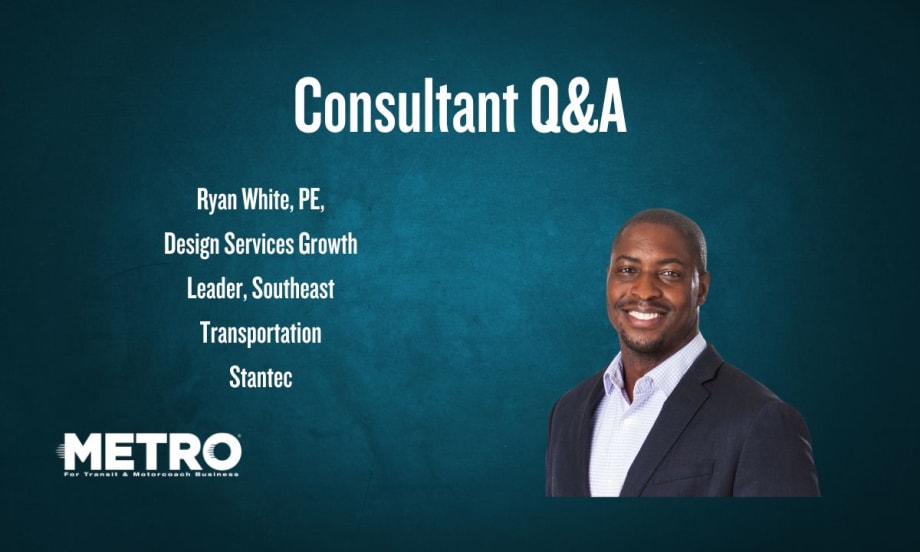
Ryan White has led outreach efforts for long-range and project-specific plans in diverse urban and rural settings.
Photo: Stantec
- Ryan White discusses strategies for navigating complex transit regulations, emphasizing the need for expertise in this area.
- The interview highlights challenges in securing funding for transportation projects and considers various solutions.
- White underscores the importance of genuine stakeholder engagement in developing inclusive, future-ready transportation infrastructure.
*Summarized by AI
As design services growth leader for Southeast Transportation at Stantec, Ryan White brings over 20 years of experience in transportation planning, engineering, and public involvement.
White has led outreach efforts for long-range and project-specific plans in diverse urban and rural settings. His work includes facilitating community and technical advisory committees, organizing in-person and virtual meetings, and engaging legislative bodies.
Beyond engagement, he has developed community impact assessments and led aesthetic design initiatives to address visual impacts on local communities.
METRO spoke to White about funding, regulatory hurdles, stakeholder engagement, and much more.
Navigating Regulatory Hurdles in Transit Project Delivery
What are the most common regulatory hurdles in transit project delivery, and how do firms like Stantec help agencies overcome them?
One of the biggest challenges is navigating NEPA — the National Environmental Policy Act —which really is the backbone of environmental regulation for infrastructure projects. I live in that world, so I appreciate its importance.
NEPA ensures we deliver technically sound projects that fit their communities and minimize impacts. But it's not just NEPA.
In urban areas, for example, we often encounter Section 106 (historic preservation) or Section 4(f) issues related to cultural resources and parks. These layers are interrelated but have different requirements, and the situation becomes even more complex when local preservation boards enter the picture.
At Stantec, we work across disciplines — environmental specialists, cultural and natural resource experts, urban designers, engineers, and planners — to ensure our engineering decisions are not made in a vacuum.
In our industry, it’s not uncommon to deliver projects in communities that we do not live in. As a result, many project teams will not experience the daily impacts of the various projects they manage, design, and deliver as consultants, contractors, or agencies. Because of this, there is an immense responsibility to plan, design, and construct with empathy and local context.
Over the years, NEPA has often been mentioned in these discussions. Are there ways the process can be streamlined?
I wouldn’t say there are simple fixes, but yes, there are ways to make it more efficient.
One promising approach is the use of Planning and Environmental Linkages (PEL). PEL allows us to carry decisions made during the long-range planning phase into the NEPA process, so we’re not starting from scratch.
Historically, even if you had a study or Purpose and Need statement, NEPA would treat it like it didn’t exist. PEL changes that — it legitimizes early planning studies, technical analysis, and decisions so that they can inform the NEPA process. That saves time, money, and staff resources, but more importantly, it acknowledges the effort and engagement that already went into those plans.
The challenge now is helping more state and local agencies understand how to implement PEL effectively. Stantec has a team of dedicated environmental specialists who engage agencies and teach them how to leverage PEL to progress projects through planning and NEPA faster and more effectively.
Funding and Policies
Let’s talk about the ever-present elephant in the room — funding. How do you help transit agencies navigate funding constraints?
Transit funding is tight. Even before we get to construction, the planning and NEPA phases can cost millions. Agencies are under intense scrutiny to manage those costs. We help by ensuring that projects are scoped correctly at the beginning, identifying landmines early, developing budgets that align with the scopes, and staying within those budgets.
Cost escalation is another hurdle. We may develop a detailed cost estimate for a project today, which is used to program a project, but when construction starts five or six years later, the actual construction costs are often much higher.
Inflation impacts materials, labor, and right-of-way costs—all of that adds up. So, we help our clients by using the best available tools, data, and professional expertise to project escalations and keep cost estimates in alignment.
We also work with agencies through our North American Funding Program, which identifies applicable federal discretionary grants, helps write competitive grant applications, and manages awarded funds. Winning a grant is only half the battle — you’ve got to deliver the project on time and on budget once that money hits your books.
Have recent policy changes impacted how you position transit projects for viability and funding?
Absolutely. With each new administration, grant program requirements evolve, whether related to equity, resilience, or economic competitiveness.
Right now, we’re in a holding pattern waiting for more precise guidance from federal agencies. We need to understand these new metrics to evaluate existing projects in the pipeline and help agencies adapt and deliver.
Sometimes, a project that scores well under one set of criteria might not rank as high under the new ones. That doesn’t make it a bad project, but it does mean we may need to rethink how it’s presented or phased to meet current requirements.
When working with stakeholders on a project, White says it's important to remain engaged from the beginning to the end.
Photo: METRO
Engaging Stakeholders with Authenticity, Consistency
One of the most powerful things you touched on was how consultants often design communities they don’t live in. What makes for meaningful stakeholder engagement?
That’s a big one. First, engagement needs to be continuous. People often hear about a project during long-range planning, and then...nothing. Years go by before NEPA starts, and the public might feel like they were forgotten or misled. Then, 10 years later, the bulldozers show up. Plus, communities change. The people you engaged with in year one may not even be there by year 10.
So, we start every project with a community context assessment. Who lives there? What are the demographics, land use, and history to gain an understanding of the community fabric? Then, we customize our outreach, offering meetings with food during dinner hours and setting up at school events, football games, churches, wherever people already are. We try to meet people on their turf, not expecting them to come to ours.
How we communicate is also crucial. We must speak the language of the communities we engage with…. and communicate in plain language — no technical jargon. More than that, we have to prove that we’re listening. If people see their feedback reflected in the designs, trust builds. If not, it’s just lip service.
That leads to a bigger-picture question: What trends are shaping the future of transit infrastructure?
Several. First, we need to broaden the demographic that uses transit. In places like the Northeast, everyone uses transit. It’s a necessity. But in the Sun Belt, where I live, it’s often seen as a fallback option. That perception needs to shift. The user experience — from safety to reliability to seamless mode switching — is key to attracting new riders.
Second, project delivery timelines need to improve — not just for planning and NEPA but also for construction. Transit projects need to be delivered faster to help shape urban growth.
Third, we need to rethink how transit is funded and prioritized. Currently, highway projects are often prioritized, but the return on investment for widening roads, especially in urban areas, is shrinking. Acquiring right-of-way is expensive, and the community impacts can be profound.
And finally, we can’t ignore rural and suburban transit needs. They’re often left out of the funding conversation, even though they have legitimate challenges that transit can help solve. Transit can’t just be for urban areas if we want a comprehensive transportation system.
In many large metropolitan areas, massive freeway networks with ten-plus lanes are already in place, and people are still stuck in traffic. Eventually, that becomes unsustainable —economically, environmentally, and socially.
Take Virginia, for example. They recently extended express lanes along I-95 from Washington, D.C. to Fredericksburg and are investing in adding passenger rail capacity and frequencies between Richmond and Washington, D.C. That kind of balanced investment is key.
When Virginia and North Carolina supported additional Amtrak frequencies and improved service reliability, ridership jumped and continues to set records. If transit is reliable and competitive with drive times, people will use it.
But to make transit truly viable, we need a cultural shift. People must see it not just as an alternative or an only option for certain groups, but as a first-choice option. And that means infrastructure, service, safety, and policy must work together.
Quick Answers
According to Ryan White, understanding local and federal transit regulations thoroughly and engaging early with regulatory bodies are crucial to navigating complex transit regulations effectively.
*Summarized by AI
More Management

METRO Opens Submissions for 2026 Motorcoach Awards
Nominations are now being accepted for METRO Magazine’s Operator of the Year and Innovative Operator of the Year awards.
Read More →
New York MTA Advances Final Contract for Second Avenue Subway Expansion
Contract Four is the largest in the Second Avenue Subway Phase 2 project and includes construction of station infrastructure, tracks, and signals for the subway expansion, MTA officials said. Work on Contract Four will begin in 2027.
Read More →
Transit Agencies Highlight Safety Gains at National Summit
Leaders from 15 major transit systems shared crime-reduction results and safety initiatives while discussing the role of continued federal support.
Read More →

NITA Names New Leadership, Expands Reduced-Fare Program at First Board Meeting
The new regional transit authority appointed its first board chair and interim executive director while extending reduced fares across CTA, Metra, and Pace for eligible riders.
Read More →
Beyond the Checklist: A Structured Approach to Transit Maintenance
Reliability-Centered Maintenance helps transit agencies move beyond routine checklists to focus limited resources on the assets and failures that have the greatest impact on safety, reliability, and service.
Read More →
APTA 2026 Nominating Committee Selects Leadership Slate, Names Chair and Vice Chair Nominees
Leadership changes will help shape the association’s priorities and its representation of the transportation industry during the 2026–2027 term.
Read More →
DART Launches Major Security, Fare Enforcement Initiative
The 90-day demonstration will deploy coordinated security teams at five light rail stations while testing controlled access and gathering data to guide future investments.
Read More →
Advancing Fare Collection Through Technology and Innovation
Learn about delivering 1300 gates at 91 stations while managing fare evasion. Explore the large scale deployment, solution customization and real-world results that affect the region. Prepare for deployment in your region now.
Read More →
Game Day in Motion: Moving Millions During the 2026 World Cup
Between packed transit stations and team motorcoaches, see how agencies and operators across North America tackled the transportation demands of the 2026 FIFA World Cup.
Read More →
Surface Transportation Extension Averts Shutdown, Leaves Transit Funding Gap
The stopgap keeps federal transportation programs moving, but missing advance funding could complicate the transit and rail projects agencies are planning next.
Read More →