



RELATED: [Video] 360-degree view of Crossrail locomotive journey
Crossrail Transforms London Transport to Move Millions
As one of Europe’s largest construction projects, Crossrail will transform rail transport in London, increasing rail capacity in central London by 10%, supporting regeneration and cutting journey times across the capital.
by By John Barker
September 20, 2016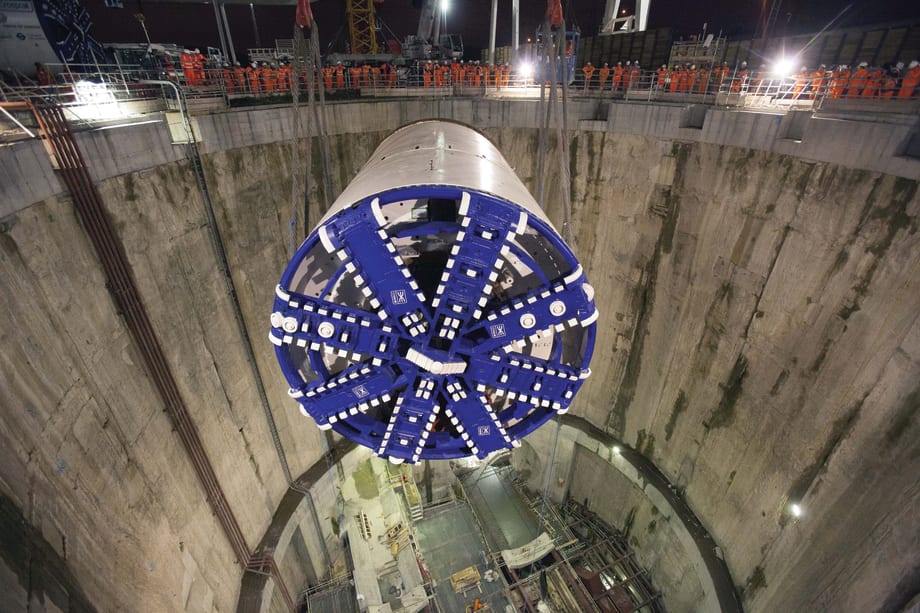
Photo: Crossrail Ltd.
5 min to read
Photo: Crossrail Ltd.
Work is well underway on Crossrail, the highly anticipated new rail system in the south east of England that will run through the heart of London. The new railway, which will be known as the Elizabeth line when services start in 2018 in honor of Her Majesty the Queen, will comprise 10 new stations and the upgrade of 30 more, integrating new and existing infrastructure. As one of Europe’s largest construction projects, Crossrail will transform rail transport in London, increasing rail capacity in central London by 10%, supporting regeneration and cutting journey times across the capital.
The new line will bring an additional 1.5 million people within 45 minutes of London’s key business and leisure districts. It will be capable of running 24 trains per hour in each direction through central London during the peak, transporting more than 200 million passengers annually. New state-of-the-art trains will span 650 feet — the length of two football pitches (Ed. Note: or as we call them in the U.S., soccer fields) and almost double the size of current London Underground trains.
Photo: Crossrail Ltd.
Underground factory
A total of eight tunnelling machines have been used on the route. Each 1,100-ton, 450-foot-long tunneling machine was an underground factory with 20-person “tunnel gangs” working in shifts. At peak times, the tunneling machines aimed for approximately 328 feet of tunneling progress per week. As the tunneling machines moved forward, precast concrete segments were built in rings behind. Excavated material from the tunnels has been shipped to Wallasea Island in Essex to create a new 1,500-acre nature reserve.
The railway will reduce congestion and link the city's major commercial and business districts, making it easier to travel and do business in London and the south east of England.
AECOM is a lead member of Transcend, the consortium comprising AECOM, CH2M Hill and The Nichols Group that is Programme Partner for Crossrail Ltd. The team is providing strategic management services to help Crossrail Ltd. deliver the project, including program and project management, program reporting, procurement and engineering management services.
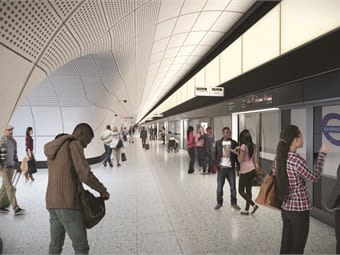
Rendering of Farringdon Station proposed platform. AECOM
Maintaining momentum
The Transcend team has brought its joint venture partners’ global experience of major projects to the scheme. On a large-scale, multidisciplinary program like Crossrail, the implementation of robust project management systems has been critical to maintaining the momentum of the project. A number of new management systems have been developed for Crossrail, including an integrated system for planning and monitoring schedule performance for all levels of the project. A new innovation scheme has also been introduced, which is designed to inspire innovative ideas, technologies and practices among Crossrail’s supply chain.
Crossrail is the first major infrastructure program in the UK to develop an innovation strategy and process, and it has encouraged collaboration with universities, railway operators and other stakeholders.
Transcend joined the Crossrail project in 2009 and will continue through to project completion in 2018. Importantly, Transcend staff have worked on the project as part of a single, integrated client team. This collaborative approach has been instrumental to the success of the program so far.
In addition to its work with Transcend, AECOM is also delivering design consultancy services for Crossrail Ltd. Projects include designing two flagship central London below-ground stations at Paddington and Farringdon.
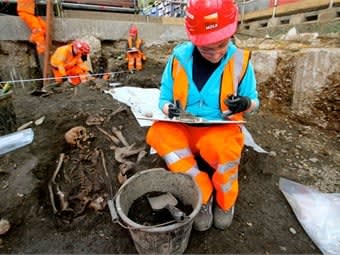
Archaeologists begin main excavation of Broadgate ticket hall_ March 2015. Photo: Crossrail Ltd.
Stations link hubs, heritage
When complete, the Crossrail station at Farringdon will be integrated with the existing London Underground and National Rail stations making Farringdon one of Britain’s busiest railway stations and a key link in bringing passengers from outer London to business hubs in the city and Canary Wharf. During excavation work at the Farringdon site, archaeologists discovered 23 skeletons believed to be up to 600-years old. Historical records reference a burial ground in the Farringdon area that opened during the Black Death in 1348.
Paddington station is being constructed next to one of London’s busiest existing mainline terminus, connecting Crossrail with national mainline services and the London Underground. The new station is adjacent to the historic mainline station, which opened in 1854, and next to the London Underground station that formed the terminus for the world’s first underground railway station when it opened in 1863.
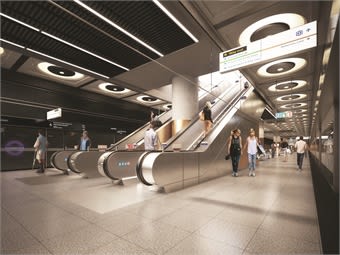
Rendering of Paddington Station platform level. AECOM
The rich heritage of the existing infrastructure at Paddington has presented significant challenges in both design and construction. The scheme includes complex links with the adjacent underground station, as well as interfacing with above-ground buildings, such as the Grade-I listed mainline station.
These single Crossrail station projects highlight the scale of the scheme. Projects of this size would normally be a major city undertaking, but there are landmark station works spread across London. At peak construction, more than 10,000 people were working on over 40 sites across the city.
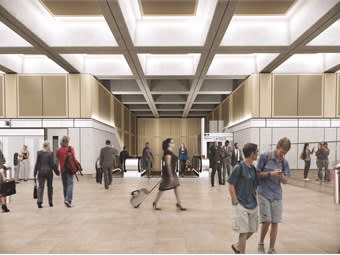
Rendering of Farringdon Station's Charterhouse Street ticket hall. AECOM
Lasting skills legacy
Leaving a lasting skills legacy to support the UK’s construction and engineering industries has been an important focus of the Crossrail project. More than 550 apprentices have been trained in a range of disciplines, including construction and quantity surveying. In 2011, Crossrail established the Tunneling and Underground Construction Academy (TUCA) to help meet the skills training needs of the project and other schemes. TUCA provides training in tunnel excavation and underground construction skills and is Europe’s only specialist soft-ground tunneling training facility.
The economic benefits of Crossrail are vast, with the project adding an estimated £42bn ($55 billion) to the UK’s economy. During the course of construction, Crossrail and its supply chain will support the equivalent of 55,000 full-time jobs across the country. The project is also helping to drive regeneration along the route, including the delivery of thousands of new homes.
A significant benefit of the scheme is the added capacity the railway will bring to central London’s rail network, making it easier to travel and do business in London and the south east of England. The railway will reduce congestion and link the city’s major commercial and business districts. With the scheme now approximately 75% complete, Crossrail is entering its final stages and is being delivered on time and on budget. The hugely positive impact that Crossrail will have on London for generations to come is what makes the project particularly special to work on.
John Barker is director, transportation, AECOM (www.aecom.com).
Subscribe to Our Newsletter
More Rail

New York MTA Advances Final Contract for Second Avenue Subway Expansion
Contract Four is the largest in the Second Avenue Subway Phase 2 project and includes construction of station infrastructure, tracks, and signals for the subway expansion, MTA officials said. Work on Contract Four will begin in 2027.
Read More →
San Diego MTS Breaks Monthly Trolley Ridership Record
Agency officials said July’s ridership indicates MTS’s continued recovery from the pandemic.
Read More →
Report Examines NJ TRANSIT Reliability, Funding Challenges
The Garden State Initiative analysis examines the roles of Amtrak infrastructure, fleet management, and agency operations while recommending a more performance-based approach to improving reliability.
Read More →
Stadler, CapMetro Sign Long-Term Rail Fleet Support Agreement
Beginning in 2027, Stadler will provide on-site technical expertise, spare parts support, training, and obsolescence management to help extend the reliability and longevity of CapMetro’s GTW fleet.
Read More →
Biz Briefs: Alstom Lands Canadian Contract, LYT to Supply California TSP, and More
In METRO's latest installment, we take a look at recent news from Complete Coach Works, Beep, FlixBus, and more partnerships making headlines across the transportation sector.
Read More →
CATS Gold Line Marks 5 Years of Service, 2.8M Passenger Trips
With a six-mile expansion planned, the Charlotte streetcar is positioned to connect more neighborhoods and major transit hubs across the region.
Read More →
Why Simulating Pedestrian Movement Has Become Essential for Modern Rail Stations
Pedestrian microsimulation is helping rail planners identify bottlenecks, test station designs, and prepare complex transit hubs for growing passenger volumes.
Read More →
Amtrak Begins Major Construction at New York’s Sunnyside Yard
The new maintenance facility will support Amtrak’s Airo trainsets while improving maintenance efficiency and turnaround times in New York.
Read More →
Chicago Leaders Unveil Plans for O’Hare Airport Express Train
The privately developed project would offer a 15-minute trip between downtown and O’Hare’s Terminal 2, with trains operating every 15 minutes on a dedicated track. The service would use battery-electric trains and three existing freight rail rights-of-way.
Read More →
OCTA Maps Out 30-Year Strategy to Protect Coastal Rail Corridor
The draft feasibility report identifies strategies to protect the coastal rail line for decades as the agency continues near-term stabilization and sand placement efforts.
Read More →