



DART rail — a case study in innovation and service
Through its partnership with INIT, DART was able to more efficiently manage its extensive light rail network.
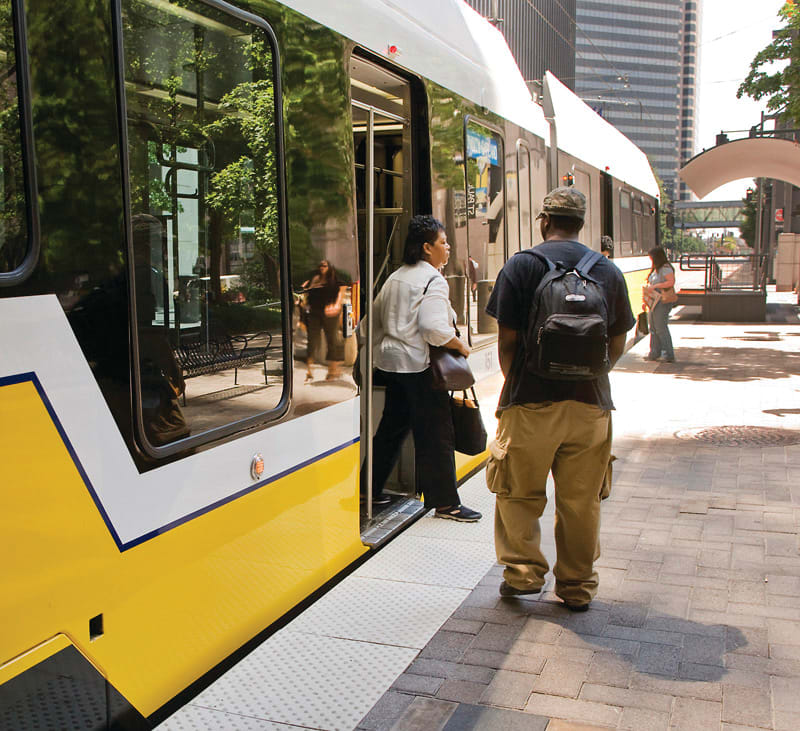
Photo Courtesy DART
Photo Courtesy DART
The Dallas Area Rapid Transit (DART) Rail System boasts the longest light rail network in the U.S. The system operates 72 miles of track and services an annual ridership of over 22 million. DART and the Fort Worth Transportation Authority (the T) also jointly operate 35 miles of commuter rail. The Trinity Railway Express (TRE) serves as the link between downtown Dallas and Fort Worth and offers service to DFW International Airport. Through 2014, the DART Rail System is slated to grow to 90 miles.
DART’s light rail system is powered by overhead electric lines. Each rail vehicle is a state-of-the-art example of modern rail technology. A “catenary system” of two electrical cables provides stable working voltage for all trains on the 72-mile, 55-station system.
DART is unusual in that it has one of the few variable voltage power distribution systems in North America. Each substation is polled for energy usage and voltages are varied according to energy used and energy needed. Not all substations have to be operational for the light rail system to work. In the event of loss of utility power to a substation, the system is designed to provide enough power to compensate.
Along with multiple awards in design and engineering, DART is a pioneering leader within the public transit industry. In 2010, the agency received two awards for their innovative approach to light rail in Dallas. The Texas Section of the American Society of Civil Engineers recognized DART’s Green Line with its Texas Outstanding Civil Engineering Achievement Award. That same year, the Greater Dallas Planning Council awarded DART the 2010 BUILT Award for Urban Design. More recently, DART received the Design-Build Institute of America’s 2011 Transportation Owner of the Year – Rail Award for its successful use of the design-build approach in its capital expansion.
Operational challenges
Operating the largest light rail network in the U.S. is no small feat. Based on the agency’s five-year strategic plan to focus on meeting customer’s needs, strive for continual improvement and deliver quality service, DART pursued an ITS solution that would help them better manage their fleet and service their passengers. A primary goal was to track trains throughout the city with greater accuracy than the existing Supervisory Control and Data Acquisition (SCADA) system allowed.
The SCADA system left a few dark areas within its tracking so the dispatchers could not discern the exact location of a train within a block. In addition, DART’s route information contained limited time points on an operator’s hand-held schedule, which made it difficult for train arrival prediction at the stops. Because of this, DART could not automatically notify passengers of a train’s estimated arrival time, or of delays.
Also, capture of train operational statistics, such as precise arrival and departure times and passenger loads was a manual process, and other statistics like dwell time and door opening events were captured only by limited sampling.
In addition to the difficulty with tracking and predicting train arrival and departure times, passengers onboard or at the stops relied solely on train operators to make announcements. Messages were not always articulated clearly or understood by passengers, and making the announcements added to operator workload. DART needed a way to give passengers stop information consistently and with clarity — an important part of their approach to ensuring the safety and security of their passengers and employees.
Fleet management
In 2009, DART partnered with INIT, Innovations in Transportation Inc., a global ITS solutions provider, to provide a vehicle business system (VBS) for their light rail network. The system would address the challenges faced by DART and assist them in achieving their strategic goals. A comprehensive fleet management system was purchased along with automatic vehicle location (AVL) technology, automatic passenger counting technology (APC) and on-board signs and announcements. By partnering with INIT, DART realized several advantages, not just on the operations side, but on the passenger side as well. The new system afforded them the tools to efficiently manage their light rail fleet and better serve their riders.
For DART dispatchers, being able to track vehicles — above ground with GPS and through the tunnels via logical positioning — was a step toward safety and operational efficiency. This was accomplished through the on-board mobile data terminal where operators logged on to a block and trip allowing them to communicate with the central ITS system. This communication — every 20 seconds via GPRS — gave DART dispatchers location information displayed right at their workstations inside the control center. The real-time ETA could now be sent to the station signs for next train arrival information for the waiting passengers.
For train operators, the mobile data terminals gave them the ability to log on using a built-in card reader. From there, all timing information was displayed for each stop on the route giving the operator the correct information to help him or her know when to leave the station. For safety reasons, DART specified that the displays go dark while the vehicle is in motion to avoid operator distraction. As soon as the train stops at the station, the driver displays light up with all the necessary information.
On the passenger side, the advantages of the automatic on-board and at-station announcements were loud and clear. DART generated the announcement files at the central site and uploaded them via WLAN to the trains and stops where passengers could be kept up to date in real-time.
Extending technology
In 2012, DART decided to extend the system to the Trinity Railway Express, their commuter rail line. An AVL system, along with APC technology and on-board, next-stop announcements will be installed on the TRE. Additionally, 19 digital message boards located at ten TRE stations will be installed giving passengers the same level of service they enjoy on DART rail.
The new technology will seamlessly interface with the existing system at DART Rail and will utilize double-sided, ADA compliant LED signage, which will be installed at five stations in Dallas County and five stations in Tarrant County. The signage, along with the audible next train arrival announcements, will increase passenger satisfaction by providing DART and TRE customers with up-to-the-minute information for their travels.
As the agency continues to expand their light rail system over the next few years, the innovation and quality of service will only improve.
More Rail
Amtrak, CN Reach Agreements to Strengthen Passenger Rail Service, Safety
The agreement resolves a more than decade-long proceeding before the Surface Transportation Board concerning the terms and conditions for Amtrak services, such as the City of New Orleans, Illini/Saluki, and Wolverine.
Read More →
New York MTA Advances Final Contract for Second Avenue Subway Expansion
Contract Four is the largest in the Second Avenue Subway Phase 2 project and includes construction of station infrastructure, tracks, and signals for the subway expansion, MTA officials said. Work on Contract Four will begin in 2027.
Read More →
San Diego MTS Breaks Monthly Trolley Ridership Record
Agency officials said July’s ridership indicates MTS’s continued recovery from the pandemic.
Read More →
Report Examines NJ TRANSIT Reliability, Funding Challenges
The Garden State Initiative analysis examines the roles of Amtrak infrastructure, fleet management, and agency operations while recommending a more performance-based approach to improving reliability.
Read More →
Stadler, CapMetro Sign Long-Term Rail Fleet Support Agreement
Beginning in 2027, Stadler will provide on-site technical expertise, spare parts support, training, and obsolescence management to help extend the reliability and longevity of CapMetro’s GTW fleet.
Read More →
Biz Briefs: Alstom Lands Canadian Contract, LYT to Supply California TSP, and More
In METRO's latest installment, we take a look at recent news from Complete Coach Works, Beep, FlixBus, and more partnerships making headlines across the transportation sector.
Read More →
CATS Gold Line Marks 5 Years of Service, 2.8M Passenger Trips
With a six-mile expansion planned, the Charlotte streetcar is positioned to connect more neighborhoods and major transit hubs across the region.
Read More →
Why Simulating Pedestrian Movement Has Become Essential for Modern Rail Stations
Pedestrian microsimulation is helping rail planners identify bottlenecks, test station designs, and prepare complex transit hubs for growing passenger volumes.
Read More →
Amtrak Begins Major Construction at New York’s Sunnyside Yard
The new maintenance facility will support Amtrak’s Airo trainsets while improving maintenance efficiency and turnaround times in New York.
Read More →
Chicago Leaders Unveil Plans for O’Hare Airport Express Train
The privately developed project would offer a 15-minute trip between downtown and O’Hare’s Terminal 2, with trains operating every 15 minutes on a dedicated track. The service would use battery-electric trains and three existing freight rail rights-of-way.
Read More →