



'Development-Oriented Transit' Emphasizes Station Design
Unlike transit-oriented development — its more well-known second cousin — development-oriented transit focuses on design of transit stations, especially in regards to integration into the community and access to pedestrians and bicyclists.
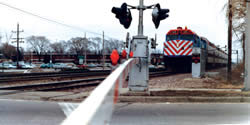
Today, transit systems across the United States are posting robust levels of ridership and exerting considerable influence on the planning, development and revitalization of adjacent communities.
Transit-oriented development, or TOD, combines planning for transit infrastructure and residential/commercial development to establish communities that are less dependent on automobiles — thus reducing road congestion and pollution — and incorporate a range of sustainable land-use strategies.
These strategies include creating mixed-use communities (residential and commercial), availability of medium- to high-density (and affordable) housing, compact and walkable neighborhoods and attractive green spaces for recreation and social interaction. These sustainable strategies can be applied to new or revitalized communities, and the transit system plays a key role both in stimulating development and in helping to shape the outcome.
Turning TOD into DOT
For every action, however, there is an equal and opposite reaction. Communities are exerting increasing influence on transit systems in return, and it goes beyond a basic impetus to locate a station here, or build an extension there. In fact, developers are beginning to ask — quite fairly — that if TOD is expected to take a transit system into account, why shouldn’t transit systems be designed with potential development in mind? In short, isn’t it time for development-oriented transit (DOT)?
The answer: Yes, it is. The query brings a new and valuable perspective to some of the most fundamental aspects of transit system design, such as station access, the nature of communities along the alignment and any likely changes, and public needs and preferences in relation to system operations.
In many cases, transit system design assumes that vehicles, especially automobiles and buses, are the only significant means of passenger access to the system. As a result, stations tend to be surrounded by Òmega” parking lots and feature drop-off locations as close as possible to station platforms. This design approach actually encourages vehicle use and automobile-oriented development within the community — the opposite of TOD goals. Moreover, it increases driver convenience but does little for pedestrians or cyclists, and the huge parking lots have the practical effect of separating the stations from the communities they serve.
Design changes can help
In contrast, a DOT design perspective might eliminate parking at some stations or establish multiple parking areas dispersed through the area around the station at a distance that is convenient for driving commuters but not close enough to dominate the station landscape. This would allow for complementary design strategies that incorporate pedestrian and bicycle pathways. This approach does not sacrifice the need for convenient vehicle access; it simply accommodates other needs while supporting the principles of sustainability.
The approach has successfully played itself out with modern and established systems. Several stations on the Metra commuter rail system in Chicago provide excellent illustrations of this approach. The Elmhurst, La Grange Road and Arlington Heights stations provide parking spaces in dispersed lots.
Meanwhile, Portland’s TriMet and Dallas Area Rapid Transit have moved parking away from the platform at some stations to accommodate TOD. This addresses the need for vehicle access while maintaining an interesting and attractive environment that invites pedestrian and bicycle movement. At each of these stations, this approach to station design reciprocates the TOD that has been occurring around the station through higher-density, mixed-use development and TOD-friendly zoning.
It’s surprising how many transit systems, including newly developed ones, have stations in areas where there is little potential for sustainable land-use development. A DOT approach would incorporate an analysis of potential TOD in the area during the planning stage. What is the community’s vision for how it wants to grow? Is the real estate market and political climate receptive to TOD? What are the probable changes in the community’s makeup and infrastructure, and how might system elements be designed in response?
Community concerns
Of course, community concerns regarding transit operations already influence system development. A DOT perspective, however, would take into account additional concerns directly linked to the goals of livable communities and sustainable development. The design would specifically explore ways to integrate stations into community spaces, instead of separating them by vehicle buffer zones. Stations would be designed to respond to an area’s social, economic and cultural makeup in a way that identifies the stations as community elements, not just functional structures that might exist anywhere but be at home nowhere.
The Washington Metropolitan Area Transit Authority’s West Hyattsville station in suburban Washington, D.C., is a good example of a station retrofit undertaken from this perspective.
The park-and-ride area is reconceived as a town square, and natural areas surrounding the station are enhanced and well maintained. The adjacent community is integrated into a new transit village, with the station acting as an anchor.
The design perspective referred to as development-oriented transit is by no means incompatible with an approach that focuses on conventional system and passenger requirements. On the contrary, it enhances that approach. It assumes that it is possible to meet user requirements and maintain cost-effective service — while seeking synergies with TOD, encouraging environmentally friendly practices and creating lively community spaces.
A simple DOT checklist might look something like this:
Are stations located in areas with TOD potential?
Do the facilities allow for convenient pedestrian and bicycle access while accommodating parking requirements?
Are the facilities integrated into the surrounding community, rather than separated from it by dividers such as giant parking lots?
Has the design actively taken into account the likely needs and outcomes of TOD in the area? The TOD-DOT connection
A DOT design perspective is a logical accompaniment to TOD. If transit systems and adjacent communities are to coexist, it’s to their mutual benefit to do so as harmoniously as possible. Ultimately, DOT makes a transit system an integral element of the community — useful, attractive, and environmentally sensitive — rather than a visitor making a brief stop on the way to some other place.
More Management

Public Transit Conference Returning to GFX in 2027, Call for Papers Now Open
The Call for Papers is now open, allowing transit agency professionals and industry experts to help shape the PTC educational program by submitting session ideas for consideration.
Read More →
Indian River Transit’s Community-Focused Approach Earns National Recognition
Named APTA’s 2026 Outstanding Public Transportation System in its size category, Florida’s Indian River County transit system continues to grow ridership through fare-free service and a focus on evolving community needs.
Read More →
ENC Lands MATA Contract and More in Biz Briefs
In this edition of Biz Briefs, we spotlight the latest developments shaping the future of mobility.
Read More →

From Surviving to Thriving: Building Stronger Transportation Organizations
Bus Business Consultants founder Brian Dickson shares lessons on leadership, organizational health, and creating options for long-term success in a changing transportation industry.
Read More →
Everett Transit, Community Transit Outline Consolidation Agreement
The proposed agreement calls for a 50% increase in bus service in Everett, a new microtransit zone, continued paratransit service, and the transfer of Everett Transit operations to Community Transit.
Read More →
Strada360’s Steve Lassey on Turning Transit Data Into Better Decisions
From breaking down data silos to preparing for AI, Strada360 CEO Steve Lassey discusses how transit agencies can use technology to improve operations, customer information, and long-term decision-making.
Read More →
People Movement: Phil Washington Joins HNTB, Denver RTD Launches CEO Search, and More
In this edition, we also spotlight recent personnel moves at STV, the Eno Center for Transportation, and more, highlighting the people taking on new roles across the transportation industry.
Read More →
SEPTA Details Accelerate Vision for Transit System
The plan outlines investments in trolley modernization, new Metro and Regional Rail vehicles, accessible stations, and more frequent bus and rail service.
Read More →
FTA Ends Direct Oversight of MBTA Safety Actions
The federal agency closed its remaining special directive to the Massachusetts Department of Public Utilities following a safety review that began in 2022.
Read More →
Report: Transit Bus Manufacturing Supports 34,100 Jobs, $5.1B in GDP
The “Buses Mean Business” report examines the transit bus manufacturing industry’s economic footprint, supply chain, and rising demand for vehicle replacements.
Read More →