



Early Returns: Hybrid Artics Ideal for Seattle
After only a few months of revenue service, King County Metro Transit and Sound Transit give high marks to their new fleet of New Flyer 60-foot hybrid buses.
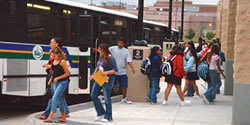
In late 2003, Seattle's two major transit properties, King County Metro Transit and Sound Transit, together signed a contract for 235 New Flyer buses in one of the largest hybrid bus orders in North American history. The order of DE60LF buses was customized for use in a unique 1.3-mile underground tunnel, called the Seattle Metro Tunnel, that currently serves as an exclusive busway.
The buses are 60-foot low-floor articulated models, with a hybrid-electric drive developed by Allison and a C9 engine from Caterpillar. King County and Sound Transit worked extensively with New Flyer and the other manufacturers to develop a product that was right for this bus rapid transit (BRT)-like application.
Underground issues
"We had to be able to operate in the tunnel. That was the single biggest issue to us with this deal," says Jim Boon, manager of fleet maintenance for King County. "It's a big perceived issue from the public if you are in a tunnel and you have any claustrophobia and then you have some diesel engine blowing smoke at you."
Because the hybrid-electric drives on the new buses burn only 3.2 cups of diesel fuel per trip through the tunnel and air is exchanged four times an hour, that problem has been addressed, says Boon.
But limiting emissions wasn't the only aim of this procurement. According to Fred Chun, project manager for Sound Transit's Express Bus Operations, the tunnel will eventually include light rail, so energy and cost efficiency were also critical.
The old buses that ran through the tunnel were dual-mode Breda vehicles that used an overhead power source. "The new system enabled us to save a lot of infrastructure costs because we don't need the overhead power supply for the buses anymore. Instead we can use it for the light rail," says Chun.
With the click of a switch, the bus can go into "tunnel mode," where horsepower drops and it runs on batteries. But this doesn't slow it down, says Boon. "They can run 65 mph, and when they reach a hill they just go up it, rather than slogging along like an elephant."
Unexpected surprises?
King County, which purchased 213 of the buses, began revenue service on them in early June. Boon says about 180 buses have been delivered, with the rest expected before Christmas. Sound Transit has received 21 of the remaining 22, and they've been operating for about a month and a half.
Both agencies are accustomed to running New Flyer buses, so there hasn't been much of a learning curve on the chassis or components. Overall, says Boon, the closest thing to a negative has been the high capital cost.
New Flyer, however, contends that the costs can be overcome by efficiency. "The technology is mature and stable in a production environment, and we believe the operational benefits offset the higher capital costs to make this a viable, long-term solution," says Paul Smith, executive vice president of sales and marketing for New Flyer.
Both Boon and Chun have already noticed improvements in efficiency. "One of the things we see but haven't put a pencil to yet is that the buses perform and accelerate so well that they don't fall off schedule. We think we will be able to reduce our route run times and that is where we will really save some money."
Chun reports similar findings. "We have seen a 15% fuel savings so far, and I think if the reliability remains the same, the life-cycle costs will make some money back with operational efficiency," he says.
Preliminary response
Chun says that even with the high cost of the buses, they have already surpassed everyone's expectations. Configured in a commuter-style, riders like them because of upgraded features such as air conditioning, high-backed seats and reading lights, he says. Additionally, the buses replace a fleet of high-floor models, and passengers enjoy the improved access.
Drivers have responded with positive feedback, too, citing improved acceleration and comfort. "They really like the smoother ride with no hard shifting," says Chun.
Boon adds that technicians have also been very happy with the new fleet. "In 14 years with the old buses, we never got more than 2,200 miles between road calls. So far with these buses we are well over 6,000 miles between road calls," he says. "It's just been an incredible honeymoon."
But though the early word on the new buses has been positive, nothing is set in stone. "No one is getting any extra federal funding for hybrid technology, or any special grant money because it is cleaner," says Boon. The bus costs are expected to be made back, operationally, in about eight years, but Boon says it was a real painful financial stretch to buy the buses. "I think that we're about a year away from making any hard predictions about what we can and can't do."
More Management

LIT Marks 10-Year Milestone at Annual Summit
Hosted by the COTA from September 10 to 13, the Summit carried the theme “Celebrating 10 Years of Excellence, Leadership, and Impact,” with every part of the program honoring the people, agencies, and partners who built LIT over its first decade.
Read More →
People Movement: Dan Dipert Coaches Adds Third-Generation Leader, Keolis Names New Valley Metro VP/GM, and More
In this edition, we also cover recent appointments and announcements at the Wabtec, SilverRide, HNTB, and more, showcasing the individuals helping to shape the future of transportation.
Read More →
METRO Opens Submissions for 2026 Motorcoach Awards
Nominations are now being accepted for METRO Magazine’s Operator of the Year and Innovative Operator of the Year awards.
Read More →

New York MTA Advances Final Contract for Second Avenue Subway Expansion
Contract Four is the largest in the Second Avenue Subway Phase 2 project and includes construction of station infrastructure, tracks, and signals for the subway expansion, MTA officials said. Work on Contract Four will begin in 2027.
Read More →
Transit Agencies Highlight Safety Gains at National Summit
Leaders from 15 major transit systems shared crime-reduction results and safety initiatives while discussing the role of continued federal support.
Read More →
NITA Names New Leadership, Expands Reduced-Fare Program at First Board Meeting
The new regional transit authority appointed its first board chair and interim executive director while extending reduced fares across CTA, Metra, and Pace for eligible riders.
Read More →
Beyond the Checklist: A Structured Approach to Transit Maintenance
Reliability-Centered Maintenance helps transit agencies move beyond routine checklists to focus limited resources on the assets and failures that have the greatest impact on safety, reliability, and service.
Read More →
APTA 2026 Nominating Committee Selects Leadership Slate, Names Chair and Vice Chair Nominees
Leadership changes will help shape the association’s priorities and its representation of the transportation industry during the 2026–2027 term.
Read More →
DART Launches Major Security, Fare Enforcement Initiative
The 90-day demonstration will deploy coordinated security teams at five light rail stations while testing controlled access and gathering data to guide future investments.
Read More →
Advancing Fare Collection Through Technology and Innovation
Learn about delivering 1300 gates at 91 stations while managing fare evasion. Explore the large scale deployment, solution customization and real-world results that affect the region. Prepare for deployment in your region now.
Read More →