



RELATED: Digital signage advances bring cost, energy savings
Effective Digital Signage Strategies for Small- to Mid-Sized Transit Agencies
Installing a new systems and/or retrofitting older LCD displays with new capabilities helps provide riders with improved travel info.
by Tanya Brusse and Bryan Gilliom
August 29, 2019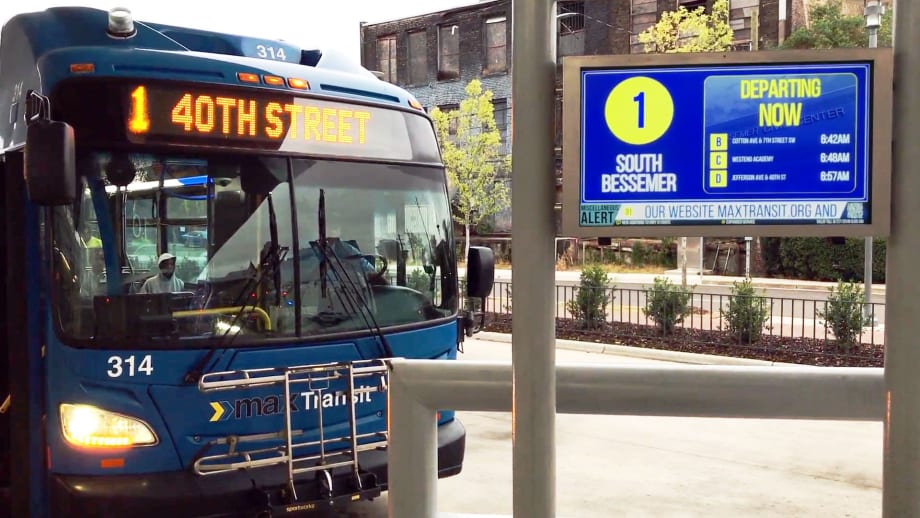
An ideal location for digital signage is at transfer stations/intermodal areas where multiple routes come together.
5 min to read
With technology’s rapid evolution, digital signage is becoming popular almost everywhere static signage once appeared — elevators, billboards, and highway overpasses.
The technology allows for dynamically changing information, easy updates, and improved audience engagement. Introducing infotainment digital signage to your agency will take passenger information to the next level by engaging and informing your riders throughout their journey with real-time information and multimedia content. It provides a platform that will build connections with local businesses and your larger community.
Why Move to an Infotainment System?
Agencies are fighting to combat the perception that public transit is a low-tech mode of last resort by evolving to become more customer-centric and meeting riders’ exceptions of having easily accessible information. Installing a new digital signage system and/or retrofitting older LCD displays with new capabilities helps provide riders with improved travel information.
Attention-grabbing: Infotainment attracts more attention compared to traditional signage because of its ability to support content rotation, animation, and video. Static/printed content left up for extended periods of time grows stale, and customers will ignore it after multiple exposures on their daily commute. Infotainment systems continuously change and refresh content, better engaging viewers.
Advertising revenue: Sell powerful digital advertising to local and national businesses to supplement farebox revenue, which in turn can be used for the 20% match needed for many grants.
Targeted content display: Content can be easily changed and triggered depending on time of day, day of the week, location, or weather, providing timely and relevant information.
Cost-saving: No more printing and installation costs associated with changing posters, interior cards, etc.
Realize even more proven benefits of real-time information, backed by research.
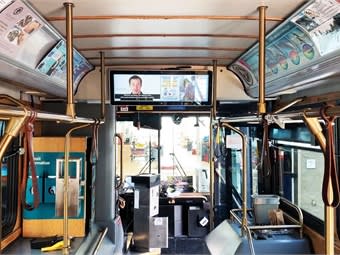
Content can be easily changed and triggered depending on time of day, day of the week, location, or weather, providing timely and relevant information.
Digital Signage Trends and Best Practices
It’s recommended to place digital signage wherever passengers are waiting, so they can view important travel information. For smaller agencies with limited budgets, it’s advised that they start with on-vehicle displays, as they can provide a longer opportunity for viewing. Another ideal location is at transfer stations/intermodal areas where multiple routes come together. If the budget permits, signage can be expanded to busy stops and shelters at major transfer points.
A common on-board display configuration is to have an LED sign mounted backward behind the driver on the bus partition, with a second LCD sign mounted to the frame by the rear exit doors. This configuration helps to ensure that content is within all riders’ line of sight.
An emerging trend is to install a super wide, color LCD screen on the bulkhead in place of the older LED Next Stop display. This location and the special wider display allows the simultaneous presentation of multiple information types, such as stop information, stop requests, agency news, and advertising, in a location that is easily viewed by all riders. This helps eliminate the competition between using screen space for route information verses information or revenue-generating advertising that traditional configurations can suffer from.
Agencies are encouraged to think beyond the hardware and consider if their vendor will be a good long-term partner. When agencies aren’t initially set up for success with thoughtfully designed content framework, training, and vendor support built into their plan, displays can quickly become stale — thereby diminishing return on investment.
The Content Management System (CMS) and integration are also important factors to take into consideration when choosing an infotainment solution. A cloud-based, intuitive CMS allows agencies to manage content and remotely monitor the status of displays, while granular permissions define what content and displays different users can manage. A solution tightly integrated with a CAD/AVL system allows new schedule information and real-time data, including service interruptions and agency news, to be automatically presented on infotainment displays, eliminating redundancy associated with maintaining multiple communication channels.
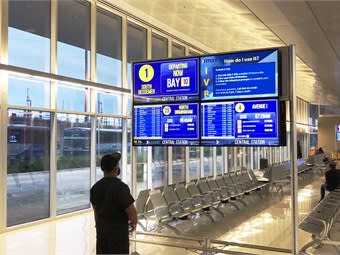
Infotainment attracts more attention compared to traditional signage because of its ability to support content rotation, animation, and video.
Types of Advertising
Across the U.S., advertising generates a half-billion dollars for transit agencies, according to the American Public Transit Association (APTA). This seems like a hefty number, but most of that action is most likely in core urban markets and is still only a small fraction compared to the $15 billion agencies earned from fare revenue.
Agencies outside of core urban markets may want to consider looking at other advertising strategies and opportunities to secure revenue, especially if there are a limited number of “traditional” advertisers in their area.
Some examples of alternative advertising are:
Transit agencies can partner with local properties — universities, building owners, housing complexes, hotels, or businesses — to provide real-time transit information on community information displays.
Local tourism boards or Better Business Bureaus can use geo-targeting to advertise local points of interest and events. For example, by letting riders know when they’re approaching an interesting landmark.
Community and other governmental organizations with grant money available to implement community messaging could be having difficulty reaching their target audience (riders of necessity). Both transit agencies and municipal governments can publish public service announcements and share other important information.
Content sponsorship could be, as an example, a local utility company sponsoring the weather in exchange for promotion of their "save on energy" community messaging at the end of the segment.
A recent example of an innovative corporate sponsorship is the City of Rock Hill, in South Carolina. Several local community partners — the local university, medical center, and credit union — are sponsoring the entire transit network, and in return they will receive prioritized messaging display within their targeted geographic area.
Content can be easily changed and triggered depending on time of day, day of the week, location, or weather, providing timely and relevant information.
Smaller urban and rural agencies who may not have the resources to secure advertisers can use an advertising agency, or other organization, to solicit and manage advertising content. The transit agency manages their content while the partner has access to manage non-transit related content. Ridership data from intelligent transportation systems (ITS) can help maximize advertising revenue by identifying routes, days, or times when impressions (i.e. ridership) are highest and charging premiums for this increased visibility.
Conclusion
Digital signage systems can help increase ridership, improve rider satisfaction and provide an additional source of revenue; a great way for smaller agencies to upgrade their passenger experience in a way that can not only pay for itself, but even help improve the agency’s bottom line.
Tanya Brusse is Transit Product Manager for TripSpark Technologies; and Bryan Gilliom is President at Message Point Media
Subscribe to Our Newsletter
More Technology

From Hardware to Digital Partner: Luminator Charts Its Next Chapter
CEO Magnus Friberg discusses Luminator’s shift toward becoming a digital partner, the growing importance of software and interoperability, and how AI can help agencies improve operations and passenger experience.
Read More →
Beyond the Checklist: A Structured Approach to Transit Maintenance
Reliability-Centered Maintenance helps transit agencies move beyond routine checklists to focus limited resources on the assets and failures that have the greatest impact on safety, reliability, and service.
Read More →
NJ TRANSIT Advances Bus Technology Upgrades Across Statewide Fleet
More than 1,500 buses now feature upgraded technology designed to improve arrival predictions and provide free Wi-Fi, with deployment expected to reach nearly 2,000 buses by the end of 2026.
Read More →

Building a Flexible Path to Transit Electrification
John Hroncich discusses BAE Systems’ modular and scalable approach, lessons learned from decades of real-world operations, and how agencies can identify electrification strategies that fit their fleets.
Read More →
Biz Briefs: Alstom Lands Canadian Contract, LYT to Supply California TSP, and More
In METRO's latest installment, we take a look at recent news from Complete Coach Works, Beep, FlixBus, and more partnerships making headlines across the transportation sector.
Read More →
Sponsored•September 8, 2026
From Legacy Silos to Conversational Intelligence
What if transit leaders could ask any operational question and get a trusted answer in seconds? Conversational AI is transforming how agencies use their data.
Read More →
USDOT Announces Rail Vehicle Replacement Grants, Chattanooga AV Shuttle Funding
More than $191 million in federal funding will help three transit agencies replace aging rail vehicles and support a new autonomous shuttle service in Chattanooga.
Read More →
Bus Tech Talk: Keeping Transit Technicians Ahead of the Technology Curve
LA Metro’s Obed Mejia discusses technician training, evolving maintenance technology, fleet replacement, and strategies for getting the most out of today’s transit fleets.
Read More →
Biz Briefs: RIPTA Unveils New Frontrunners, Clevland RTA Adds New Siemens, and More
In METRO's latest installment, we take a look at recent news from Siemens, Prevost, Dodge, and more partnerships making headlines across the transportation sector.
Read More →
Why Simulating Pedestrian Movement Has Become Essential for Modern Rail Stations
Pedestrian microsimulation is helping rail planners identify bottlenecks, test station designs, and prepare complex transit hubs for growing passenger volumes.
Read More →