



Enhanced Customer Service Key to Improving Transit Systems
Transit operations are using new applications to streamline their customer service systems, resulting in improved productivity and reduced costs. Feedback from customers is also being elicited to help improve transit services.

[IMAGE]njtransitbus.jpg[/IMAGE] Customer service is no longer just a public relations function. Instead, it is becoming a key tool to attract and retain customers, as well as a vital method of eliciting customer feedback and ideas that will ultimately be used to help improve transit systems.
Yet, providing quality customer service is not inexpensive. For example, it costs $5 to $7 for each interaction to be handled by an agent. With rising fuel costs and ridership demands for more service, agencies are juggling the needs for better customer service with better service to customers.
In response, customer service is becoming customer relationship management (CRM), which is the strategy of building and enhancing relationships with customers through meeting their needs while managing costs.
To that end, agencies have turned to Web and text messaging to reduce call volumes, while shortening hold times and the time taken to resolve issues. They have also deployed CRM software and workflow changes to respond more effectively to commendations, complaints and suggestions (CCS). These tools enhance customer service, while boosting productivity and reducing expenses.
With these methods in place, customers are now getting better service in more ways than one.
Cutting-edge management
In June 2008, New Jersey Transit (NJT), the U.S.’s third-largest transit system, discontinued its toll-free customer service number and replaced it with a regular phone line; toll-free access continues for hearing-impaired TTY users. The move will save the agency approximately $500,000 annually.
While at first glance NJT’s decision appears to be a move backward, it is actually the latest step forward in what may be the most cutting-edge CRM program of any North American transit agency.
NJT customers have an array of automated feature-rich information sources at their fingertips that reduce their need to call or to send e-mails.
These tools include a specialized Website, launched in 2006, that enables customers to check schedules, fares and scan up-to-the-minute information about system operations with their wireless devices. The site has recently been upgraded with a “Contact Us” Web form that permits patrons to provide feedback.
The methods include “My Transit,” a subscriber-based text message alert system, available on all NJT modes. Using this system, customers can receive up-to-the-minute travel information for their specific trip whenever there is a delay affecting their designated itinerary.
NJT’s switchover to the regular number generated minimal media comment and public reaction. “We also realized that most customers were making the calls at no additional charge anyway, either because they were using a cell phone, an unlimited home voice over Internet calling plan or calling from their workplace,” explains NJT spokesperson Dan Stessel.
The communications front end only tells part of NJT’s CRM story. The agency transformed its back-end CCS handling from a chaotic situation where issues would go unresolved, with no tracking and, in some cases, with multiple executives seeing and responding to the same inquiry to a streamlined, faster, more accurate and more efficient response system.
The key has been a hosted CRM system from Salesforce.com that processes comments received by phone and online. Hosted software, also known as Software as a Service (SaaS), is less expensive, more flexible and quicker to implement than traditional software installations on clients’ computers. It avoids hardware investment that in turn also saves on internal IT costs.
To take full advantage of the software’s capabilities, NJT realigned its customer service department to make each member of the staff the expert for a specific customer service area, which decreased communications overhead and improved productivity.
The Salesforce.com system provides workflow rules that routes incoming customer questions to the subject area expert. It also enabled customers and internal users the ability to ask questions and submit issues on the existing site via Web forms, which flow into the Salesforce central customer information warehouse. The system’s applications are linked to a data warehouse, employee information, an e-mail management system and a data quality system.
The initial application proved far more successful than what the transit agency had hoped. The same number of staff handled 42,323 inquiries in 2006, compared with 8,354 in 2004. During its use, the average response time to inquiries dropped by more than 35 percent and productivity increased by 31 percent. The Web forms cut down on the time spent handling free-form e-mail; nearly 50 percent of all CCS cases are captured via the forms.
NJT may be going to the next level of CRM by utilizing social networking. Earlier this year it piloted an online suggestions exchange using Salesforce.com’s “Ideas” platform. Customers were able to post their thoughts, read what other customers were saying and vote on the proposals they liked best, which were reviewed by management.
The program pulled in 349 ideas over the pilot’s 30-day time span and netted several great suggestions.
[PAGEBREAK]Government partnership
Sharing resources related to customer service enhancement makes good sense, especially from a cost-savings perspective. For those reasons, the San Francisco Municipal Transportation Agency (SFMTA) partnered with the City and County of San Francisco’s 3-1-1 Customer Service Center to provide route planning, general inquiries, lost item reports and CCS gathering capabilities — replacing a separate SFMTA contact center.
The 3-1-1 system is equipped with a CRM solution that enables the SFMTA to query the data, allowing it to pinpoint problems and assign resources to resolve critical concerns. Unresolved CCS items that the 3-1-1 team receives are forwarded to SFMTA’s internal Customer Service group.
The move to 3-1-1 enabled the transportation agency to provide 24-hour customer service, which it could not have economically provided on its own, points out SFMTA spokesperson Kristin Holland. It also dramatically reduced hold times, with over 70 percent of calls answered within 60 seconds.
The agency has been continually improving its customer service processes. Partnering with the city of San Francisco, SFMTA recently launched a self-service portal that enables customers to submit comments and lost item inquiries online. The agency is now looking at access via wireless devices.
The SFMTA is seeking ways to improve its customer satisfaction. Its goal is resolving 75 percent of issues in 30 days, but admits its performance has been slightly below that. In response, SFMTA will be assigning an internal lead staff member for each category, setting up a call queue for each inquiry type and establishing service protocols with each lead member. Customer Service group staff will conduct random spot checks to ensure that issues raised by customers have been adequately resolved.
The SFMTA’s new and enhanced contact center and Web tools have come together at the right time. The agency and the city have been reviewing the transit system, the first major overhaul in more than 25 years, to see where best to deploy these services to meet the city’s needs within existing budgets.
Key to this review, known as the Transit Effectiveness Project, has been the customer feedback received via the 3-1-1 system, online, as well as those received during public meetings. The SFMTA received more than 4,000 comments and the project Website had 20,000 unique hits. The input has helped staff identify needs and key issues that they worked into their recommendations and presented to the SFMTA board in mid-September.
Keeping up with demand
Metro Vancouver, British Columbia, is one of Canada’s fastest-growing urban areas. It is also the subject of a major effort by governments to push motorists to use public transit through the establishment of new routes and services via the province’s new carbon tax.
TransLink, Metro Vancouver’s transit agency, handles approximately 185,000 customer service contacts, about 2,500 of which are CCS for the region’s bus, commuter rail, automated rapid transit, urban ferry services and road network.
All customer service issues are entered into a CRM database that TransLink planners tap into. To help determine needs, planners and schedulers query increased frequency requests, route suggestions and schedule adjustments with the CRM. That leads to better service, less complaints and more commendations.
To better manage the contact load, TransLink embarked on a strategy to divert more calls to other channels. In April 2007 it launched “NextBus,” which provides automated text responses to Website inquiries regarding bus schedule arrival times.
The service has proven successful, handling nearly 240,000 contacts in the first nine months of operation. NextBus will gain more functionality when TransLink equips its entire bus fleet with GPS systems this fall, enabling it to relay the actual estimated arrival times.
In addition, TransLink will soon deploy an online customer comment form, which will accept many customer inquiries previously handled by phone, free-form e-mail, fax and letters more cost effectively.
Boosting performance
A key performance indicator of customer service is first contact resolution (FCR). The greater the FCR, the more likely customers will be satisfied because they did not call back.
Faced two years ago with a FCR rate of 59 percent — low by industry standards — Portland, Ore.-based TriMet took steps to boost its numbers. The agency looked closely at the types of issues raised by customers and made the best information available to its contact center agents via databases, Web pages and hard copy. It also empowered agents to serve as liaisons and information conduits with other departments. TriMet’s FCR statistics include in-person, as calls, e-mails, faxes and mail.
One of the issues identified was a doubling in e-mail Web form responses. TriMet then assigned one agent to receive and respond to those contacts. The strategies proved very successful. In spite of a dramatic increase in customer contacts to 94,000 in FY 08 that ended June 30 from 64,604 in FY07, its FCP rose to 77 percent.
“The bottom line goal is to anticipate the questions people are going to ask and to get the information out on the Web and through e-mail subscriptions, proactive messaging on the phone system, or through direct contact with the customers,” says Lisa Freeman, TriMet spokesperson. “We continually make customer inquiries and comments available to project managers and decision makers.”
Brendan B. Read is a frequent METRO contributor. He is also a longtime editor/writer for contact center customer service, CRM, and direct marketing publications.
More Paratransit

Everett Transit, Community Transit Outline Consolidation Agreement
The proposed agreement calls for a 50% increase in bus service in Everett, a new microtransit zone, continued paratransit service, and the transfer of Everett Transit operations to Community Transit.
Read More →
Driving Smarter Paratransit
John Hanlon shares how AlphaRoute is leveraging AI-powered technology to help paratransit providers optimize operations, support frontline staff, and enhance the rider experience.
Read More →
People Movement: Dan Dipert Coaches Adds Third-Generation Leader, Keolis Names New Valley Metro VP/GM, and More
In this edition, we also cover recent appointments and announcements at the Wabtec, SilverRide, HNTB, and more, showcasing the individuals helping to shape the future of transportation.
Read More →
Biz Briefs: RIPTA Unveils New Frontrunners, Clevland RTA Adds New Siemens, and More
In METRO's latest installment, we take a look at recent news from Siemens, Prevost, Dodge, and more partnerships making headlines across the transportation sector.
Read More →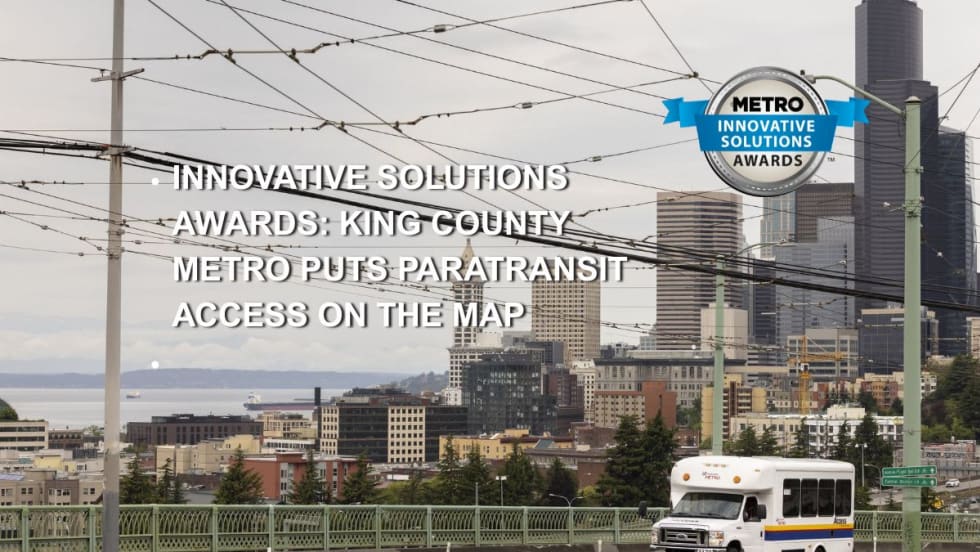
King County Metro Makes ADA Paratransit Easier to Navigate
METRO's Innovative Solutions Award winner replaces complex service-area descriptions with an accessible, interactive map that puts paratransit information directly in customers’ hands.
Read More →
Jacksonville’s NAVI Project Charts a New Course for Autonomous Public Transportation
Through its NAVI program, JTA is showing how autonomous vehicles, intelligent infrastructure, and coordinated operations can work together to deliver everyday public transportation.
Read More →
Driving Smarter Paratransit
John Hanlon shares how AlphaRoute is leveraging AI-powered technology to help paratransit providers optimize operations, support frontline staff, and enhance the rider experience.
Read More →
METRO Magazine Announces 2026 Innovative Solutions Awards Winners
Projects Recognized for Advancing Mobility Through Technology, Accessibility, Workforce Innovation, and Operational Excellence
Read More →
Biz Briefs: STV teams with Amtrak, Motorcoach Operators Boost Fleet and Land Contracts, and More
From manufacturers and suppliers to transit agencies and motorcoach operators, these updates offer a snapshot of the projects, partnerships and business moves driving the industry forward.
Read More →
Biz Briefs: Masabi Teams with St. Louis Metro and More
In METRO's latest installment, we take a look at recent news from Transdev, Hitachi, and more partnerships making headlines across the transportation sector.
Read More →