



How Do We Minimize the New Fire Risks Associated with EVs and HEVs?
As the industry shifts to make full use of greener fuels, all detection and suppression systems need to work and communicate together to determine risk.

Due to the types of fire that could spread in different areas of these vehicles, and the sensitivity of electrical components, specific extinguishing agents may need to be used.
Photo: Getty Images_WENGEN LING
With a growing number of countries pledging to meet ambitious climate change targets, the world is witnessing a rapid transition to renewable fuels. Consequently, the automotive industry is transforming to meet growing demand for hybrid and electric public transport vehicles.
In Europe, the United Nations Economic Commission (UNECE) issued Regulation 107 to enforce stronger bus and coach safety regulations. These regulations require engine vehicles to have an automated fire suppression system in the engine compartment.
However, UNECE Regulation 107 doesn’t cover the new fire risks brought about by lithium-ion (li-ion) batteries used in electric vehicles (EVs) and the electric component of hybrid electric vehicles (HEVs).
As of now, vehicles without internal combustion engines (such as EVs) are not legally required to be equipped with automated fire suppression systems. However, these types of fire suppression systems are more likely to reduce the spread of fire, should one occur.
The latest version of UNECE Regulation 100 (Construction and Safety of Electric Powertrains) was released in 2020 and recommends an early warning signal in the event of battery failure in rechargeable electrical energy storage systems (REESS), especially when there’s a risk of thermal runaway. Thermal runaway occurs when a battery cell defect — caused by overcharging, overvoltage, overheating, or physical damage — generates rapid temperature increases, fire, potential explosions, and toxic gas emissions.
To detect potential battery cell defects at the earliest possible stage, in line with Regulation 100, fire suppression systems can be used as an additional safety measure, releasing a cooling agent to minimize fire risk.
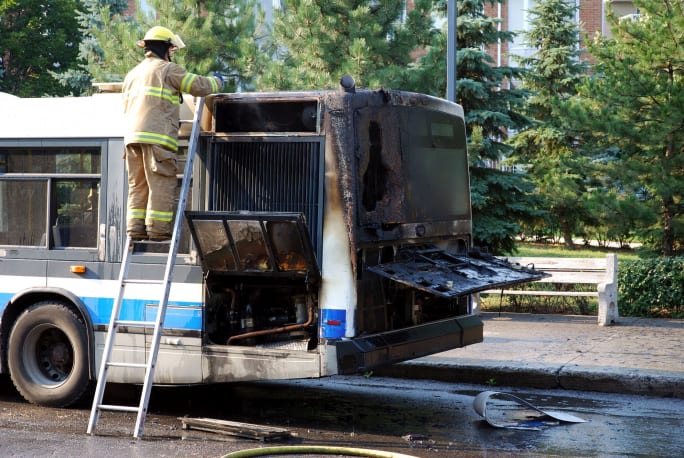
There are new and individual challenges to overcome and new risk assessments to implement, in line with the introduction of HEVs and EVs in public transport.
Photo: Getty Images_MATHIEUKOR
But What About…in the United States
In the United States, the transportation landscape differs significantly from that of Europe, with a diverse array of public vehicles, including over-the-road coaches, transit buses, and school buses each operating under distinct regulations and considerations.
1. Over-the-road-coaches:
Over-the-road-coaches cross state lines, and they’re under the jurisdiction of the Department for Transportation. As of now, there’s no requirement for these coaches to have anything beyond a portable fire extinguisher. Original equipment manufacturers (OEMs) make the judgment to install detection and suppression systems.
After Hurricane Katrina brought about a nationwide catastrophe, insurance premiums increased rapidly. OEMs tried to negotiate insurance discounts for coaches fitted with a fire suppression system, and insurance companies wouldn’t negotiate discount deals. Ultimately, the coaches were responsible for losses following a fire. Coaches are privately funded, and OEMs aren’t accountable to a public authority for fire safety in coaches.
2. Transit buses:
A great percentage of costs to fund transit systems are subsidized by public tax dollars. Each transit agency has authority over its own remit, where it decides what fire protection and systems to use.
A rail incident occurred around 10 years ago in Washington D.C. After an investigation, the government found problems with overall safety and gave the transit agency a year to improve its safety protocols. However, the responsibility to improve safety protocols was ignored. As a result, now, safety officers are divided from management, and their job is to ensure health and safety on transit buses.
Currently, many transit agencies, including Washington Metropolitan Area Transit Authority, are helping to improve the industry through finding new solutions to strengthen fire risk management.
3. School buses:
There are approximately half a million school buses with just a few major manufacturers. Children run evacuation practice drills and school buses are equipped with large exit doors. The location of the engine is critical to detecting fire risk — bus drivers would be able to spot smoke if the engine is located at the front, however if the engine is located at the back of the bus, they wouldn’t be able to spot risks as quickly.
Currently, there’s no legal requirement for school buses to be fitted with a fire suppression system. In Los Angeles County, however, if school buses use alternative fuel, such as liquefied petroleum gas or propane, they need to be fitted with gas sensors.
The bus and coach industry is looking to change to develop and introduce fire risk management, detection and suppression systems for EVs. The industry is evolving in line with the growing international movement to use greener fuels and decrease greenhouse gas emissions.
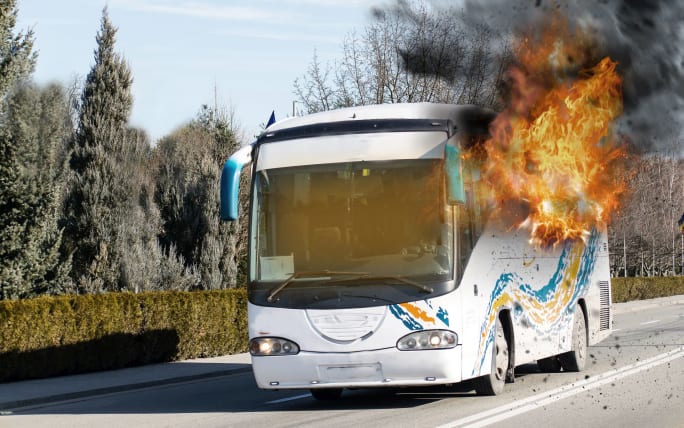
In Europe, vehicles without internal combustion engines (such as EVs) are not legally required to be equipped with automated fire suppression systems.
Photo: Getty Images_BOGDANV
How to Spot New Fire Risks
Joey Peoples, CEO, Dafo US, and Jay Taylor, regional manager in Dafo’s Transit and Motorcoach area, express the direction of travel for the industry is understanding the mistakes of the past and learning from them to making improvements for the future. With any new technology, fires are bound to happen, and there should be more focus on origin and prevention, instead of deliberating who’s to blame.
As the industry shifts to make full use of greener fuels, Joey Peoples comments: “All detection and suppression systems need to work and communicate together to determine risk. We need to understand our own systems and understand how one communicates to send warning signals to alert the other to release agent.”
Li-ion batteries, commonly used to power EVs, are at risk of thermal runaway. The best way to mitigate these new fire risks is by cooling, with early fire suppression systems providing cooling by localizing and mitigating thermal runaway risk.
There are new and individual challenges to overcome and new risk assessments to implement, in line with the introduction of HEVs and EVs in public transport.
The location is the fundamental difference between vehicles with ICEs (internal combustion engines) and HEVs or EVs. Most fire sources in vehicles with ICEs are located in the engine compartment area. However, the potential fire sources can be found in different areas in HEVs and EVs, in which case, additional protection zones should be put in place.
Due to the types of fire that could spread in different areas of these vehicles, and the sensitivity of electrical components, specific extinguishing agents may need to be used.
Fire Risk Management Assessment
The Research Institutes of Sweden (RISE) introduced a fire risk management assessment, which can be used as a guide and includes the following steps:
Hazard identification
Risk estimation
Risk evaluation
Risk reduction
“Failure mode and effective analysis” (FMEA) involves identifying hazards and then measuring risks, so they can be ranked in order of priority.
After the risks have been measured, they can be ranked in order of priority, so a holistic view of the risk map can be shown. A risk map separates risks that are deemed to be “acceptable” from risks that need to be addressed.
Finally, an action plan is needed for the identified fire risks, and it can be developed with suitable risk reduction measures, including:
Risk elimination or minimization by design
Active and passive fire protection systems
Improved cleaning and maintenance procedures
Improved quality and training procedures
Soon after hazards are identified, priorities naturally emerge as to which risks need to be addressed first. Consequently, the actions that follow this work toward ensuring that the automotive industry — including its many and varied users — is made safer.
About the Author: Jonas Bergström is Business Manager for Dafo Vehicle Fire Protection’s Bus and Coach Division
More Security and Safety

Transit Agencies Highlight Safety Gains at National Summit
Leaders from 15 major transit systems shared crime-reduction results and safety initiatives while discussing the role of continued federal support.
Read More →
DART Launches Major Security, Fare Enforcement Initiative
The 90-day demonstration will deploy coordinated security teams at five light rail stations while testing controlled access and gathering data to guide future investments.
Read More →
RTD Launches NextRide App to Consolidate Trip Planning, Fares, Security Reporting
The app expands on RTD’s existing NextRide web application and allows customers to view real-time vehicle locations and service alerts, purchase and store digital fares, and access customer support.
Read More →

TAPTCO Updates OSHA Compliance Training for Transit Maintenance Operations
The revamped program addresses 26 OSHA standards for maintenance facilities, with TAPTCO pointing to training, documentation, and everyday shop hazards as continuing challenges for transit operations.
Read More →
How VaporVision Adds Value to Transit Door Systems
Wabtec engineers explain how the system improves doorway detection, strengthens diagnostics and gives transit agencies and OEMs greater operating flexibility.
Read More →
FRA Announces $5.3B in Rail Investments, Including $2B for Amtrak
Funding will support grade-crossing improvements, infrastructure upgrades, and new Amtrak equipment in 23 states.
Read More →
Chicago, Maryland Expand Non-Law-Enforcement Safety, Rider Support
The CTA and MTA are launching new programs aimed at de-escalation, crisis response, rider assistance, and greater transparency.
Read More →
LA Metro, City of West Hollywood, and Partners Advance Smarter Bus Lane Enforcement
The award-winning partnership combines AI-powered detection with human oversight to improve bus reliability, accessibility, and enforcement efficiency.
Read More →
LA Metro Reports 57% Decline in Homelessness on Transit System Since 2024
The agency's latest homelessness count offers new data on how care-based services and cross-sector partnerships can complement traditional transit security strategies.
Read More →
FTA Launches 'Transit Moves America' Dashboard to Highlight Agency Safety and Performance
The online dashboard transforms National Transit Database information into a public-facing resource that allows users to compare transit agencies on key operational and safety metrics.
Read More →