




Keep Reading: Lawrence Transit Uses Tech to Improve Passenger Experience
How the Transit App Is Redefining What It Means to Move Without a Car
Over a decade after launching in Montreal, Transit has grown into one of North America's most trusted mobility apps, proving that technology can make cities more human, not just more efficient.
November 3, 2025
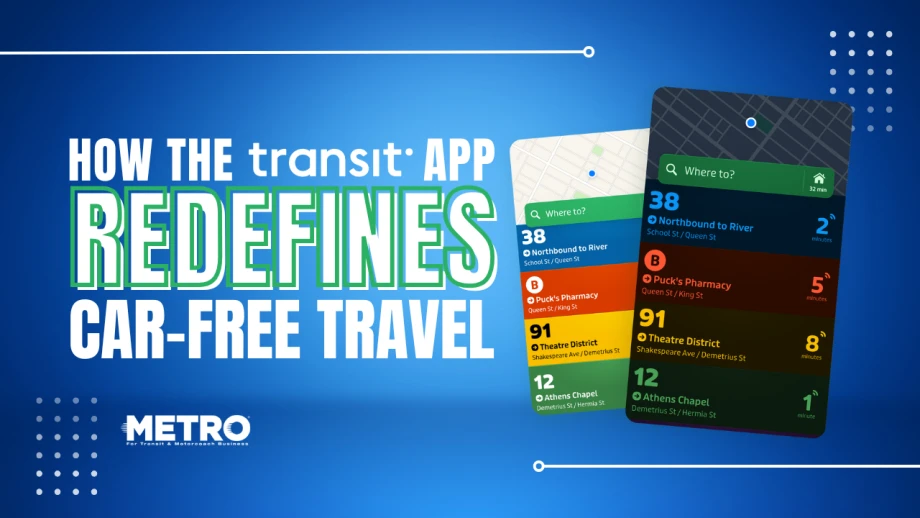
Even Transit's color system has been reengineered to handle dark mode more intelligently. "About half of people use Transit in dark mode, even during the day," says Stephen Miller, policy lead at Transit.
Photo: Transit/METRO
6 min to read
- Transit, launched in Montreal, has evolved into a leading mobility app in North America.
- The app demonstrates that technology can enhance city living beyond just improving efficiency.
- Transit is redefining urban mobility by facilitating car-free movement for users.
*Summarized by AI
When the Transit app launched in Montreal in 2012, its developers aimed to create a unique tool for everyday commuters, and in doing so, they found a focus on solving a more minor, more human problem — a moment of uncertainty that hits every rider waiting at a stop.
"When is my bus going to come?"
Other navigation tools forced users to plan an entire trip before answering, according to Stephen Miller, policy lead at Transit, but Transit flipped the script. It was built for real people — riders who already know their routes, their stops, and their city, but want to know "where the closest stop is located and when the next trip will arrive."
More than a decade later, that minimalist idea has grown into one of the most widely used public transportation tools in North America. Transit is used by over 20% of all transit riders in the U.S. and Canada every month, putting the app in a league of its own among independent mobility apps. However, the company's mission has stayed remarkably consistent.
"For many, many people, it means a lot to have a tool, a companion, that helps them take transit and get around by bike or on foot," said Miller. "That's really what animates our mission, which is to make life better without a car.”
Built for the World We Actually Live In
In a "perfect" city, riders wouldn't need an app at all. Trains would arrive every five minutes, buses would never detour, and the streets would be safe for anyone on two wheels. But, as Miller pointed out, "We don't live in that world."
Instead, we live in one where delays, funding shortages, and unpredictable service are routine. Transit's role is to bridge that gap by keeping riders informed, calm, and connected even when systems aren't running perfectly.
Research supports the impact of these tools, as Miller explained, riders who receive accurate, real-time information perceive their wait times as shorter and are more likely to keep riding.
"It's important to communicate when things aren't perfect so that people can adjust," said Miller. "Mastering those basics requires a team effort, not just within a transit agency, but also with public- and private-sector partners, and we help transit agencies do that work every day."
Although Transit's success is in telling people when their bus is coming, it's also in listening. Most of the time, people need more than just accurate transit service updates. Through constant app engagement and user feedback loops, the platform has become a direct line between riders and the agencies that serve them. Transit makes it a point to ask its users about their trip, including details like whether a bus shelter needs repair or if the bus arrived at the time indicated by the app’s real-time countdown.
"Because people are opening Transit multiple times each day, right at the moment when they are thinking about how they get around, our app is a great touchpoint not just to guide riders through a trip, but also to listen to what they have to say about what's going right and wrong on that trip, and to inform people about efforts to improve their commute," Miller explained.
This is where Miller said apps in general, and Transit in particular, can help shape habits. It encourages people to forgo a car-centric society and ride public transit while helping shape the future of their own city through an established two-way feedback loop.
Sustaining Growth Without Sacrificing Trust
In an era where nearly every navigation app profits from advertising, Transit stands apart and doesn't sell or share personal location data with advertisers.
"The dominant monetization approach for navigation apps, from Google all the way to the smallest players, has traditionally been advertising," said Miller. "That means collecting massive amounts of data about users, and very often, installing software kits into your app that sell this information to data brokers who build out individual advertising profiles."
Transit has built a sustainable model that blends user subscriptions with partnerships with transit agencies like the Maryland Department of Transportation, Maryland Transit Administration , and Metro Transit in Minneapolis-St.Paul. It may not be a simple path, but it aligns with the company's values.
However, Transit does share limited app usage data with transit agencies as part of their partnership to help them understand their riders and improve their service.
"We've done it in a way that we can look at our users, our partners, and ourselves in the eye, because our business doesn't survive at the expense of our users' privacy," said Miller.
"Our mission is to make life better without a car, and we can't achieve that mission by working alone," Miller says.
Photo: Transit/METRO
The New Language of Mobility
The company's recently launched Transit 6.0 redesign is its most ambitious to date. Miller stressed that, for riders, apps — no matter how pretty — need to be easy to scan and understand.
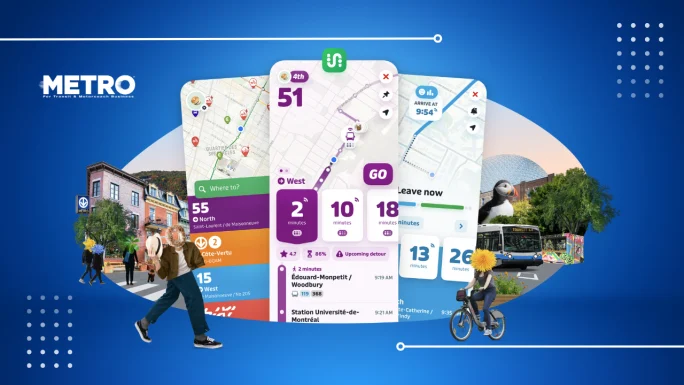
With this in mind, the new interface centers on bold, horizontally scrollable ETA cards that display real-time arrivals, crowding levels, and service alerts in large, easy-to-read numbers.
"The goal is to provide the most critical information in a quick, clear, easy-to-browse format," said Miller.
The overhaul also introduced a custom typeface, Puffin Transit, designed in collaboration with Pieter van Rosmalen and the team at type studio Bold Monday. The font is round, approachable, and highly legible on small screens, which is perfect for an app that wants to feel friendly rather than technical.
Even the color system has been reengineered to handle dark mode more intelligently. "About half of people use Transit in dark mode, even during the day," said Miller. "At night, it jumps up to about three-quarters."
Color is crucial to the public transit experience because it distinguishes different lines, systems, and emergency alerts.
"Since our app works across so many cities, with so many different hues and tints, we had to develop a way to handle these adjustments programmatically," said Miller. "So, we developed an algorithm to match each color to ensure that it remained useful for navigation, while also being legible on dark backgrounds."
The result is a subtle yet significant change that provides a calmer interface, reinforcing Transit's goal of being both functional and intuitive. Plus, accessibility has become a defining feature of the new design.
Roughly one in four Transit users has some form of accessibility need, spanning from low vision to mobility limitations.
"We regularly get feedback from users about accessibility issues, and it's a big focus for our team," said Miller. "And before release, we specifically included users who had offered useful feedback in the past in our beta testers group."
Transit 6.0 improves support for dynamic text, screen readers like VoiceOver and TalkBack, and offers customizable walking and biking speeds. The app also flags step-free routes and accessible transit trips.
"When it came time to work on Transit 6.0, accessibility feedback from users helped inform our decision-making, and we made significant improvements to how the app handles dynamic type size for low-vision users," Miller explained.
Working With Agencies, Not Against Them
Transit knew from the start that it was not a "disruptor" tech company.
"Our mission is to make life better without a car, and we can't achieve that mission by working alone," said Miller. "It means we also have to work with, and be valuable to, the public servants who run the transit networks and manage the streets.
For agencies, Transit offers a ready-made platform to communicate detours, collect feedback, and reach residents who might never attend a town hall. Doing this work in partnership has allowed for a much greater impact than if Transit had tried to do it alone.
"[Other apps] think that they alone can revolutionize transportation. That's not who we are," said Miller. "We believe in our bones that life should be better without a car, we respect our users and put their needs first, and we do it all in deep partnership."
More than a decade after it began with a straightforward question, Transit is helping cities answer a bigger one: What does a world built around people, not cars, actually look like?
Quick Answers
The Transit app is a mobility application that started in Montreal and has become one of North America's leading tools for navigating urban transportation without a car.
*Summarized by AI
Subscribe to Our Newsletter
More Technology

From Hardware to Digital Partner: Luminator Charts Its Next Chapter
CEO Magnus Friberg discusses Luminator’s shift toward becoming a digital partner, the growing importance of software and interoperability, and how AI can help agencies improve operations and passenger experience.
Read More →
Beyond the Checklist: A Structured Approach to Transit Maintenance
Reliability-Centered Maintenance helps transit agencies move beyond routine checklists to focus limited resources on the assets and failures that have the greatest impact on safety, reliability, and service.
Read More →
NJ TRANSIT Advances Bus Technology Upgrades Across Statewide Fleet
More than 1,500 buses now feature upgraded technology designed to improve arrival predictions and provide free Wi-Fi, with deployment expected to reach nearly 2,000 buses by the end of 2026.
Read More →

Building a Flexible Path to Transit Electrification
John Hroncich discusses BAE Systems’ modular and scalable approach, lessons learned from decades of real-world operations, and how agencies can identify electrification strategies that fit their fleets.
Read More →
Biz Briefs: Alstom Lands Canadian Contract, LYT to Supply California TSP, and More
In METRO's latest installment, we take a look at recent news from Complete Coach Works, Beep, FlixBus, and more partnerships making headlines across the transportation sector.
Read More →
Sponsored•September 8, 2026
From Legacy Silos to Conversational Intelligence
What if transit leaders could ask any operational question and get a trusted answer in seconds? Conversational AI is transforming how agencies use their data.
Read More →
USDOT Announces Rail Vehicle Replacement Grants, Chattanooga AV Shuttle Funding
More than $191 million in federal funding will help three transit agencies replace aging rail vehicles and support a new autonomous shuttle service in Chattanooga.
Read More →
Bus Tech Talk: Keeping Transit Technicians Ahead of the Technology Curve
LA Metro’s Obed Mejia discusses technician training, evolving maintenance technology, fleet replacement, and strategies for getting the most out of today’s transit fleets.
Read More →
Biz Briefs: RIPTA Unveils New Frontrunners, Clevland RTA Adds New Siemens, and More
In METRO's latest installment, we take a look at recent news from Siemens, Prevost, Dodge, and more partnerships making headlines across the transportation sector.
Read More →
Why Simulating Pedestrian Movement Has Become Essential for Modern Rail Stations
Pedestrian microsimulation is helping rail planners identify bottlenecks, test station designs, and prepare complex transit hubs for growing passenger volumes.
Read More →