Kansas' Lawrence Transit Uses Tech to Improve Passenger Experience
For its fearless jump into technology and improving the customer experience, LT was selected as a winner of METRO’s Innovative Solutions Award for Efficiency.
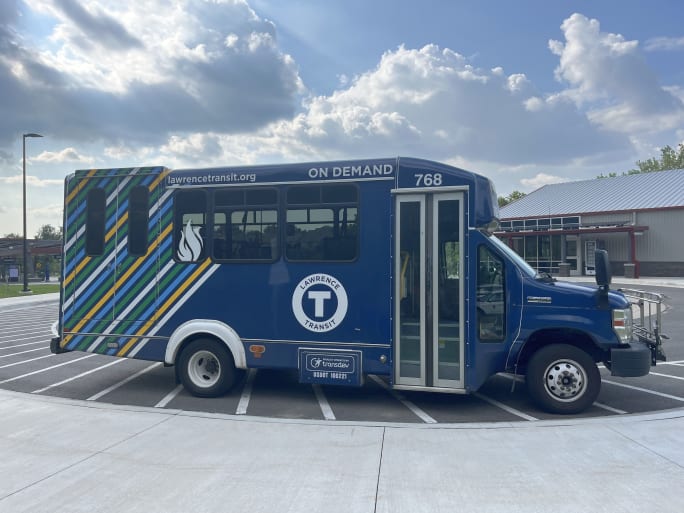
LT’s first innovation was to update its call-ahead, overnight service to a microtransit model, launched as Lawrence Transit On Demand, in September 2023.
Photo: Lawrence Transit
5 min to read
Beginning in 2023, Kansas’ Lawrence Transit (LT) set out to tangibly improve the rider experience. One piece of the process has been to update technology and partner with cutting-edge solutions providers, including Spare, Swiftly, and the Transit app.
With three new apps in tow, LT, a system that provides three million rides per year while serving the population of Lawrence, Kan., which is just under 100,000 people, has the technology and a level of service rivaling systems in large metropolitan areas.
Ad Loading...
The tech projects were funded by a Kansas DOT Access, Innovation, and Collaboration grant, allowing LT to leverage state and federal resources and responsibly steward local dollars.
“As a small agency, it’s important to Lawrence Transit to provide the highest quality service and the best use of our available funding and service hours,” says Felice Lavergne, transit planner II, at LT. “Providing high quality services using innovative technology positions Lawrence Transit to be a leader in sustainability, economic development, and partnership and a major contributor to making Lawrence a place where all enjoy life and feel at home.”
Building Mobility in the Region
LT’s first innovation was to update its call-ahead, overnight service to a microtransit model, launched as Lawrence Transit On Demand, in September 2023.
Partnering with Spare for the service enables individuals to instantly book a ride via an app, while simultaneously allowing LT to more efficiently use the agency’s scheduled driver hours.
“Spare technology is a great fit for transit agencies of any size because of its flexibility and scalability,” says Kristoffer Vik Hansen, CEO of Spare. “The Spare Engine — the AI algorithm at the core of the Spare Platform — optimizes fleet management, making it easy for agencies to adjust their operations as needed. Whether an agency needs to ramp up or scale down, Spare can handle it.”
Ad Loading...
Before On Demand service began, drivers were idling for long periods between rides and between service peaks. The agency can now provide double the overnight service for the same cost.
During the process of launching its on-demand service, LT also launched Sunday service in January 2024, using the same Lawrence Transit On Demand model.
Using Spare enabled LT to provide Sunday service for the first time since LT was launched in 2000.
“At Lawrence Transit, Spare Engine allowed them to double their overnight service without increasing costs,” explains Vik Hansen. “This transition to a microtransit model, powered by Spare's technology, allowed them to offer more rides for less money. This kind of efficiency is a game-changer for agencies working with tight budgets.
“Spare provides robust data and heat maps of origin and destinations, which will allow the LT team to plan for better service, or a future Sunday fixed route,” adds Lavergne. “These two services have been extremely successful, providing about 2,000 rides per month.”
Ad Loading...
Expanding Real-Time Data
LT also partnered with Swiftly in late 2023 to provide publicly accessible GTFS-RT data for the first time.
The agency explains it had various bus tracking apps that did not provide trip planning options or real-time data via an open API. This closed approach kept real-time data from being passed to trip planning apps like Google and Transit, essentially holding LT back from providing the most accurate information to riders.
With Swiftly’s real-time data, passengers can now see if their bus is on time or delayed, as well as exactly when it will arrive at their bus stop, vastly improving the quality of LT’s customer service information while also decreasing the agency’s call volume and truly modernizing the system.
After implementing real-time data, LT began funding Transit Royale service for its riders in early 2024.
“With our proximity to Kansas City, who also uses Transit, our riders can plan a seamless transit or multimodal trip from anywhere in Lawrence, Kansas, to locations in Kansas City, Missouri, and surrounding suburbs,” says Lavergne. “This was a strategic decision to improve both the rider experience, as well as regional transit access for services that already exist, simply by providing data and trip information in a meaningful way to riders.”
Ad Loading...
As Transit is an app used in most major cities, the agency wanted visitors to Lawrence to use an app they already know and trust, which increases access to the system, as well as to the city’s vibrant community.
The result is LT users opened app over 100,000 times per month — 30 times more than before implementing real-time data, according to agency officials.
Users also interacted with specific routes on the app up to 95 times more than they had before the implementation of real-time data.
"We worked closely with Lawrence Transit to implement Real-Time Passenger Information tailored to their needs, focusing on delivering service to both local riders and students at the University of Kansas,” says Morgan Greene, Swiftly’s director, marketing. “Swiftly has been able to provide Lawrence Transit with real-time information for its passengers that is 22% more accurate than the industry standard and available wherever passengers get their information from Transit App to Google Maps. This can only be achieved with mutual trust and collaboration."
The tech projects were funded by a Kansas DOT Access, Innovation, and Collaboration grant, allowing LT to leverage state and federal resources and responsibly steward local dollars.
Photo: Lawrence Transit
The Road to Recovery
As an additional value add to the community, LT has been fare-free since 2023, providing all services, including Lawrence Transit On Demand, at no cost.
Ad Loading...
The move to fare-free service ensures robust ridership and a full recovery from 2020 ridership decreases, while also keeping dollars in residents’ pockets as they travel to work and other essential services, contributing to Lawrence’s economic recovery, explain LT officials.
For its fearless jump into technology and improving the customer experience, LT was selected as a winner of METRO’s Innovative Solutions Award for Efficiency.
“Lawrence Transit sincerely thanks METRO for this recognition and for promoting excellence in our industry,” says Lavergne. “We look forward to future collaboration and continued innovation.”
CEO Magnus Friberg discusses Luminator’s shift toward becoming a digital partner, the growing importance of software and interoperability, and how AI can help agencies improve operations and passenger experience.
Reliability-Centered Maintenance helps transit agencies move beyond routine checklists to focus limited resources on the assets and failures that have the greatest impact on safety, reliability, and service.
More than 1,500 buses now feature upgraded technology designed to improve arrival predictions and provide free Wi-Fi, with deployment expected to reach nearly 2,000 buses by the end of 2026.
John Hroncich discusses BAE Systems’ modular and scalable approach, lessons learned from decades of real-world operations, and how agencies can identify electrification strategies that fit their fleets.
In METRO's latest installment, we take a look at recent news from Complete Coach Works, Beep, FlixBus, and more partnerships making headlines across the transportation sector.
What if transit leaders could ask any operational question and get a trusted answer in seconds? Conversational AI is transforming how agencies use their data.
More than $191 million in federal funding will help three transit agencies replace aging rail vehicles and support a new autonomous shuttle service in Chattanooga.
LA Metro’s Obed Mejia discusses technician training, evolving maintenance technology, fleet replacement, and strategies for getting the most out of today’s transit fleets.
In METRO's latest installment, we take a look at recent news from Siemens, Prevost, Dodge, and more partnerships making headlines across the transportation sector.
Pedestrian microsimulation is helping rail planners identify bottlenecks, test station designs, and prepare complex transit hubs for growing passenger volumes.