



Innovative Operator Profile: Cutting Costs to Stay Competitive
Eric Chartrand, president/owner of Autocar Chartrand in Quebec, does all he can to help the environment, while maintaining the quality of his fleet, to keep ahead of the area’s stiff competition.

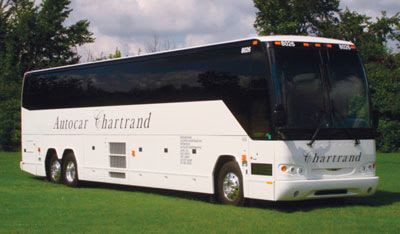
Eric Chartrand, president/owner of Autocar Chartrand in Quebec, does all he can to help the environment, while maintaining the quality of his fleet, to keep ahead of the area’s stiff competition.
Chartrand recently purchased six 2009 Prevost H3-45 motorcoaches featuring the Volvo D 13 engine, thus replacing his entire motorcoach fleet with new, cleaner vehicles. “The big reason we made the decision to purchase new buses was quality,” explains Chartrand. “It’s easier to give good service with brand new buses. It may cost more, but in the end everybody is happy.”
Chartrand adds that the new engines have improved fuel consumption and the switch has helped the operation maintain a more streamlined stockroom.
“It helps us to only have to worry about the basics, such as oil changes and things of that nature, so we don’t have to house a lot of parts” he says of getting new coaches. By Quebec law, all heavy vehicles have to pass a “mechanical verification” test every six months, and, as a testing facility and motorcoach operator, the operation is expected to stay ahead of the curve.
“If we do a mechanical verification for a competitor, our fleet has to be better than theirs,” says Chartrand. “It keeps us on top of things.” Calling his operation the “greenest company in Quebec,” Chartrand also has a new, cleaner fleet of school buses, which earn him tax breaks, and runs a testing facility that is similar to the smog check system used in the U.S.
“Just like you do in the U.S., Canada wants to have clean air,” he says. “Everybody has to do their part to enjoy that, and these are the things we do to help.”
With business doing well at the moment despite the stiff competition, the operation does not advertise, earning most of its business from return customers or by word-of-mouth. Therefore, Chartrand believes that his operations’ biggest obstacles are staying competitive when rivals begin lowering their prices, the value of the Canadian dollar compared to the U.S. dollar and fuel costs.
“The change of the value of our dollar is sometimes difficult when we are trying to purchase or sell something in the U.S., or when we are doing things like making hotel reservations for trips,” he says. “Sometimes we win, but sometimes we lose and it costs a lot more money.”
As far as competing, Chartrand says that his experienced drivers — some around as long as 20 years — and brand new coaches help him sell a quality service instead of one that is just cheap. To help keep pricing both competitive and profitable, and to help offset escalating fuel prices, Chartrand and his staff review their prices every six months, adjusting accordingly depending on the cost of fuel.
The operation’s biggest challenge down the road, Chartrand believes, will be in turning the fleet around so that he can keep his coaches no older than 2.5 years old. “We always want to keep our buses new so that we can continue operating at a high quality,” he says. “Figuring out how we can consistently do that will be a difficult task.”
MOTORCOACHES: 6
FLEET MIX: Prevost H3-45s
EMPLOYEES: 180
DRIVERS: 150
SERVICE AREA: Canada, U.S.
SERVICES OFFERED: charter, school bus, paratransit
YEAR STARTED: 1986
AVERAGE ANNUAL MILEAGE: 750,000
PRESIDENT: Eric Chartrand
More Management

LIT Marks 10-Year Milestone at Annual Summit
Hosted by the COTA from September 10 to 13, the Summit carried the theme “Celebrating 10 Years of Excellence, Leadership, and Impact,” with every part of the program honoring the people, agencies, and partners who built LIT over its first decade.
Read More →
People Movement: Dan Dipert Coaches Adds Third-Generation Leader, Keolis Names New Valley Metro VP/GM, and More
In this edition, we also cover recent appointments and announcements at the Wabtec, SilverRide, HNTB, and more, showcasing the individuals helping to shape the future of transportation.
Read More →
METRO Opens Submissions for 2026 Motorcoach Awards
Nominations are now being accepted for METRO Magazine’s Operator of the Year and Innovative Operator of the Year awards.
Read More →

New York MTA Advances Final Contract for Second Avenue Subway Expansion
Contract Four is the largest in the Second Avenue Subway Phase 2 project and includes construction of station infrastructure, tracks, and signals for the subway expansion, MTA officials said. Work on Contract Four will begin in 2027.
Read More →
Transit Agencies Highlight Safety Gains at National Summit
Leaders from 15 major transit systems shared crime-reduction results and safety initiatives while discussing the role of continued federal support.
Read More →
NITA Names New Leadership, Expands Reduced-Fare Program at First Board Meeting
The new regional transit authority appointed its first board chair and interim executive director while extending reduced fares across CTA, Metra, and Pace for eligible riders.
Read More →
Beyond the Checklist: A Structured Approach to Transit Maintenance
Reliability-Centered Maintenance helps transit agencies move beyond routine checklists to focus limited resources on the assets and failures that have the greatest impact on safety, reliability, and service.
Read More →
APTA 2026 Nominating Committee Selects Leadership Slate, Names Chair and Vice Chair Nominees
Leadership changes will help shape the association’s priorities and its representation of the transportation industry during the 2026–2027 term.
Read More →
DART Launches Major Security, Fare Enforcement Initiative
The 90-day demonstration will deploy coordinated security teams at five light rail stations while testing controlled access and gathering data to guide future investments.
Read More →
Advancing Fare Collection Through Technology and Innovation
Learn about delivering 1300 gates at 91 stations while managing fare evasion. Explore the large scale deployment, solution customization and real-world results that affect the region. Prepare for deployment in your region now.
Read More →