



It’s too early to define a distinct BRT strategy
After several years of moving in fits and starts, bus rapid transit is beginning to generate some momentum — well, if not momentum, at least serious discussion.
After several years of moving in fits and starts, bus rapid transit (BRT) is beginning to generate some momentum — well, if not momentum, at least serious discussion. The Federal Transit Administration (FTA), to its credit, is facilitating lively debate about the future of BRT through a series of workshops around the U.S. These workshops bring together representatives of transit agencies, bus manufacturers, consultants and various other interested parties — all of whom seem to have divergent opinions about how BRT should be perceived, categorized, tested, funded and implemented. In Los Angeles, a two-day workshop generated much energetic discussion about the beguiling potential of BRT and the difficulty in defining exactly what it is or, more precisely, what it can and should be. Therein lies the problem. How does BRT fit into the continuum of transit applications? Is it bus service or light rail on rubber tires? What types of vehicles and propulsion systems should be used? How about fixed guideways? Sexy or merely practical? One size doesn’t fit all Still more concept than reality, at least in the U.S., BRT is best viewed as a wide range of possibilities and opportunities. We don’t have enough facts yet to commit to a single type of vehicle, propulsion system, guideway, fare collection system, station and so on. Every transit community will have its own unique needs and potential for BRT. Forcing a single vision of BRT onto a myriad of communities will most likely fail. In Los Angeles, the MetroRapid service exemplifies a service fitting the needs of the community. It has been widely successful, operating more as an upgraded fixed-route service than as a rail-like application with experimental vehicles and expensive infrastructure development. According to Roger Snoble, CEO of the Los Angeles County Metropolitan Transit Authority, MetroRapid is 25% faster than fixed-route service and could be even more efficient with signal coordination and dedicated lanes. “We’re trying to match the right tools to the right job,” he says. That’s exactly the point. BRT, like fixed-route or demand-response bus service, is a tool. It needs to be matched to the task, which in this case is filling a niche that exists in many communities for high-capacity transportation that can service corridors that don’t support light rail service. The federal government validated the cost effectiveness of BRT in its September 2001 GAO report, “Bus Rapid Transit Shows Promise.” The key to successful implementation will be to meet the needs of communities, both in identifying routes that support the BRT concept and in delivering an express service that will be reliable, efficient and, yes, a little sexier than traditional fixed-route bus service. Start with a clean slate It’s too early to rule out any BRT scenarios. Small and large steps are being taken. Los Angeles has a low-cost, practical version of BRT; Las Vegas is planning a showier, more expensive program using the CIVIS. Other BRT programs are in development at transit agencies across the country. Years from now, a standard BRT vehicle may emerge that will simplify the design and engineering process for bus manufacturers, but until then, transit agencies need to work with the supplier community to create efficient and practical BRT programs that, most importantly, attract riders, improve service and also set the stage for upgraded technologies.
More Management
People Movement: Connectpoint Expands Leadership Team, Stadler Names New Group CEO, and More
In this edition, we also spotlight recent personnel moves at Burns, UZURV, and more, highlighting the people taking on new roles across the transportation industry.
Read More →
More Than a Summer Job: Building the Next Generation of Transit Talent
The Delaware River Port Authority and PATCO have transformed their internship program into a hands-on professional development experience that introduces students to the breadth of transportation careers — and creates a pipeline for future employees.
Read More →
LA Metro Board Awards 220 Battery-Electric Bus Contract to ENC
The contract, which is the largest base award of battery-electric buses by a U.S. transit agency, will be built in Southern California, sustaining good jobs as LA prepares to welcome the world in 2028
Read More →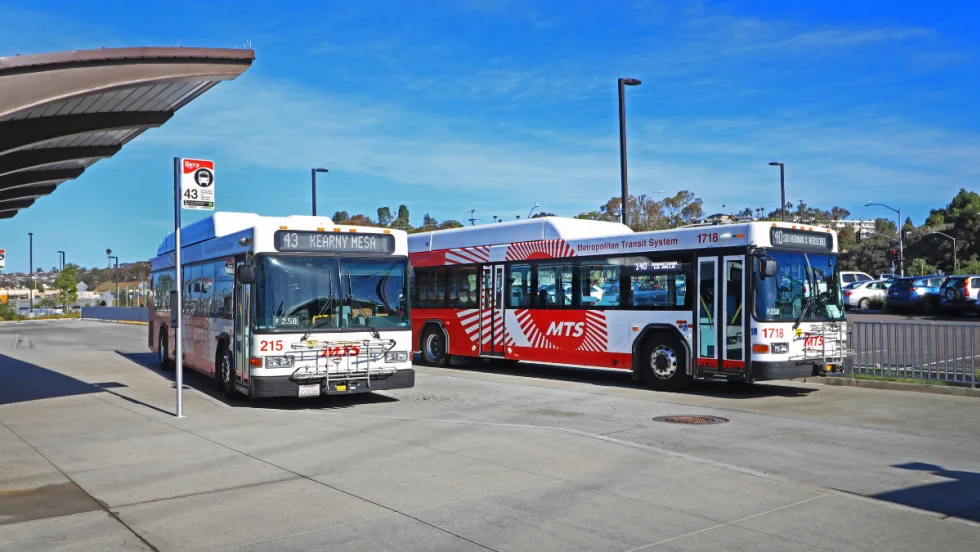
What’s Behind San Diego MTS’s Award-Winning Transit Strategy
Named one of APTA’s 2026 Outstanding Public Transportation Systems with 50 million or more annual passenger trips, California’s San Diego Metropolitan Transit System points to gains in ridership, safety, technology, and reliability as foundations of its success.
Read More →
Public Transit Conference Returning to GFX in 2027, Call for Papers Now Open
The Call for Papers is now open, allowing transit agency professionals and industry experts to help shape the PTC educational program by submitting session ideas for consideration.
Read More →
Indian River Transit’s Community-Focused Approach Earns National Recognition
Named APTA’s 2026 Outstanding Public Transportation System in its size category, Florida’s Indian River County transit system continues to grow ridership through fare-free service and a focus on evolving community needs.
Read More →
ENC Lands MATA Contract and More in Biz Briefs
In this edition of Biz Briefs, we spotlight the latest developments shaping the future of mobility.
Read More →
From Surviving to Thriving: Building Stronger Transportation Organizations
Bus Business Consultants founder Brian Dickson shares lessons on leadership, organizational health, and creating options for long-term success in a changing transportation industry.
Read More →
Everett Transit, Community Transit Outline Consolidation Agreement
The proposed agreement calls for a 50% increase in bus service in Everett, a new microtransit zone, continued paratransit service, and the transfer of Everett Transit operations to Community Transit.
Read More →
Strada360’s Steve Lassey on Turning Transit Data Into Better Decisions
From breaking down data silos to preparing for AI, Strada360 CEO Steve Lassey discusses how transit agencies can use technology to improve operations, customer information, and long-term decision-making.
Read More →