



K.C. Gears Up for BRT
After twice failing to win voter approval for light rail projects, the Kansas City Area Transportation Authority has embraced bus rapid transit as its linchpin service enhancement.
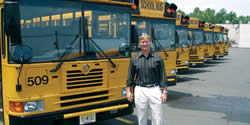
The Kansas City Area Transportation Authority (KCATA) was scheduled to introduce revenue service of its new bus rapid transit (BRT) service, called MAX, on July 24 — marking a key shift in the system’s outlook on improving transportation.
For many years, light rail was the mode of choice, but two ballot initiatives — the latest in 2001 — failed to win over the pocketbooks of voters and effectively ended the Missouri city’s bid for a rail system.
After the setback in 2001, KCATA General Manager Mark Huffer said the transit system regrouped and took an honest look at its transportation options.
“What we kept hearing from the community was that it wanted improved transit, but wasn’t looking for a $1 billion project to get there,” Huffer says. After meeting with local stakeholders, KCATA officials decided that BRT would satisfy many of the community’s transportation needs at a relatively low cost.
“It was met with strong support,” Huffer says. “Sen. Kit Bond helped secure the funds for it, and we’ve been in the planning and construction phase ever since.” The BRT project was funded with $21 million. Approximately $16.8 million was provided by the federal government and $4.2 million was contributed by local sources.
High hopes for BRT
Although the opening of the MAX won’t draw the fanfare typical of a rail system unveiling, Huffer says the community is excited about the project. “It’s unquestionably the most significant investment we’ve made in the region to improve public transit in 20 years,” he says. “We think it’s going to be highly marketable, very distinguishable on the street and operate with such frequency that it will be attractive to residents and visitors.”
The marketability of the MAX is buttressed by the smart styling of the vehicles and the construction of distinctive metal-and-glass “stations” that include a 17-foot-tall marker that can be seen from blocks away and is illuminated in the evenings.
“These shelters give the customer a sense of place, origin and security,” Huffer says. “They have the MAX logo and provide real-time information on the arrival time of the next bus. They also have individual names, like rail stations.”
Distinctive new buses
The buses are equally striking. “We were looking for a bus that had a styling impact that would catch the public’s eye,” Huffer says. To that end, the buses have a strong contemporary design that includes a large, one-piece windshield. “They also have the best-looking paint scheme in the country,” he says proudly.
In addition to their appealing exterior, the 40-passenger buses were designed with interior enhancements such as a raised seating platform on one side to provide customers with a better window view and a special lighting package.
Gillig Corp. manufactured and delivered 12 MAX buses to KCATA. The vehicles are based on Gillig’s 40-foot low-floor model, the most common vehicle in KCATA’s fleet. The agency worked closely with Gillig engineers on the design. “We worked off an existing platform that we were familiar with and essentially designed the body from scratch,” Huffer says. “It was a fun project.”
Brian Macleod, senior vice president at Gillig, says the excellent working relationship his company has with KCATA contributed to the project’s success.
“They were demanding but reasonable, and Mark was understanding and fair, but kept us focused, and on budget, and on track,” Macleod says. “I couldn’t be happier about the way the project turned out.”
A quick turnaround
Macleod says the buses were designed and built in 16 months, but adds that Gillig has been working on its BRT program for much longer. “We started studying the BRT concept about six years ago and even explored a European partnership in 2000, but discovered that the U.S. market was not quite ready,” Macleod says. “So, about three years later, in early 2003, we started our BRT design program, and almost a year later, in January 2004, we began working with KCATA on its specific program, which concluded with delivery of the buses in May.”
Versions of KCATA’s BRT vehicles are being built by Gillig for other transit systems. “We even did some buses for Steve Wynn’s new resort in Las Vegas, and he’s legendary about getting things exactly right,” Macleod says.
Although the agency considered powering the buses with hybrid diesel-electric propulsion, it eventually chose clean diesel engines. “We looked at hybrid technology and were intrigued by it, but when we first began the project, we were concerned that the technology wasn’t proven enough,” Huffer says.
Key system details
The 7-mile BRT system in Kansas City will run primarily along the city’s Main Street corridor and will feature 21 stops.
Because they’ll be running along arterial streets, the buses won’t have dedicated lanes. But Huffer says Kansas City officials have upgraded the traffic signal controller system to give the BRT buses more time to get through green lights.
The availability of real-time bus arrival information at the bus stations is another key feature of the system. “An 11-minute wait when you know it’s an 11-minute wait is a lot different than when you walk into a bus station and don’t know if the bus just came or if it’s coming at all,” Huffer says.
The system will be operating seven days a week, from 5 a.m. to 1 a.m. During rush hour, the frequency will be 9 minutes. On weekends, it shifts to 15 minutes on Saturday and 30 minutes on Sunday. The fare will be $1.
More Management

ENC Lands MATA Contract and More in Biz Briefs
In this edition of Biz Briefs, we spotlight the latest developments shaping the future of mobility.
Read More →
From Surviving to Thriving: Building Stronger Transportation Organizations
Bus Business Consultants founder Brian Dickson shares lessons on leadership, organizational health, and creating options for long-term success in a changing transportation industry.
Read More →
Everett Transit, Community Transit Outline Consolidation Agreement
The proposed agreement calls for a 50% increase in bus service in Everett, a new microtransit zone, continued paratransit service, and the transfer of Everett Transit operations to Community Transit.
Read More →

Strada360’s Steve Lassey on Turning Transit Data Into Better Decisions
From breaking down data silos to preparing for AI, Strada360 CEO Steve Lassey discusses how transit agencies can use technology to improve operations, customer information, and long-term decision-making.
Read More →
People Movement: Phil Washington Joins HNTB, Denver RTD Launches CEO Search, and More
In this edition, we also spotlight recent personnel moves at STV, the Eno Center for Transportation, and more, highlighting the people taking on new roles across the transportation industry.
Read More →
SEPTA Details Accelerate Vision for Transit System
The plan outlines investments in trolley modernization, new Metro and Regional Rail vehicles, accessible stations, and more frequent bus and rail service.
Read More →
FTA Ends Direct Oversight of MBTA Safety Actions
The federal agency closed its remaining special directive to the Massachusetts Department of Public Utilities following a safety review that began in 2022.
Read More →
Report: Transit Bus Manufacturing Supports 34,100 Jobs, $5.1B in GDP
The “Buses Mean Business” report examines the transit bus manufacturing industry’s economic footprint, supply chain, and rising demand for vehicle replacements.
Read More →
LIT Marks 10-Year Milestone at Annual Summit
Hosted by the COTA from September 10 to 13, the Summit carried the theme “Celebrating 10 Years of Excellence, Leadership, and Impact,” with every part of the program honoring the people, agencies, and partners who built LIT over its first decade.
Read More →
People Movement: Dan Dipert Coaches Adds Third-Generation Leader, Keolis Names New Valley Metro VP/GM, and More
In this edition, we also cover recent appointments and announcements at the Wabtec, SilverRide, HNTB, and more, showcasing the individuals helping to shape the future of transportation.
Read More →