




An Eye For It: Benteler, Beep and Mobileye Partner to Deploy Autonomous People Movers
LA Metro, Rosco Pilot Improves Operator Safety
The project is one of the winners of 2022's Innovative Solutions Awards in the category of Safety.
October 10, 2022
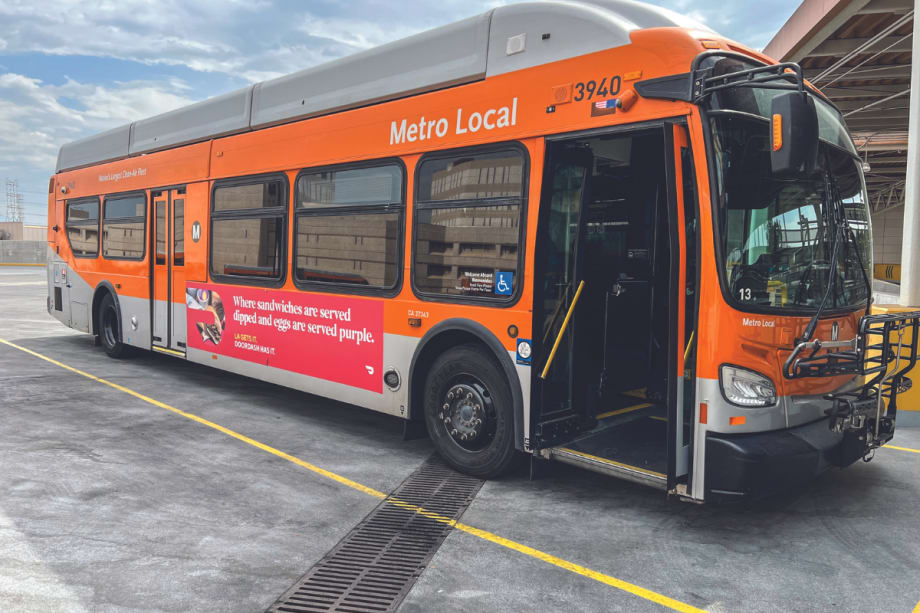
As part of an FTA-funded project to study the feasibility of commercially available collision avoidance systems on transit buses, LA Metro installed the Mobileye Shield+ system on 50 buses in the middle of 2021.
Photo: LA Metro
5 min to read
In 2016, Mobileye and Rosco won the Innovative Solutions award along with Wash.’s Pierce Transit for the Mobileye Shield+ Collision Avoidance System — a multi-camera solution designed for long vehicles, including buses, as an Advanced Driver Assistance System (ADAS) to help prevent collisions with other vehicles and Vulnerable Road Users (VRUs) such as pedestrians and cyclists.
Shield+ increases awareness for drivers, while keeping passengers and VRUs safe on the streets. The system includes smart cameras and driver alert displays to warn drivers, audibly and visibly, when the bus is on an imminent collision with another vehicle or VRU.
Fast forward to today and the Mobileye Shield+ technology has been improved to also detect in low light/night environments. Nighttime driving brings on an even bigger challenge to the bus operator with less visibility. The problem was recognized and the Shield+ technology has been improved, so the smart cameras can now detect pedestrians and cyclists in low light conditions, offering crucial assistance to drivers when needed most.
Along with this new innovation, the Mobileye Shield+ System can now connect to an external intelligent pedestrian audio alert called the Advanced Pedestrian Assistance System (APAS). The intelligent external alert system will send an audible alert to VRUs around the bus to ensure they are aware of the bus, only when Shield+ detects an imminent collision between the vehicle and a VRU. This “intelligent” or smart technology alert reduces noise pollution and helps prevent VRUs from “tuning out” excessive alerts.
“The innovation of any product or technology always starts with a problem. Identify the problem — create a solution,” says Amy Ahn, director, marketing & digital engagement, for Rosco. “The new, innovative Mobileye Shield+ V4 has been upgraded to use the EyeQ4 chip, which replaces the EyeQ2 chip, and allows collision detection at night.”
As part of an FTA-funded project to study the feasibility of commercially available collision avoidance systems on transit buses, LA Metro installed the Mobileye Shield+ system on 50 buses in the middle of 2021.
“LA Metro is continuously investigating and testing new technology solutions that will enhance the safety of our passenger and operation, as well as provide our operators with better tools to perform their job safely,” explains Daniel Surmenian, sr. engineer, vehicle engineering & acquisition, at L.A. Metro. “It was a great opportunity to test this system with the FTA and consultants, and we look forward to more opportunities like this that will move technology forward.”
The agency ran the buses in “stealth” mode — meaning the technology was installed and detecting alerts/warnings, but not giving the drivers actual alerts on the displays. The tech was ran in stealth mode to gather information on driving behaviors of the operators to use as the “before Shield+” data points.
At the start of 2022, Rosco and L.A. Metro went into “active” mode so drivers would receive visible and audible alerts from the Mobileye Shield+ system, if they were on a collision course with another vehicle or VRU. Using the data gathered in stealth mode and the data gathered in active mode, the collective team was able to measure the improvements in driving behavior among the operators.
Some key improvement areas included:
Headway Monitoring Warning (HMW) – HMW alerts the driver when the distance between the bus and vehicle in front has fallen below a safe threshold. HMW alerts declined by more than 21% between “stealth” and “active” mode.
Forward Collision Warning (FCW) – FCW alerts the driver when the system detects an imminent collision with a vehicle ahead. The system issues an alert up to three seconds before a collision, allowing time to react. The FCW alert is based on the calculation of the Time to Collision (TTC) with the vehicle ahead, taking into account the distance from it and the relative traveling speed. FCW alerts declined by more than 28% between “stealth” and “active” mode.
Pedestrian & Cyclist Detection (PDZ) – PDZ alerts the driver that a pedestrian or cyclist has been detected near the front of the bus. The is only a visual alert that lets the driver know to exercise additional caution until verifying the danger of collision as passed. PDZ alerts declined by more than 20% between “stealth” and “active” mode.
Pedestrian & Cyclist Detection Left Rear (PDZLR) – PDZLR alerts the driver that a pedestrian or cyclist has been detected near along the left rear of the bus. The visual alert lets the driver know to exercise additional caution until verifying the danger of collision has passed. PDZLR alerts declined by more than 6% between “stealth” and “active” mode.
Pedestrian & Cyclist Detection Right Rear (PDZRR) – PDZRR alerts the driver that a pedestrian or cyclist has been detected near along the right rear of the bus. The visual alert lets the driver know to exercise additional caution until verifying the danger of collision has passed. PDZRR alerts declined by more than 30% between “stealth” and “active” mode.
Pedestrian & Cyclist Collision Warning (PCW) – PCW alerts the driver before an imminent collision with a pedestrian or cyclist in front of the bus, allowing the driver time to react. The TTC is calculated and when it drops below two seconds, a PCW is generated. PCW alerts declined by more than 17% between “stealth” and “active” mode.
Pedestrian & Cyclist Collision Warning Left Rear (PCWLR) – PCWLR alerts the driver before an imminent collision with a pedestrian or cyclist alongside the left of the bus, allowing the driver time to react. This alert is especially important during a left turn. PCWLR alerts declined by more than 17% between “stealth” and “active” mode.
Pedestrian & Cyclist Collision Warning Right Rear (PCWRR) – PCWRR alerts the driver before an imminent collision with a pedestrian or cyclist alongside the right of the bus, allowing the driver time to react. This alert is especially important during a right turn. PCWRR alerts declined by more than 39% between “stealth” and “active” mode.
“Operator surveys were conducted before and after installation of the system. Overall, the operators found the system to be beneficial and helpful,” says Surmenian. “The left/right side pedestrian warning light seemed to be the most valuable, according to our operators.”
Subscribe to Our Newsletter
More Technology

From Hardware to Digital Partner: Luminator Charts Its Next Chapter
CEO Magnus Friberg discusses Luminator’s shift toward becoming a digital partner, the growing importance of software and interoperability, and how AI can help agencies improve operations and passenger experience.
Read More →
Beyond the Checklist: A Structured Approach to Transit Maintenance
Reliability-Centered Maintenance helps transit agencies move beyond routine checklists to focus limited resources on the assets and failures that have the greatest impact on safety, reliability, and service.
Read More →
NJ TRANSIT Advances Bus Technology Upgrades Across Statewide Fleet
More than 1,500 buses now feature upgraded technology designed to improve arrival predictions and provide free Wi-Fi, with deployment expected to reach nearly 2,000 buses by the end of 2026.
Read More →

Building a Flexible Path to Transit Electrification
John Hroncich discusses BAE Systems’ modular and scalable approach, lessons learned from decades of real-world operations, and how agencies can identify electrification strategies that fit their fleets.
Read More →
Biz Briefs: Alstom Lands Canadian Contract, LYT to Supply California TSP, and More
In METRO's latest installment, we take a look at recent news from Complete Coach Works, Beep, FlixBus, and more partnerships making headlines across the transportation sector.
Read More →
Sponsored•September 8, 2026
From Legacy Silos to Conversational Intelligence
What if transit leaders could ask any operational question and get a trusted answer in seconds? Conversational AI is transforming how agencies use their data.
Read More →
USDOT Announces Rail Vehicle Replacement Grants, Chattanooga AV Shuttle Funding
More than $191 million in federal funding will help three transit agencies replace aging rail vehicles and support a new autonomous shuttle service in Chattanooga.
Read More →
Bus Tech Talk: Keeping Transit Technicians Ahead of the Technology Curve
LA Metro’s Obed Mejia discusses technician training, evolving maintenance technology, fleet replacement, and strategies for getting the most out of today’s transit fleets.
Read More →
Biz Briefs: RIPTA Unveils New Frontrunners, Clevland RTA Adds New Siemens, and More
In METRO's latest installment, we take a look at recent news from Siemens, Prevost, Dodge, and more partnerships making headlines across the transportation sector.
Read More →
Why Simulating Pedestrian Movement Has Become Essential for Modern Rail Stations
Pedestrian microsimulation is helping rail planners identify bottlenecks, test station designs, and prepare complex transit hubs for growing passenger volumes.
Read More →