



Maximizing Route Efficiency with Software
With today's technology, routing software is used to create efficient schedules for dozens to hundreds of routes, factoring in numerous variables that include road conditions to union contracts.
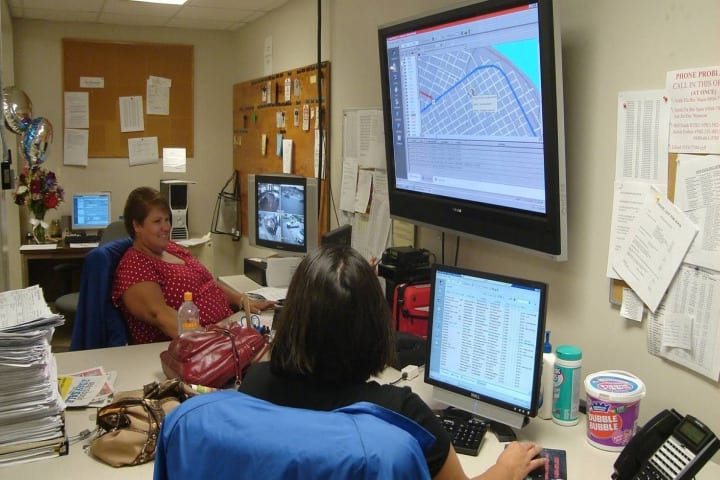
[IMAGE]MET7route-.jpg[/IMAGE]For both fixed-route and on-demand services, routing software is essential in creating efficient routes, and the right one can reduce routes and the number of vehicles needed.
Routing software is used to create efficient schedules for dozens to hundreds of routes, factoring in numerous variables that include road conditions to union contracts. Technology has taken over what in the past was a laborious project, and advances now allow dispatchers to follow, in real-time, the routes of each vehicle, ensuring more accuracy. Routing software is available for both fixed route and paratransit systems.
Fixed-route scheduling
Trapeze Group, based in Mississauga, Ontario, offers its fixed-route scheduling product, FX, which performs the usual functions of trip building, blocking trips for each vehicle, run cutting and rostering driver work.
According to Matthew Goddard, director of product development for Trapeze, the run cutting process takes into consideration many variables such as union contracted driver guarantees. "There's a lot of fine-tuning that goes into that process," he says. "You have to drive as much efficiency out of that entire schedule creation process as a whole. The blocking process, if done efficiently, can use a lesser amount of vehicles, and the more efficient you do the run cutting process, help you incur less driver expense."
The FX product integrates with other components, including planning tools, operations management, demand-response scheduling, customer information and intelligent transit technologies such as Computer-Aided Dispatch and Automated Vehicle Location (CAD/AVL).
The RouteMatch CA, for fixed-route public transit agencies, includes CAD/AVL technology, which allows the user to track vehicles in real time to see where vehicles are in relation to where they are scheduled to be. It gives the dispatcher the ability to let riders standing at the bus stop know if their bus will be early or late.
Made by Atlanta, Ga.-based RouteMatch, the software uses the RouteMatch Scheduling Engine (RSE), a GIS-based optimization engine that models real-world driving conditions. Its routes typically result in a 10 percent to 20 percent reduction in vehicle miles traveled.
The software is designed for "transit systems that want to tightly integrate all their dispatching needs into one single platform," says Tim Quinn, executive vice president of RouteMatch. He recommends the system for small-to-medium agencies running less than 50 routes.
Managing Growth
Trapeze's PASS software, for agencies of all sizes, supports multiple demand response models such as door-to-door and curb-to-curb transportation. Demand trip requests and regular subscription trip requests are input into the system and scheduled onto assigned vehicles for day runs. Scheduling is done as efficiently as possible, taking into account many variables such as vehicle capacity, relative geography, distance of travel and individual needs, including loading time for riders depending on their mobility, says Goddard.
The Orange County (Calif.) Transportation Authority (OCTA) began using Trapeze's PASS system for its paratransit services for client management, trip booking and scheduling in an effort to manage growth of both eligible and active clients. Limited funding prevented the addition of more vehicles and personnel, and OCTA wanted a cost-effective solution that could handle advance reservations, same-day emergency changes, and access to previous trip information for investigations and to measure system performance. By 2005, service had grown to 26,000 enrolled riders and 255 vehicles, servicing more than 1.1 million trips that year.
The PASS system ensures that requested trips are eligible for the service, making sure they fall within the three-quarter-mile zone around the fixed route. It also tracks eligibility on a trip-by-trip basis, letting reservationists notify the customer of any issues at the time the request is made.
OCTA later chose to add mobile computing to the system, allowing dispatchers to see itinerary and trip status on onboard computers. It also automates data collection and communication between drivers and dispatch.
The paratransit program was projected to save $1 million annually, with a return on investment after approximately two years.
[PAGEBREAK]
Scalable for Expansion
For agencies that operate both demand-response service and fixed routes, RouteMatch TS can be seamlessly integrated into the CA software to coordinate both systems using the same architecture. RouteMatch TS is a fully-automated schedule, routing and dispatching system for paratransits that also includes management features such as reporting, billing and data analysis.
"All the data, fixed route and paratransit, is integrated into a single database so that RouteMatch TS has access and knowledge of the fixed route system," says Quinn. "You can leverage that data to make better decisions for the paratransit dispatcher and vice versa."
Fixed-route data can be used to help a reservationist determine trip eligibility on the paratransit side. If a trip is requested that falls outside of the operating time of a fixed route, the reservationist will immediately know that trip is not an ADA trip.
The TS system can be used for systems of any size, and are in use by agencies running from 100 to 7,000 trips per day. RouteMatch designed the scalable product to allow smaller agencies, or those with a smaller budget, to choose basic components and purchase add-ons as the agency grows. This way, agencies do not need to pay for the features they won't use.
"As business needs change, requirements change. Your systems grow, so first you may purchase RouteMatch TS, and then you may want to add automated vehicle location technology a year from now," says Quinn. "All you do is plug in the module, and you install equipment on the vehicle."
In addition, RouteMatch clients of both products get GIS data updated annually to ensure up-to-date road conditions. The customer support department sends the data to customers, who then load it on to their server.
RouteMatch TS was chosen by the Iredell County Transit System in Statesville, N.C., in order to replace a system that was unreliable and unable to handle the agency's 160,000 trips per year. The transit system went live after three months of personnel training, achieving a 28.6 percent increase in ridership. A drop in vehicle usage from 25 to 18 led to significant fuel cost savings.
Simplifying Implementation
Trapeze also offers a NOVUS version for both its FX and PASS products. The browser-based technology works as a traditional desktop application on a central server, with other users accessing the application through the Web. It does not require installation in the workspace, simplifying implementation and maintenance. NOVUS is the 3rd and 4th generation of FX and PASS, respectively, and performs the same basic functions.
According to Goddard, training for the paratransit system typically is provided for those who take calls and reservations, dispatchers, operational managers and those who work on schedule efficiency, all of which would work with different aspects of the technology.
RouteMatch provides training on-site, and includes data conversion services and implementation services for the training program. "We're on-site with the customer then they go live, when they switch from the old platform to the RouteMatch platform," says Quinn. "We're with them...making sure it goes smooth."
Length of training period can vary widely, depending on size of the transit agency or the number of users that need to be trained. The entire training process up to implementation and going live can range from one week for very small agencies to months for larger ones.
[PAGEBREAK]
Smartmaps: Simplifies Routing Data for Riders
Smartmaps Inc., based in Knoxville, Tenn., designs and produces system-wide maps, individual route maps and timetables for more than 100 transit systems nationwide. The company gathers route and schedule information from transit agencies and designs easy-to-understand maps and schedules that are directly geared to the rider. "We believe that clarity and user-friendliness are the most important design objectives, and our goal is to create designs that virtually anyone can understand," says Kathy Hart, founder of Smartmaps.
In business for almost 20 years, Smartmaps' simplification of maps aims to promote ridership and "increase public understanding of available transportation options," says Hart.
She believes it is essential for map designers to understand the transit industry in order to know which map elements are important to emphasize. If the designer doesn't understand what is important for riders to know, they're simply laying out raw data. "It's important to selectively filter map and schedule data to effectively communicate with transit riders," says Hart.
Hart has seen an improvement in transit graphics, but worries that while graphics look better, they are still not helpful to riders planning their trips. With the large amount of data to work with, she sees an overload of information in many maps and schedules, which can cause confusion for the rider. Maps that are difficult to understand can discourage potential riders from using public transit. "Well designed maps make using public transportation easier," says Hart.
Smartmaps creates a hierarchy of information based on relevance to the rider, stressing general information, and giving less emphasis to information not needed by all riders, such as infrequent service. Smartmaps presents route information in a logical, clear format and uses clear graphic conventions such as large typefaces, universal icons and distinct route colors.
When the company designs a system map, the map base is created that includes a street grid. Routes are added, usually using five or six route colors, then rail lines and express routes. Insets for dense areas are also created. Smartmaps designs both geographic-style maps, with a street grid, and schematic-style maps, with a simplified map. Route variations such as loops, forks and detours are incorporated into the map instead of using symbols, codes or footnotes, which minimizes confusion for the rider, says Hart.
Large system maps could take months to create, but revisions can be made in hours, says Hart. Printing and display production is done in the Smartmaps facility, allowing the company to manage all processes for accuracy and quicker output.
In addition, Smartmaps repurposes its designs for use in Web graphics, bus stop signs, shelter graphics, transit center displays, and it also provides graphic design for marketing and advertising.
More Bus

New York MTA Plans Largest Bus Fleet Upgrade in More Than a Decade
The agency is seeking manufacturers for 650 new CNG buses to replace aging vehicles, improve reliability, and advance its broader fleet modernization strategy.
Read More →
Building a Flexible Path to Transit Electrification
John Hroncich discusses BAE Systems’ modular and scalable approach, lessons learned from decades of real-world operations, and how agencies can identify electrification strategies that fit their fleets.
Read More →
Bus Tech Talk: Keeping Transit Technicians Ahead of the Technology Curve
LA Metro’s Obed Mejia discusses technician training, evolving maintenance technology, fleet replacement, and strategies for getting the most out of today’s transit fleets.
Read More →
Biz Briefs: RIPTA Unveils New Frontrunners, Clevland RTA Adds New Siemens, and More
In METRO's latest installment, we take a look at recent news from Siemens, Prevost, Dodge, and more partnerships making headlines across the transportation sector.
Read More →
People Movement: Holly Arnold Joins Transdev and More
In this edition, we also cover recent appointments and announcements at Pace, CamTran, MCI, and more, showcasing the individuals helping to shape the future of transportation.
Read More →
The High Cost of Transit Buses: Industry Leaders Look to Procurement Reform
Transit leaders and policymakers examine how standardized bus designs, streamlined procurement, and predictable funding could help agencies stretch budgets and deliver better service.
Read More →
The Business Voice Behind Public Transportation
As chair of APTA’s Business Members Board of Governors, Ray Melleady explains how more than 850 business members are partnering with transit agencies to advance funding, innovation, and industry-wide collaboration.
Read More →
From Surviving to Thriving: Building Stronger Transportation Organizations
Bus Business Consultants founder Brian Dickson shares lessons on leadership, organizational health, and creating options for long-term success in a changing transportation industry.
Read More →
Finding the ‘Happy Medium’: Optimizing Maintenance Without Sacrificing Reliability
The key to maintenance optimization isn’t doing less work—it’s doing the right work at the right time on the right assets.
Read More →
LA Metro, City of West Hollywood, and Partners Advance Smarter Bus Lane Enforcement
The award-winning partnership combines AI-powered detection with human oversight to improve bus reliability, accessibility, and enforcement efficiency.
Read More →