



Mich. operator adds 'hearing loop' tech
The Michigan Department of Transportation (MDOT) and Owosso, Mich., motorcoach operator Indian Trails Inc. partnered to install “hearing loop” technology on a fleet of 17 motorcoaches, operating 34 scheduled routes that serve passengers throughout Michigan.

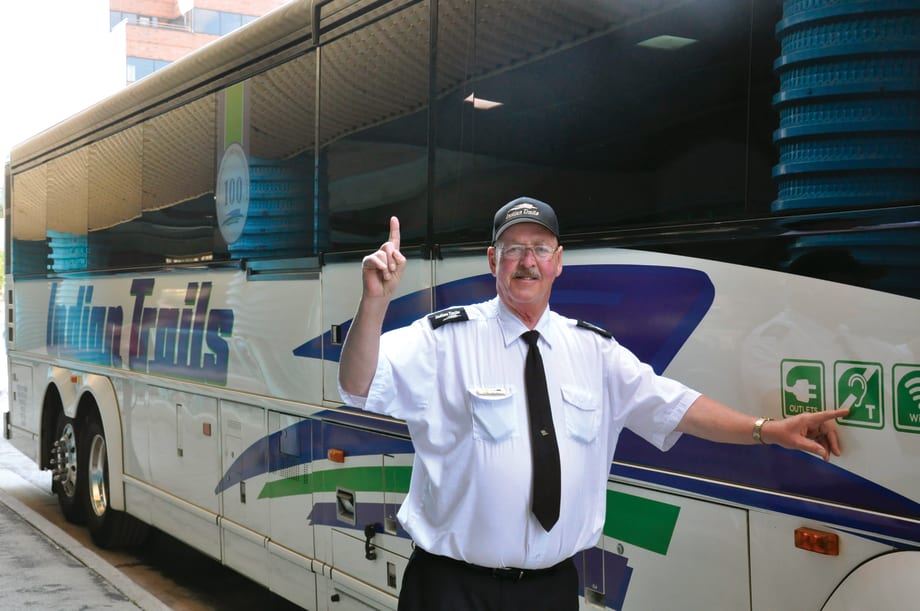
The Michigan Department of Transportation (MDOT) and Owosso, Mich., motorcoach operator Indian Trails Inc. partnered to install “hearing loop” technology on a fleet of 17 motorcoaches, operating 34 scheduled routes that serve passengers throughout Michigan.
“I’m quite sure this is the first American bus line with hearing loops,” said David G. Myers, a professor of psychology at Hope College in Holland, Mich., who has hearing loss and is one of the nation’s foremost advocates for hearing loops, according to Indian Trails.
Hearing loops are important to nearly 1.4 million Michigan residents who currently have hearing loss, a number that is expected to double in 10 years. About 11% of the general population has significant hearing loss, and one-third of people are 65 and older.
Hearing loops are based on technology that enables hearing aids equipped with “telecoils,” or “T-coils,” which are tiny coils of copper wire, to amplify a single source of sound (telephone, television, PA system, etc.) instead of all sounds, as ordinary hearing aids do. Nearly 70% of hearing aids in the U.S. are already equipped with T-coils.
The hearing loop is a wire that runs around a space, such as a bus interior or auditorium, and is attached to the sound source. The hearing loop transmits those sounds to the telecoil in a hearing aid electromagnetically, while surrounding noises are screened out.
Jeffrey Deason, sales director, Indian Trails, heard about the hearing loops from National Public Radio’s “Science Friday” program. “It turns out Western Michigan is a hotbed for this technology,” he said.
“Because hearing aids work far better when a hearing loop is available, and hearing loops are common in Great Britain, Scandinavia, Australia and New Zealand, I’m often asked why more of them haven’t been installed in the U.S.,” said Myers. “Our federal disability laws require most public facilities with 50 or more seats to provide unspecified assistive listening devices, which they tend to do by letting visitors borrow earphones and pocket–size receivers that tune into FM broadcast signals or infrared waves.”
Deason added that since his father suffers from hearing loss, he thought about putting the technology on buses, allowing hearing impaired passengers to enjoy their trips more.
Holland, Mich.-based Hearing Loop Systems and Contacta Inc. assisted with the custom design and engineering of the loop systems about a year and a half ago. The company taught Indian Trails’ maintenance crew how to install the technology so it could save money by installing it on the rest of its vehicles.
The technology costs about $800 per bus for parts and slightly more for installation, Deason said.
MDOT installed hearing loops on a pilot basis at two of its bus stations about three months ago.
“We’ve heard only positive comments from customers since the technology has been installed,” Rob Pearson, analyst, MDOT Office of Passenger Transportation, said. “We’ll continue to monitor the new system. MDOT shares a commitment with Indian Trails to making public transportation more accessible and safer for people with hearing loss.”
Indian Trails operates, under a contract with MDOT, subsidized fixed routes in rural Michigan and other routes with MDOT’s equipment. MDOT was able to use state funds to purchase the equipment and the operator covered the installation cost, Chad Cushman, VP, Indian Trails, said.
Indian Trails designated coaches specifically for facilities with hearing-impaired customers and asked riders for feedback.
“They really enjoyed being able to listen to the tour guide explain what they were seeing,” Deason said.
In the upcoming year, assuming everything goes well with the long-term application on the fixed route, Cushman says, Indian Trails will consider installing hearing loops on its charter coaches as well.
More Motorcoach

People Movement: Dan Dipert Coaches Adds Third-Generation Leader, Keolis Names New Valley Metro VP/GM, and More
In this edition, we also cover recent appointments and announcements at the Wabtec, SilverRide, HNTB, and more, showcasing the individuals helping to shape the future of transportation.
Read More →
METRO Opens Submissions for 2026 Motorcoach Awards
Nominations are now being accepted for METRO Magazine’s Operator of the Year and Innovative Operator of the Year awards.
Read More →
Biz Briefs: Alstom Lands Canadian Contract, LYT to Supply California TSP, and More
In METRO's latest installment, we take a look at recent news from Complete Coach Works, Beep, FlixBus, and more partnerships making headlines across the transportation sector.
Read More →
Biz Briefs: RIPTA Unveils New Frontrunners, Clevland RTA Adds New Siemens, and More
In METRO's latest installment, we take a look at recent news from Siemens, Prevost, Dodge, and more partnerships making headlines across the transportation sector.
Read More →
People Movement: Holly Arnold Joins Transdev and More
In this edition, we also cover recent appointments and announcements at Pace, CamTran, MCI, and more, showcasing the individuals helping to shape the future of transportation.
Read More →
ABA Report: Motorcoach Travel Generates $161.6B Economic Impact
The 2025 analysis finds motorcoach travel supported nearly 900,000 jobs and generated $28 billion in federal, state, and local taxes.
Read More →
CharterUP’s Armir Harris on Technology, AI, and the Future of Group Mobility
In a recent episode of METROspectives, CharterUP Founder/CEO Armir Harris discussed the company’s evolution from an online charter bus marketplace into a technology platform supporting public- and private-sector mobility and much more.
Read More →
People Movement: ABC Names John Walsh as Chief Commercial Officer
In this edition, METRO also covers recent appointments and announcements at the DART, STV, and more, showcasing the individuals helping to shape the future of transportation.
Read More →
From Surviving to Thriving: Building Stronger Transportation Organizations
Bus Business Consultants founder Brian Dickson shares lessons on leadership, organizational health, and creating options for long-term success in a changing transportation industry.
Read More →
Biz Briefs: Luminator Marks Milestone and More
From manufacturers and suppliers to transit agencies and motorcoach operators, these updates offer a snapshot of the projects, partnerships and business moves driving the industry forward.
Read More →