



MJ Maynard Talks Advocacy, Mentorship, and the Future of Transit
In October, MJ Maynard-Carey, CEO of the Regional Transportation Commission of Southern Nevada in Las Vegas, handed over the gavel to Leanne Redden, the incoming chair of APTA.

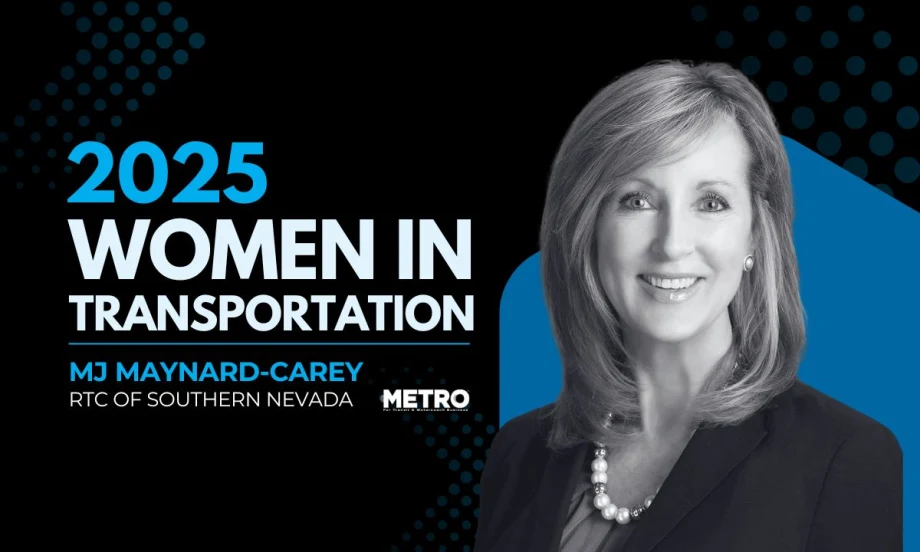
Before joining the RTC of Southern Nevada, MJ Maynard spent several years in the hospitality and gaming industries, including as VP at the then-new Hard Rock Hotel & Casino in Las Vegas.
Photo: RTC of Southern Nevada/METRO
- MJ Maynard-Carey stepped down as chair of APTA, passing the role to Leanne Redden.
- MJ Maynard-Carey serves as CEO of the Regional Transportation Commission of Southern Nevada.
- The leadership transition occurred in October, marking a new chapter for APTA.
*Summarized by AI
In October, MJ Maynard-Carey, CEO of the Regional Transportation Commission of Southern Nevada in Las Vegas, handed over the gavel to Leanne Redden, the incoming chair of the American Public Transportation Association, after a year defined by collaboration, storytelling, and a shared commitment to elevating transit’s value across every community.
“It’s really not about me — it’s about the organization and the industry itself,” Maynard-Carey reflected. “I’ve come to appreciate that we’re stronger together. The APTA staff is a top-notch, professional team, and the same can be said for the executive committee and the board of directors. Whether you’re a CEO from a rural system or a major agency like New York or Chicago, we all share the same focus — ensuring APTA is advocating for funding and that we’re working collaboratively.”
Throughout her term as APTA chair and her time on the board of directors, Maynard-Carey has pushed the industry to sharpen its message and tell a story that connects transit not just to mobility but also to economic vitality, public health, and community well-being.
“If we aren’t telling our story, that means somebody else is going to tell it for us,” she said. “I don’t think we’ve done a good enough job as an industry of explaining how essential transit is to every community. We are part of the economic ecosystem, and every single day, we connect millions of employees to employers.”
Maynard-Carey’s initiative to update APTA’s Economic Impact of Public Transportation Investment report is part of that effort.
“It hadn’t been refreshed since 2020,” she said. “It needed to be written in a way that resonates across every community, not just about saving money on gas or insurance, but about accessibility, opportunity, and quality of life.”
Collaboration and Federal Advocacy
During her tenure as chair and now as immediate past chair of APTA, Maynard-Carey has emphasized the importance of working closely with the industry’s federal partners, including the Federal Transit Administration.
She has personally engaged with the agency’s leadership, focusing on key priorities for transit agencies nationwide.
“I’ve had a chance to speak with the new FTA Administrator, Marc Molinaro, and his team, and they made it very clear that they want transit to focus on three things — safety and security of our systems, cleanliness, and efficiency,” she said. “We’re putting together a task force to do just that.”
Maynard-Carey added that funding remains a perennial challenge facing the industry.
“In an industry that doesn’t make a profit, funding is always difficult, and inflation has only made it harder. Some systems are cutting service, so our ability to communicate those realities to the FTA — around safety, cleanliness, and fare collection — is critical,” she said.

Throughout her term as APTA chair and her time on the board of directors, MJ Maynard-Carey has pushed the industry to sharpen its message and tell a story that connects transit not just to mobility but also to economic vitality, public health, and community well-being.
Photo: RTC of Southern Nevada
A Changing Industry
Supposing a silver lining could be found in the COVID pandemic, Maynard-Carey believes that it changed the way people view public transit, seeing it now as a lifeline for their communities that continued to operate even during trying times.
“I think people saw the value of transit during COVID more than ever before,” she said. “Even if you’ll never get on a bus or train, you rely on someone who does. The person serving you at your favorite restaurant or the nurse caring for you in the hospital, someone got there by way of public transit.”
That message, Maynard-Carey argues, must be at the heart of transit advocacy.
“We have to make sure that those who may never use public transit understand its value — how it moves our economy, connects employers and employees, provides independence for seniors, and access to education and healthcare,” she said.
From Hospitality to Public Service
Like many in the industry, Maynard-Carey’s path to public transportation was far from predictable.
Before joining the RTC, she spent several years in the hospitality and gaming industries, including as VP at the then-new Hard Rock Hotel & Casino in Las Vegas.
“If you’d asked me 19 years ago if I thought I’d be running a transit system someday, I would’ve thought you had one too many cocktails,” she laughed. “It just wasn’t on my radar.”
After building a career in hospitality and gaming, Maynard-Carey was recruited by then-RTC GM Jacob Snow. She said her hospitality background profoundly shaped her leadership philosophy as she leaped into a new industry.
“Whether you’re running a hotel or a transit system, it’s about the customer,” said Maynard-Carey. “If you don’t understand and value the customer experience, you probably should find another line of work.”

MJ Maynard-Carey credits her own growth to strong mentorship, particularly from women who paved the way before her.
Photo: RTC of Southern Nevada
Leadership in a Male-Dominated Industry
Coming from a male-dominated hospitality industry, Maynard-Carey was no stranger to being the only woman at the table, a dynamic that persisted early in her public-sector career.
“When I was in the private sector, I was often the only woman at the table; when I came to the RTC, it was the same,” she recalls. “My name, MJ, doesn’t immediately say man or woman, so people often assume I am male. I still have an award hanging on my wall that thanks me for ‘his service.’ I keep it as a reminder that, yes, it can be challenging, but if you put your head down, do the work, and take the high road, you'll get through it. Eventually, that gender story falls away.”
Maynard-Carey points to a historic milestone as a sign of progress for women in the industry.
“When I became APTA Chair, for the first time the immediate past chair, the chair, and the vice chair were all women,” she says. “We looked at each other on stage and said, ‘Wow, this is pretty incredible.’”
Maynard-Carey credits her own growth to strong mentorship, particularly from women who paved the way before her.
“When I first joined the RTC, my deputy CEO was an incredibly talented woman, and I had such a great opportunity to learn from her. Now it’s my turn to pay that forward,” she says. “Mentorship doesn’t always have to be official. Even if your badge doesn’t say ‘mentor,’ it’s about being available, listening, and helping others navigate challenges.”
Maynard-Carey adds that she also wants to raise awareness of the opportunities transit careers offer.
“This industry isn’t just bus drivers and mechanics,” she explains. “We need finance professionals, planners, engineers, HR experts, and communicators. There’s so much opportunity. Women often think they have to know everything before applying for the next job. You don’t. It’s okay to be bold and take a risk because growth happens outside of your comfort zone.”
Quick Answers
MJ Maynard-Carey is the CEO of the Regional Transportation Commission of Southern Nevada in Las Vegas.
*Summarized by AI
More Management

LIT Marks 10-Year Milestone at Annual Summit
Hosted by the COTA from September 10 to 13, the Summit carried the theme “Celebrating 10 Years of Excellence, Leadership, and Impact,” with every part of the program honoring the people, agencies, and partners who built LIT over its first decade.
Read More →
People Movement: Dan Dipert Coaches Adds Third-Generation Leader, Keolis Names New Valley Metro VP/GM, and More
In this edition, we also cover recent appointments and announcements at the Wabtec, SilverRide, HNTB, and more, showcasing the individuals helping to shape the future of transportation.
Read More →
METRO Opens Submissions for 2026 Motorcoach Awards
Nominations are now being accepted for METRO Magazine’s Operator of the Year and Innovative Operator of the Year awards.
Read More →

New York MTA Advances Final Contract for Second Avenue Subway Expansion
Contract Four is the largest in the Second Avenue Subway Phase 2 project and includes construction of station infrastructure, tracks, and signals for the subway expansion, MTA officials said. Work on Contract Four will begin in 2027.
Read More →
Transit Agencies Highlight Safety Gains at National Summit
Leaders from 15 major transit systems shared crime-reduction results and safety initiatives while discussing the role of continued federal support.
Read More →
NITA Names New Leadership, Expands Reduced-Fare Program at First Board Meeting
The new regional transit authority appointed its first board chair and interim executive director while extending reduced fares across CTA, Metra, and Pace for eligible riders.
Read More →
Beyond the Checklist: A Structured Approach to Transit Maintenance
Reliability-Centered Maintenance helps transit agencies move beyond routine checklists to focus limited resources on the assets and failures that have the greatest impact on safety, reliability, and service.
Read More →
APTA 2026 Nominating Committee Selects Leadership Slate, Names Chair and Vice Chair Nominees
Leadership changes will help shape the association’s priorities and its representation of the transportation industry during the 2026–2027 term.
Read More →
DART Launches Major Security, Fare Enforcement Initiative
The 90-day demonstration will deploy coordinated security teams at five light rail stations while testing controlled access and gathering data to guide future investments.
Read More →
Advancing Fare Collection Through Technology and Innovation
Learn about delivering 1300 gates at 91 stations while managing fare evasion. Explore the large scale deployment, solution customization and real-world results that affect the region. Prepare for deployment in your region now.
Read More →