



Moonlighting troopers make excellent tour directors
In order to alleviate parent concerns on student tours, one company in South Carolina looks to state troopers to ease the worrying.
Coach operators that serve the school tour market understand that one area almost always addressed by school officials and parents is student safety.
One way to alleviate their concerns about travel safety and security is to hire tour directors who have a background in law enforcement.
At my company — Blue Ridge Tours in Travelers Rest, S.C. — we employ 10 state troopers as tour directors. You can imagine how comforting it is to administrators, teachers and parents to hear that a trained law enforcement official will be directing the trip.
How did this come about? My wife Rosie and I have owned and operated the company since 1988. In June 2003, I retired as a highway patrol officer in South Carolina to focus on the tour business and do more driving.
'Deficiency' identified
Our company specializes in the student tour market and has done so since the early 1990s, when we recognized that upstate South Carolina was a good market for school tours. As the school business grew, Rosie and I identified a deficiency in qualified tour directors.
Initially, we assigned school trips to tour directors who were successful in handling our senior citizen tours. In most cases, these tour directors were retired seniors.
Anyone who has traveled on tours with a school group and a senior church group will tell you that they are two entirely different experiences. As the demand for school tours increased, I looked to fellow troopers to take the job of tour director.
Police officers, like schoolteachers and firefighters, are known for being underpaid and often turn to part-time work to make ends meet. Moonlighting as a security guard is a popular option, but officers who enjoy traveling can easily make the transition to a tour director. Not many part-time jobs allow an individual to travel to Washington, D.C., Williamsburg, Va., and Disney World in Orlando, Fla.
Feedback is encouraging
As we integrated the troopers into the business, the feedback from teachers, school administrators and parents was overwhelmingly positive. I encourage a parent meeting before the trip to familiarize the students and parents with the people who will be directing the tour.
When I am introduced as "trooper Steve Sulligan," owner of Blue Ridge Tours, along with "trooper Robert Seawright," a 17-year veteran, as the children's tour director in Washington, D.C., you can see the look of satisfaction and relief in the eyes of the parents.
Barbara Pilgrim, a 19-year employee for Woodmont Middle School in Greenville, S.C., has planned school field trips for the past 14 years. "I really feel safe having the troopers on our trips as tour directors and knowing that anything that happens on the road or at an attraction can be handled professionally," she says.
As a testament to the troopers' abilities to lead successful trips, many are requested back year after year for annual trips.
How to sign up troopers
The search for your own police officer turned tour director begins right in your backyard. Contact your local or state trooper agency and ask to speak to the officer who handles off-duty assignments.
Explain that you are looking for officers with good people skills and who get along well with kids. Selecting appropriate candidates is vital and a department contact who knows the officers personally can be an invaluable asset.
Also, most people know someone in law enforcement. Once you spread the word that you're looking for police officers to act as tour directors, it's not hard to find them. Every year I am approached by police officers interested in becoming tour directors.
After you have obtained the names of interested candidates, meet with them to outline the job duties. This meeting will shed light on the officer's people skills and will let you know if he or she is receptive to the responsibilities expected for the job.
At Blue Ridge Tours, our troopers manage and lead trips and see that all points of the tours are met. The advantage is that our tour directors can often take appropriate measures beyond what a civilian director could do if a safety or security issue arises.
The question of armed police officers often comes up, and we address that issue on a case-by-case basis. It is up to the individual trooper to make that decision based on law and policy. If an officer does choose to be armed, no one on the trip knows except the teacher in charge and the bus driver.
Training is key to success
Once you have selected the officers, I recommend holding class sessions with them to further explain what is expected of a tour director, your company policy and procedures and all the aspects of the trip from beginning to end.
Then, put the troopers with some of your experienced tour directors so they can see a tour in action as it unfolds on the road. I go as far as taking troopers with me on a familiarization tour by car to popular destinations.
As tours for the school year begin to accumulate, I keep a trip roster that I follow in assigning troopers, based first on requests, then availability.
Tour directors are typically given three months' notice before a tour so they can make arrangements to take time off from work. My wife Rosie's job is to prepare the tour directors' files and go over them to make the job on the road easier.
Now, the trip takes on the normal appearance of a tour, and we begin the task of taking the students and chaperones on a fun-filled experience.
After talking to parents and school administrators, I have found that both groups value a carefully planned trip with all safety aspects and possibilities taken into account.
One way to improve the safety factor is to upgrade your tour director staff from the ranks of retired senior adults and casual part-timers to highly trained law enforcement officers.
More Management

Public Transit Conference Returning to GFX in 2027, Call for Papers Now Open
The Call for Papers is now open, allowing transit agency professionals and industry experts to help shape the PTC educational program by submitting session ideas for consideration.
Read More →
Indian River Transit’s Community-Focused Approach Earns National Recognition
Named APTA’s 2026 Outstanding Public Transportation System in its size category, Florida’s Indian River County transit system continues to grow ridership through fare-free service and a focus on evolving community needs.
Read More →
ENC Lands MATA Contract and More in Biz Briefs
In this edition of Biz Briefs, we spotlight the latest developments shaping the future of mobility.
Read More →

From Surviving to Thriving: Building Stronger Transportation Organizations
Bus Business Consultants founder Brian Dickson shares lessons on leadership, organizational health, and creating options for long-term success in a changing transportation industry.
Read More →
Everett Transit, Community Transit Outline Consolidation Agreement
The proposed agreement calls for a 50% increase in bus service in Everett, a new microtransit zone, continued paratransit service, and the transfer of Everett Transit operations to Community Transit.
Read More →
Strada360’s Steve Lassey on Turning Transit Data Into Better Decisions
From breaking down data silos to preparing for AI, Strada360 CEO Steve Lassey discusses how transit agencies can use technology to improve operations, customer information, and long-term decision-making.
Read More →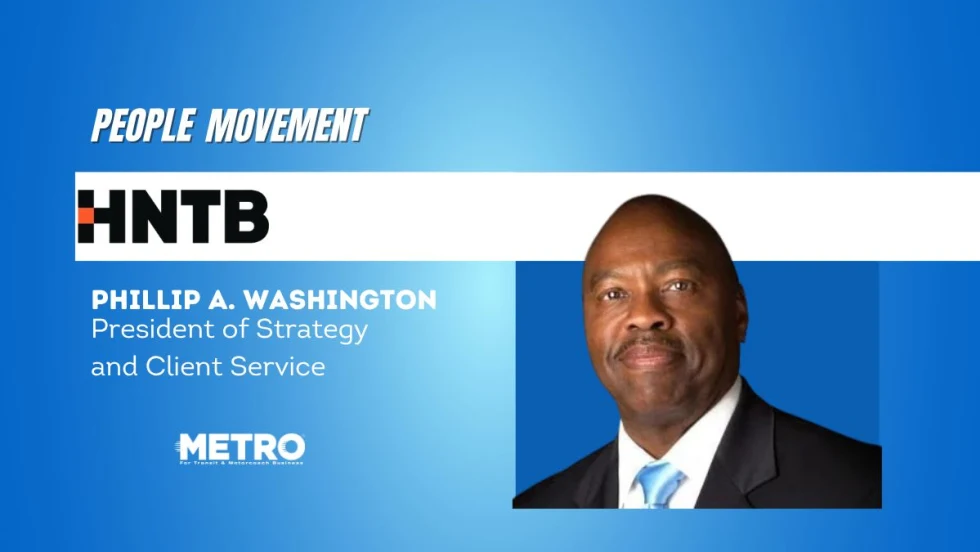
People Movement: Phil Washington Joins HNTB, Denver RTD Launches CEO Search, and More
In this edition, we also spotlight recent personnel moves at STV, the Eno Center for Transportation, and more, highlighting the people taking on new roles across the transportation industry.
Read More →
SEPTA Details Accelerate Vision for Transit System
The plan outlines investments in trolley modernization, new Metro and Regional Rail vehicles, accessible stations, and more frequent bus and rail service.
Read More →
FTA Ends Direct Oversight of MBTA Safety Actions
The federal agency closed its remaining special directive to the Massachusetts Department of Public Utilities following a safety review that began in 2022.
Read More →
Report: Transit Bus Manufacturing Supports 34,100 Jobs, $5.1B in GDP
The “Buses Mean Business” report examines the transit bus manufacturing industry’s economic footprint, supply chain, and rising demand for vehicle replacements.
Read More →