



New Starts moves continue rail favoritism over BRT
Cliff Henke, a contributing editor to METRO, is senior analyst at PB. His views herein are solely his own.
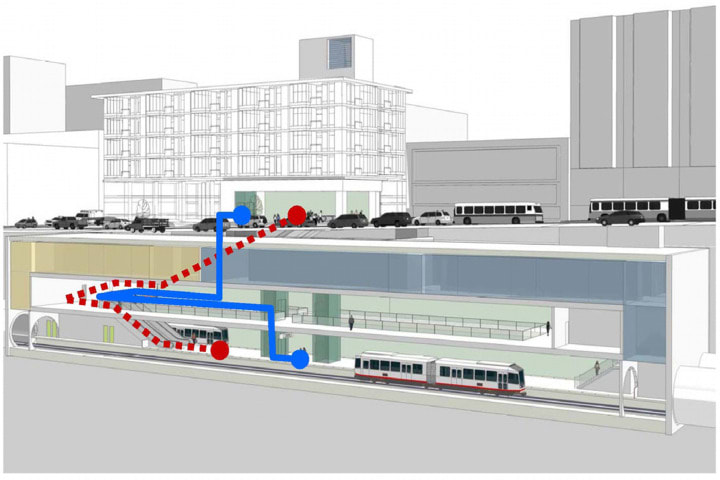
Courtesy SFMTA
[IMAGE]Rails.jpg[/IMAGE]The Obama administration continues to display a preference for rail-based public transportation modes in its recent regulatory and budgetary actions. However, whether transit agencies and cities can take advantage of these new opportunities will continue to depend in part on local factors.
Taking away BRT favoritism
The first recent move came with the FTA's announcement in December of two new programs designed to implement the administration's livability agenda. The programs total $280 million for urban circulator, bus and bus facility projects. The first is for urban circulator systems, funded with $130 million in unobligated discretionary New Starts/Small Starts money.
The second is for a Livability Bus program, funded by $150 million in unobligated Discretionary Bus and Bus Facilities Program money. Evaluation criteria for both programs are the same; promoting transportation options is only one evaluation measure, with the others having to do with economic development and energy security.
Project proposals for both programs were due Feb. 8, 2010, with expected project awards announced by the summer of this year. While both programs were launched with already appropriated funds for previous years, they showed that the administration was committed to assisting projects that emphasized economic development as much as promoting mobility.
In January, U.S. Department of Transportation Secretary Ray LaHood proposed a revision of funding guidelines for major transit projects so that evaluation of submitted projects will be based equally on livability issues, such as economic development opportunities and environmental benefits, in addition to cost and time saved - currently the primary criteria. The FTA immediately rescinded budget restrictions issued by the "Dear Colleague" letter and other policy guidance of the Bush administration that focused the agency's evaluation primarily on a cost-effectiveness index that emphasized how much a project shortened commute times in comparison to its cost. In the Bush criteria, bus rapid transit (BRT) almost always scored more favorably than rail-based projects because of this index.
Local decisions
Both announcements clearly signal a new desire to de-emphasize evaluations based on criteria that almost always favored BRT over rail and virtually shut out streetcar projects from federal funding. This is not to say, however, that the feds will rescue a project that is struggling locally. For one thing, the new programs have grant caps of $25 million, meaning that other funds will have to be lined up; moreover, statutory local match rules still apply.
Secondly, environmental review, local approvals and demonstration of local financial and technical capacity are still required. Finally, while the recent moves undid some of the rules stacked in favor of BRT, it only leveled the playing field.
In other words, a worthy project still needs local support and local financial contribution, regardless of mode.
More Bus

From Surviving to Thriving: Building Stronger Transportation Organizations
Bus Business Consultants founder Brian Dickson shares lessons on leadership, organizational health, and creating options for long-term success in a changing transportation industry.
Read More →
Everett Transit, Community Transit Outline Consolidation Agreement
The proposed agreement calls for a 50% increase in bus service in Everett, a new microtransit zone, continued paratransit service, and the transfer of Everett Transit operations to Community Transit.
Read More →
SEPTA Details Accelerate Vision for Transit System
The plan outlines investments in trolley modernization, new Metro and Regional Rail vehicles, accessible stations, and more frequent bus and rail service.
Read More →
Report: Transit Bus Manufacturing Supports 34,100 Jobs, $5.1B in GDP
The “Buses Mean Business” report examines the transit bus manufacturing industry’s economic footprint, supply chain, and rising demand for vehicle replacements.
Read More →
Biz Briefs: New Flyer Delivers in Columbus, Houston, Beep and Freebee Merge, and More
In this edition of Biz Briefs, we spotlight the latest developments shaping the future of mobility.
Read More →
People Movement: Dan Dipert Coaches Adds Third-Generation Leader, Keolis Names New Valley Metro VP/GM, and More
In this edition, we also cover recent appointments and announcements at the Wabtec, SilverRide, HNTB, and more, showcasing the individuals helping to shape the future of transportation.
Read More →
New York MTA Plans Largest Bus Fleet Upgrade in More Than a Decade
The agency is seeking manufacturers for 650 new CNG buses to replace aging vehicles, improve reliability, and advance its broader fleet modernization strategy.
Read More →
Building a Flexible Path to Transit Electrification
John Hroncich discusses BAE Systems’ modular and scalable approach, lessons learned from decades of real-world operations, and how agencies can identify electrification strategies that fit their fleets.
Read More →
Bus Tech Talk: Keeping Transit Technicians Ahead of the Technology Curve
LA Metro’s Obed Mejia discusses technician training, evolving maintenance technology, fleet replacement, and strategies for getting the most out of today’s transit fleets.
Read More →
Biz Briefs: RIPTA Unveils New Frontrunners, Clevland RTA Adds New Siemens, and More
In METRO's latest installment, we take a look at recent news from Siemens, Prevost, Dodge, and more partnerships making headlines across the transportation sector.
Read More →