



Operational Efficiency through Security Technology
Recent advances in the world of mobile surveillance increase public safety while allowing transit agencies to improve incident response, reduce risk and save money.
Surveillance technology is key to public safety, incident management and risk reduction. The benefits are well documented.
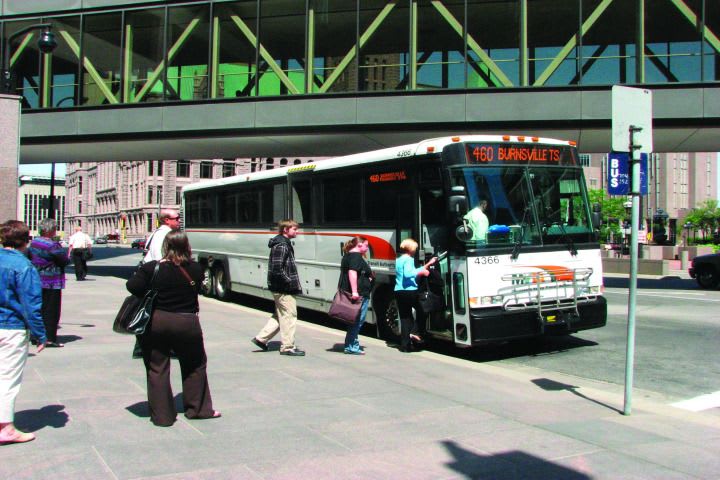
[IMAGE]security-2.jpg[/IMAGE]Public transportation provides a vital service that millions of passengers depend on every day. Statistics from the American Public Transportation Association indicate that as recently as 2008, passengers in the U.S. took as many as 10.5 billion trips, while public transportation spent more than $543 billion on services and infrastructure. The sheer scale of the people and property involved means that there is a lot at stake.
With so many routes and riders, the protection of passengers, employees and assets can be a daunting task, especially on a limited or fluctuating budget. Budget constraints make operational efficiency an imperative, with the goals of streamlining the management of security systems, controlling expenses and reducing administrative overhead.
Risk Management
The inherently open nature of public transportation makes it vulnerable to security threats, which is what makes security systems so important. In the case of public transit, security systems entail mobile surveillance equipment. "Once you have it, you don't know how you got along without it," says Glenn Boden, fleet manager of Minnesota Valley Transit Authority (MVTA). "It's just a great management tool."
Surveillance technology is key to public safety, incident management and risk reduction. The benefits are well documented. "If there are any onboard incidents, you can use recorded data to reconstruct events and investigate customer complaints, accidents, and criminal activity," Boden says. "It really helps with liability and insurance issues."
Quintus Douglas, supervisor of paratransit operations with Tallahassee, Fla.-based Starmetro, has also found mobile surveillance an invaluable risk management tool. "We can pinpoint the time and details of any incident. We know who was on the bus, who was off, even where people were sitting," he explains. "It prevents discrepancies when the police come, and it has a great impact on liability."
Onboard surveillance involves more than cameras. Video recording systems can combine with automatic vehicle location (AVL) technology and GPS data to precisely track the location and movement of a single bus (or an entire fleet) using mapping software. Through wireless technology, it is even possible to track vehicles live, allowing front-line personnel to receive video and audio information in real time, as an event unfolds, through a laptop.
"You can be blocks away," Douglas says, "and if there is an incident on a bus, or something has happened to the driver, you can actually look and know what is going on inside."
Integrated sensors can detect vehicle ignition status, route mileage, direction and aggressive driving, including speed, inertia, abrupt breaking and turning. Geo-fencing technology allows fleet managers to designate a geographic boundary for a vehicle and receive notification if the vehicle deviates. If a driver leaves his or her route (or in the event of a theft or hijacking), operations can know immediately. Surveillance systems can also detect a vehicle break-in while the vehicle ignition is off.
Mobile surveillance technology allows fleet managers to assess situations and respond quickly and effectively, mitigating risk to people and property. As Douglas says, "there are no disadvantages."
Aside from its essential function of providing safety and security, mobile surveillance technology can save transit agencies a great deal of money. The presence of cameras deters crime, such as vandalism and theft. Recorded data can assist with liability defense and reduce false injury claims, which can lower legal and insurance costs. It can also assist with preventive maintenance and reduce fuel expenses by ensuring drivers maintain good driving practices and stay on designated routes.
Boden says that drivers are often less than enthused when they learn that their transit agency is going to employ security technology; however, "nine out of 10 times it works to their benefit," he says. Boden describes one incident where a passing dump truck came over the center line and damaged an MVTA vehicle. "The camera information exonerated our driver," he says. "It showed that she didn't do anything wrong."
Boden also sees cameras as a great training tool. "Our contractor loves it," he says. "One person can review multiple drivers, and save all the time involved with ride-alongs. A manager can go and pull a random piece of footage to review a driver's performance, which is much more efficient. Since drivers never know when you are going to review footage, you get a more accurate sample of their habits and behavior."
Video surveillance footage can also be used to train drivers using various real-life scenarios, increasing safety even further. From customer service to accidents and other onboard incidents, the camera provides an unbiased witness from which drivers can learn from other drivers.
[PAGEBREAK]Operational Efficiency
A lot of advantages come with onboard security technology, but it does come at a cost. There is the capital expenditure involved in acquiring it; then there is the task of managing it. Beyond the hardware involved, which includes everything from cameras; digital video recorders; GPS receivers; monitors; computers; IT infrastructure and more, data management involves software.
Software provides the reporting tools that make a dramatic difference in a transit agency's ability to deal with limited staff and large-scale operations, often spread over multiple transit properties in different locations.
New technologies have emerged to help transit agencies lower the administration requirements of managing the onboard data from their fleet. Such advancements include centralized and automated mobile surveillance data management, systems-health monitoring, wireless downloading, remote configuration, and the ability to view video live over a Web-based or GPRS (general packet radio service) network.
With the ability to download video and audio clips remotely, monitor multiple vehicles and automate the notification of alarmed events, automation helps fleet managers spend less time and fewer resources gathering and utilizing onboard data. Automation allows operations to quickly and easily identify any bus in the fleet, retrieve key information, and rapidly distribute it to the individual or department that needs it, including administration; maintenance; security personnel; first-responders or law enforcement.
Wireless technology offers unparalleled convenience. "The beauty of it is you don't have to chase a vehicle down," Boden says. "You know where the vehicle is and when it's in the garage. In the past, you had to manually pull the hard drive, take it back to the camera room and put it in a docking station. There was lots of manpower and running back and forth involved. Wireless technology has eliminated all of that. When there is an issue, you can easily access whatever information you are looking for right from the office."
Wireless technology combined with automation offers other efficiencies. Automated system-wide health monitoring is an invaluable preventive maintenance tool. It alerts transit agencies if any part of the system isn't working. There are few things more frustrating than to have invested in onboard surveillance, only to have it fail when you need it the most.
The system can be programmed to report video loss and systems related problems automatically. If a bus is not connected to the network for a period of time, operations will know. Automatic health monitoring reduces liability by minimizing equipment downtime and ensuring that the data required is available.
Other advantages to automation include the ability of onboard surveillance to measure idling. Idling wastes fuel and money. According to the U.S. Environmental Protection Agency, a typical truck or bus burns approximately one gallon of diesel fuel for each hour it idles. If a truck idles for 6 hours per day and operates 300 days a year, it would consume 1,800 gallons of fuel per year. Idling also causes excessive engine wear and pollution, so idling-reduction measures simply make sense.
Another important consideration for transit agencies is systems integration. There is a lot of technology on board a bus, which mostly falls into the category of Intelligent Transportation Systems (ITS). ITS includes everything from AVL and video surveillance to fare collection, automatic passenger counters, radios, mobile data terminals, traffic signal priority technology, electronic bus stop signage and more. All this technology needs to work together, seamlessly, to be effective. It must not conflict with existing networks, IT infrastructure or other onboard technologies.
Surveillance systems are only one of many onboard technologies that a transit agency needs to manage. If managing it is difficult, the transit agency will need to allocate more time and internal resources. For this reason, integration of onboard technology has become a critical issue for both transit agencies and suppliers alike. In addition, the more functions that a security system (or any onboard technology) can perform, the more operational efficiency will increase. Mobile surveillance, for example, can be used for route planning.
"Our planner also uses our mobile surveillance system to review passenger counts, who gets on and off the bus and where. It helps us figure out passenger loads, whether we need larger or smaller buses, or more buses on certain routes," Boden says. "It helps us be more efficient."
The integration of onboard technology is often easier said than done. No vendor does it all, so integrating onboard technology from separate vendors becomes all the more important. Integration also has an impact on the RFP process. If a transit agency were to acquire all its ITS from separate vendors, the cost of procurement would rise dramatically due to the number of RFPs that would need to be created and managed. Integration saves internal project management resources and implementation costs.
The Future
Mobile surveillance technology is evolving rapidly. Broadband capabilities have grown in giant leaps. To be effective, a security system with wireless capabilities must have sufficient power and bandwidth to download video and other data reliably and efficiently, regardless of the number of buses or locations involved. The data pipes are getting larger, allowing the transfer of more media-rich data quicker than ever before.
Until recently, the ability to watch live video anywhere on any bus at any time was just a dream. Now, it is a reality. GPRS is being replaced by technology that allows increasing amounts of data to transfer to existing cellular networks, giving transit managers quicker access to information. In addition, vast improvements in video capture and compression technology (H.264, an industry standard format for video compression) have brought about near broadcast quality video, bringing clarity to onboard events with exceptional image quality and detail — but requiring less bandwidth.
Other inevitable advancements in the world of mobile security technology include increased integration between video surveillance and ITS and more consistent communication standards between onboard systems. Analytics will also evolve, allowing security systems to make decisions based on video content. If a bag is abandoned or left unattended, for example, the system can notify security personnel.
Finally, managed services are also on the rise. Transit agencies will increasingly outsource their mobile surveillance needs, offloading one or more administrative tasks to the vendor or supplier. For example, if a transit agency requires video or other data, it simply requests it from the vendor. The vendor then downloads it, analyzes it and reports to the agency. There is no need for the internal management of recorded data.
Transit agencies can also outsource maintenance. In this scenario, the vendor continually monitors the health of fleets' security systems. If a component fails, the vendor can report the malfunction to the agency for repair, initiate the repair on the agency's behalf, or automatically manage all aspects of the repair. In short, the transit agency buys the equipment, but the vendor takes care of everything.
Transit agencies that outsource their mobile surveillance needs can greatly reduce their overhead, which is the heart of operational efficiency.
Cost savings, increased safety
Properly implemented mobile surveillance systems increase operational efficiency while improving the security and safety of public transportation. Tight or fluctuating budgets require transit agencies to extract greater value from existing resources.
Fleet efficiency translates into cost savings but, in the case of onboard security technology, the good news is that efficiency also translates into increased public safety, risk reduction and more effective incident response. Everybody wins.
Kara Cunningham is the communications officer for Seon Design Inc.
More Bus

New York MTA Plans Largest Bus Fleet Upgrade in More Than a Decade
The agency is seeking manufacturers for 650 new CNG buses to replace aging vehicles, improve reliability, and advance its broader fleet modernization strategy.
Read More →
Building a Flexible Path to Transit Electrification
John Hroncich discusses BAE Systems’ modular and scalable approach, lessons learned from decades of real-world operations, and how agencies can identify electrification strategies that fit their fleets.
Read More →
Bus Tech Talk: Keeping Transit Technicians Ahead of the Technology Curve
LA Metro’s Obed Mejia discusses technician training, evolving maintenance technology, fleet replacement, and strategies for getting the most out of today’s transit fleets.
Read More →
Biz Briefs: RIPTA Unveils New Frontrunners, Clevland RTA Adds New Siemens, and More
In METRO's latest installment, we take a look at recent news from Siemens, Prevost, Dodge, and more partnerships making headlines across the transportation sector.
Read More →
People Movement: Holly Arnold Joins Transdev and More
In this edition, we also cover recent appointments and announcements at Pace, CamTran, MCI, and more, showcasing the individuals helping to shape the future of transportation.
Read More →
The High Cost of Transit Buses: Industry Leaders Look to Procurement Reform
Transit leaders and policymakers examine how standardized bus designs, streamlined procurement, and predictable funding could help agencies stretch budgets and deliver better service.
Read More →
The Business Voice Behind Public Transportation
As chair of APTA’s Business Members Board of Governors, Ray Melleady explains how more than 850 business members are partnering with transit agencies to advance funding, innovation, and industry-wide collaboration.
Read More →
From Surviving to Thriving: Building Stronger Transportation Organizations
Bus Business Consultants founder Brian Dickson shares lessons on leadership, organizational health, and creating options for long-term success in a changing transportation industry.
Read More →
Finding the ‘Happy Medium’: Optimizing Maintenance Without Sacrificing Reliability
The key to maintenance optimization isn’t doing less work—it’s doing the right work at the right time on the right assets.
Read More →
LA Metro, City of West Hollywood, and Partners Advance Smarter Bus Lane Enforcement
The award-winning partnership combines AI-powered detection with human oversight to improve bus reliability, accessibility, and enforcement efficiency.
Read More →