



Providers Seek to Maximize Paratransit Efficiency, Cut Costs
As economic pressures continue to affect transit agencies, some are raising fares and initiating service cuts to keep budgets in line. In many regions, paratransit passengers face the greatest impact from service cuts as most rely on those services as a low-cost mode of transportation.
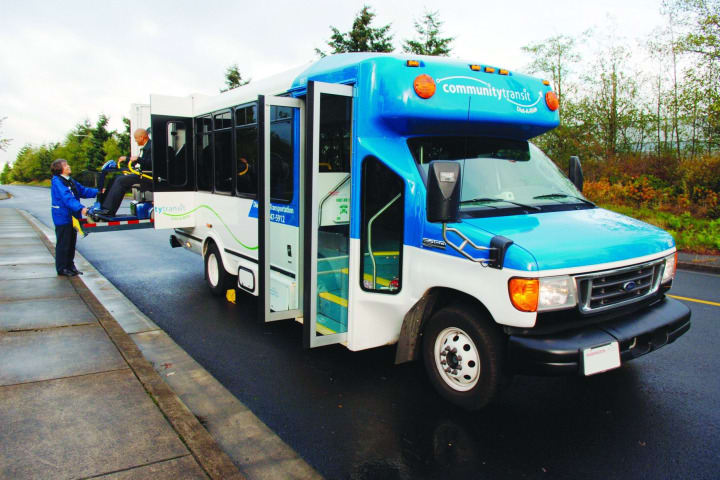
Courtesy Community Transit
[IMAGE]paratransit-2.jpg[/IMAGE]As economic pressures continue to affect transit agencies, some are raising fares and initiating service cuts to keep budgets in line. In many regions, paratransit passengers face the greatest impact from service cuts as most rely on those services as a low-cost mode of transportation. But paratransit rides are across the board more expensive for transit agencies to provide than fixed-route service, so systems are looking for ways to maximize paratransit efficiency and cut costs.
In Washington, D.C., Washington Metropolitan Area Transit Authority (Metro) MetroAccess riders attended public hearings in March and April to voice their concerns regarding proposed service cuts. The agency needs to close a $189 million budget deficit for the fiscal year that begins July 1 and is considering, among other options, cutting paratransit to the Americans with Disabilities Act (ADA) requirement of a three-quarter mile radius from fixed routes — Metro currently exceeds this requirement.
At the beginning of the year, Broward County, Fla., rebid contracts with paratransit providers and launched a centralized call center in an effort to boost efficiency, improve customer service and cut costs by $8 million, officials estimate.
Sacramento, Calif.'s Regional Transit (RT) provides about 300,000 paratransit trips annually, with demand historically increasing year over year, until fiscal year 2010. "We've actually seen an unprecedented drop in demand," says Laura Ham, director of Accessible Services and Customer Advocacy. "So far this year, demand is down close to four percent when comparing year-to-date to fiscal year 2009."
The agency attributes the drop to economic pressures - consumers have less for discretionary spending and travel, and RT also raised fares last September to $5 per one-way ride. "That may be cost-prohibitive to some of our riders," Ham explains.
RT faces a $25 million budget shortfall for fiscal year 2011, and the agency's board of directors approved plans in March to cut routes, eliminate service after 9 p.m. and decrease frequency. The changes, which affect both fixed-route and paratransit service, will take effect in June.
"We've had a lot of public testimony at our recent board meetings on the service reductions," Ham says. Before the cuts were approved, Ham expressed the hope that paratransit trips after 9 p.m. might be easily shifted to daytime hours. "The paratransit trips that take place in the evening are probably more discretionary trips; they may not be trips to work and school. We think that those trips may shift into the earlier service hours, but we'll have to wait and see," she says.
Community Transit, serving Snohomish County in Washington, is set to eliminate service on Sundays and major holidays. In 2009, the agency's total paratransit boardings added up to about 220,000, — up about 1.6 percent over 2008 — Public Information Officer Martin Munguia reports. Meanwhile, regular service was down about 4.5 percent.
Because Community Transit's primary funding source is revenues generated by a local sales tax, the agency's budget is suffering. "The economy has hit us so hard," Munguia says. "People aren't spending in our community."
To help bridge the gap, the agency also initiated a $0.25 fare increase on both regular and paratransit routes.
Despite the service cuts, which will add up to about 15 percent of the agency's services, Munguia says that Community Transit has identified just five individuals who will lose paratransit service out of the 1,200 community members who regularly use the service. "To make all those cuts and only impact five individuals, we think we did a pretty careful job of really looking at these as being the most vulnerable people who depend on transit service and not wanting to impact them," he says.
In addition, the agency has planned efforts to mitigate these impacts, including the VanGo program, which awards surplus vehicles to nonprofit agencies to provide transportation to special populations, and the creation of a $50,000 fund for local organizations providing transportation services.
"We're trying to be creative," Munguia says. "Our CEO was hoping to ride out the recession. We did a lot of internal cost cutting, we borrowed against our capital reserves and we deferred bus replacements for a couple of years with the hope that we wouldn't have to cut service. We know there are going to be impacts to a lot of people, so it was part of our board's mission to try and figure out what we can do in a lost-cost way to offset these impacts."
Community Transit is also phasing in new transit technology to help reduce the comparatively high cost of providing paratransit rides. All vehicles are being equipped with GPS and navigation devices. Dispatch operators will be able to better control paratransit routes and communicate with drivers. "Paratransit, as opposed to regular transit where the driver goes out on the same route every day, has a lot of room for human error," Munguia says, "so this system is going to really make it more efficient."
The system will enable dispatchers to match multiple riders in one vehicle, and drivers will be able to improve on-time arrivals due to better navigation on unfamiliar routes, both of which will improve paratransit service efficiency and reduce costs, Munguia says.
More Paratransit

Biz Briefs: RIPTA Unveils New Frontrunners, Clevland RTA Adds New Siemens, and More
In METRO's latest installment, we take a look at recent news from Siemens, Prevost, Dodge, and more partnerships making headlines across the transportation sector.
Read More →
King County Metro Makes ADA Paratransit Easier to Navigate
METRO's Innovative Solutions Award winner replaces complex service-area descriptions with an accessible, interactive map that puts paratransit information directly in customers’ hands.
Read More →
Jacksonville’s NAVI Project Charts a New Course for Autonomous Public Transportation
Through its NAVI program, JTA is showing how autonomous vehicles, intelligent infrastructure, and coordinated operations can work together to deliver everyday public transportation.
Read More →
Driving Smarter Paratransit
John Hanlon shares how AlphaRoute is leveraging AI-powered technology to help paratransit providers optimize operations, support frontline staff, and enhance the rider experience.
Read More →
METRO Magazine Announces 2026 Innovative Solutions Awards Winners
Projects Recognized for Advancing Mobility Through Technology, Accessibility, Workforce Innovation, and Operational Excellence
Read More →
Biz Briefs: STV teams with Amtrak, Motorcoach Operators Boost Fleet and Land Contracts, and More
From manufacturers and suppliers to transit agencies and motorcoach operators, these updates offer a snapshot of the projects, partnerships and business moves driving the industry forward.
Read More →
Biz Briefs: Masabi Teams with St. Louis Metro and More
In METRO's latest installment, we take a look at recent news from Transdev, Hitachi, and more partnerships making headlines across the transportation sector.
Read More →
New York MTA Leverages Zoning Program to Advance Station Accessibility
Accessibility enhancements at Nevins St Station will be financed through a development agreement tied to the MTA's Zoning for Accessibility initiative.
Read More →
Reinventing Fleet Maintenance with Real-time Visibility and AI
Transit leaders need to know what needs fixing, where to look, who is responsible, when work is completed, and what it costs without having to chase information across disconnected systems.
Read More →
SamTrans Sets Priorities for Potential Connect Bay Area Revenue
The board-approved framework allocates future funding to maintaining service, rider improvements, equity initiatives, and infrastructure repairs.
Read More →