



School Budget Woes Challenge Coach Operators with Student Transport Contracts
School budgets are declining, leaving many with no choice but to cut activities such as class trips and summer school. Carriers are negotiating fuel payments and benefiting from alternative vehicle scheduling.

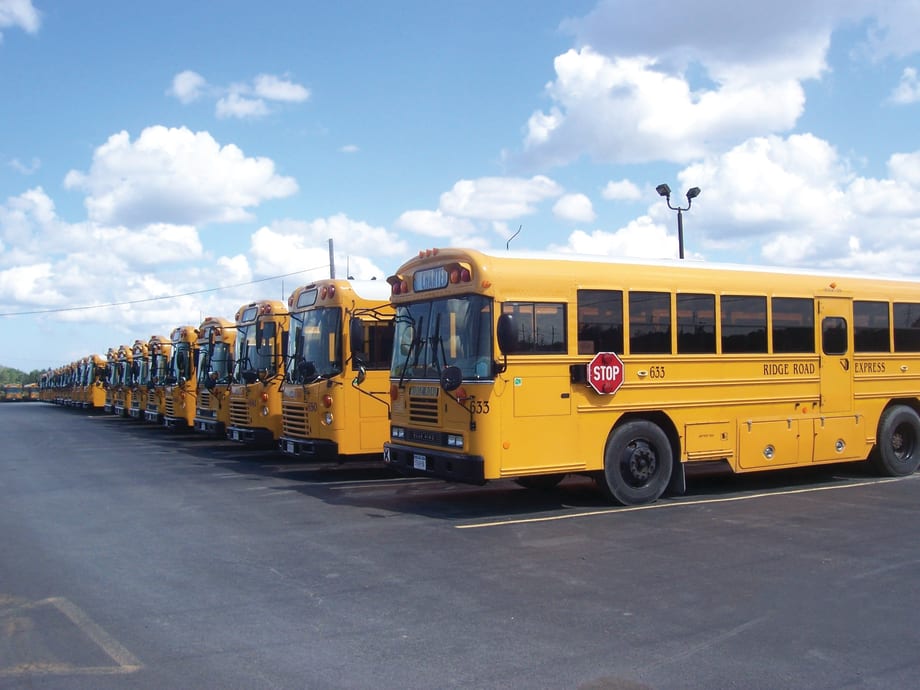
Fewer school days. No more field trips. Senior class parties canceled. School budgets across the U.S. are being squeezed more than ever, impacting motorcoach operators with school buses in their fleets and contracts with schools. However, some carriers have been able to hang on to their contracts through payment arrangements for fuel and using multiple buses on some runs. One operator has even seen its school service thrive over the past year.
Small role for motorcoaches
School service comprises about 80 percent of Lockport, N.Y.-based Grand Tours, Ridge Road Express and management company Scholastic Transportation Management Services Inc.'s (STMS) business, and the companies have seen their share of ups and downs with the market.
In early January, the companies were purchased by Student Transportation Inc. (STI) and became wholly-owned subsidiaries of STI.
STI's Ridge Road runs transportation services for the Lockport, Star point, Newfane, Barker and Royalton-Hartland districts. The carrier provides home-to-school service and out-of-district special education transportation for four additional districts. Three of those districts run their own buses, but hire the carrier for out-of-district transportation.
"It's a nice operation for them," R. Thomas Weeks, president, Ridge Road Express Inc., Grand Tours and STMS, says. "It's halfway between district-owned and a total contract. Maybe the district feels like they've got a little more control as long as they own the buses, versus a contractor, where a district turns everything over to them."
The operator only uses school buses for school service, as required by New York State law. "New York State is specific with their specs for school buses: they have to have yellow warning lights, red stoplights, stop arms, seat belts and roof hatches to mention a few things," Weeks explains.
However, Grand Tours does use motorcoaches for over-the-road middle and high school field trips to cities ranging from Washington, D.C., to Boston to Orlando, Fla.
School buses can be more lucrative than motorcoaches, which tend to operate like a retail program: on an if-come basis, Weeks says.
"Not that school buses aren't competitive, but if you know you're going to have a contractor run a school bus for a 180-day school year, that's pretty solid for borrowing money," he explains.
However, with motorcoaches, during the recession, and when SARS hit years ago, once-popular transportation to Canada decreased tremendously.
"Matter of fact it still hasn't [rebounded], not necessarily [because of] SARS, but mostly because of passports and identification requirements," Weeks says. "In a lot of cases, Canadian work has never come back."
School budget challenges
The downside of school business, Weeks says, is that some districts are questioning the viability of their sports programs, which Ridge Road services. "How much longer will they be able to [transport] a football team, pay for uniforms and everything that goes with having athletic teams?" Weeks asks. Some districts, he adds, also are seeing declining enrollments, usually caused by people having fewer children or moving away to follow jobs.
"We used to take fourth graders to the zoo. [Now], some of those trips, if they're not funded by parents, don't [happen] anymore," Weeks says.
Additionally, many schools no longer offer summer classes. "We don't do much in large buses for summer school like we used to," Weeks says.
Some districts also are looking at bringing some special needs students in-house instead of sending them to specialty schools. That may be more likely attributed to tuition expenses than the cost of transportation, Weeks admits.
Like STI, Clearfield, Pa.-based Fullington Tours has been significantly affected by declining demand for motorcoaches for sporting events and field trips. Schools are increasingly turning to school buses instead because they are less expensive.
When Fullington was in the process of renewing school contracts, one, which they had for 20 years, put the business out for RFP, because they were notified by the state they were going to have their budget subsidy cut by $2 milion. "It came at a horrible time," Aerial Fullington Weisman, president, says. "We did shave some off [the price], so they benefited from that."
Increasingly, Fullington says, school districts are putting out RFPs to get the lowest pricing. Some schools Fullington works with have canceled their end of the year and senior class trips.
"There have been a lot of cuts. Some school districts will [have] the PTO or the Boosters will pay for it, but in a lot of cases, it's the school that's still maintaining it and they're just cutting it," Fullington says. She adds that schools also are cutting some sports programs and freezing wages.
One strategy Fullington has implemented is utilizing a "flip-flop" policy. The term refers to operators using two different buses on the same run each day — one bus in the morning and another in the afternoon, which maximizes the ridership and miles for all the school runs.
Fullington confirmed with the Pennsylvania Department of Education that the practice is legal. The carrier will begin the process this upcoming school year.
The practice will particularly benefit schools working with state formulas, but also those reporting mileage on a per diem basis.
"It drives up the amount of passengers and possibly the amount of miles for that run," Fullington explains. "You can't do it with every run, but it will increase the school's reimbursement from the state."
Fullington plans to use the "flip-flops" process with all its school contracts. "We're on a per diem with two of them, so we won't get any benefit, but we're going to do the right thing because the school will get a higher reimbursement," she says.
[PAGEBREAK]
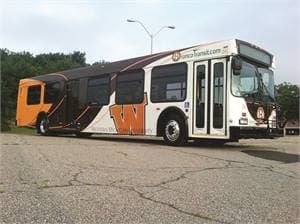
In 2007, operator Indian Trails and Western Michigan University partnered to create the expanding Bronco Transit. The service saved the university nearly half a million dollars.
Training, certifications
Another looming financial challenge is the critical matter of keeping up special state driver certifications required to transport students. For example, New York State's Article 19-A calls for special driver physicals, follow-up testing, observations, a criminal record check and 30 hours of classroom training, annually. An operator's safety department is one of its most active areas and constantly under pressure to keep all the necessary paperwork up to date.
"From a contractor's standpoint, he or she has a ton of money invested in these people by the time they're trained and ready to go," Weeks says. "It's an expensive proposition."
In addition, school buses are inspected by the New York Department of Transportation once every six months.
Despite the hefty investment, Weeks does believe it pays off. The incentive, he says, comes in the insurance rate because the company knows New York State has high standards.
"Before we sold, we had tremendous insurance rates. I am positive that...we earned it, because our accident frequency and severity was very low, and I think that had a lot to do with our safety program," he says.
One challenge, Weeks says, is the cost of fingerprinting, at about $104 per driver. "That will continue to go up, and you can't ask the driver to pay for it," he says. "Sometimes you get to that point and find out that they're disqualified, or could be."
Fuel pricing benefit
One way, Weeks says, the operator has been able to cope with less business is an arrangement for school districts to pay for their own fuel, which works out to be more cost effective since they don't pay fuel taxes.
"We have four districts that use over 100,000 gallons of fuel a year. At New York State's tax rate, each of those districts probably saves close to $50,000 a year," Weeks explains. "If they didn't buy it for us, I'd have to buy it and charge them, and what I would charge would include the tax. As you can imagine, with the fuel prices, our districts have eaten the increases."
In this arrangement, the operator simply figures out the total mileage the buses and vans operated each day, averages the miles per gallon, divides the total mileage by the van or bus rate, and then multiplies that by 180 to come up with the daily allotment. If Ridge Road runs out of fuel, it needs to buy the difference for the rest of the school year. If there's extra fuel it rolls over to the following school year.
"Not having to contend with [fuel] increases has been big for us," Weeks says. "When you bid a contract at $2.75 a gallon and all of a sudden fuel is $4.25, it's not good."
[PAGEBREAK]
Expanding service
One motorcoach operator was able to help a school save its transportation service. Owosso, Mich.-based Indian Trails has seen a 2007 contract to provide shuttle service for Western Michigan University (WMU) expand, despite budgetary issues for schools nationwide.
The carrier began operating the service with nine 1997 model New Flyer transit buses.
"We started off with some old RTS transit buses that we had purchased from the West coast. We used those for the first year, just to make sure that everyone was happy with the service," Chad Cushman, vice president, business, says. The service, Bronco Transit, received positive feedback, and Indian Trails started looking into purchasing new transit buses for the service. "After doing some cost analysis, [we] determined that it was better to refurbish older buses," Cushman says.
The service had previously been operated by Metro Transit, (Kalamazoo, Mich.). After receiving a significant cost increase proposal from the agency - from $1.8 million to $2.1 million — to continue operating the university approached Indian Trails, which had provided its athletic transportation for years. Rising fuel costs in part contributed to Metro's price increase, according to a news article published in the Kalamazoo Gazette.
"They were getting ready to cut service. They came to us and said, 'Can you give us pricing? If you were to operate this, what would it be?'" Cushman recalls.
WMU signed a one-year agreement with Indian Trails to provide some of the bus service on its main campus and to and from its Parkview campus.
Within approximately six weeks they negotiated a contract, put the schedules and brochures together, built the brand, wrapped all the buses with Bronco Transit's colors and logo, developed the website, and by the beginning of the school year, service was operating.
"It was a pretty quick window, but...they didn't have it in the budget to pay [Metro]," Cushman says. "When they contracted with us, they were able to maintain all the routes and bring the cost down about half a million dollars," Cushman says.
While Cushman acknowledges that universities in Michigan have had to endure significant budget cuts, he says, given this experience, he believes there are opportunities for private operators to step in and potentially save customers using public operators a significant amount of money.
Ridership on Bronco Transit has grown exponentially since Indian Trails took over. During the 2009/2010 school year, Bronco Transit transported 393,370 students. Ridership has since increased to 556,711 students during the 2010/2011 school year.
"It has been a great addition to our service," Cushman says. "It complimented what we were already doing with the university, because we've been doing their athletic transportation for decades. It has been a win-win for everyone."
More Motorcoach

METRO Opens Submissions for 2026 Motorcoach Awards
Nominations are now being accepted for METRO Magazine’s Operator of the Year and Innovative Operator of the Year awards.
Read More →
Biz Briefs: Alstom Lands Canadian Contract, LYT to Supply California TSP, and More
In METRO's latest installment, we take a look at recent news from Complete Coach Works, Beep, FlixBus, and more partnerships making headlines across the transportation sector.
Read More →
Biz Briefs: RIPTA Unveils New Frontrunners, Clevland RTA Adds New Siemens, and More
In METRO's latest installment, we take a look at recent news from Siemens, Prevost, Dodge, and more partnerships making headlines across the transportation sector.
Read More →
People Movement: Holly Arnold Joins Transdev and More
In this edition, we also cover recent appointments and announcements at Pace, CamTran, MCI, and more, showcasing the individuals helping to shape the future of transportation.
Read More →
ABA Report: Motorcoach Travel Generates $161.6B Economic Impact
The 2025 analysis finds motorcoach travel supported nearly 900,000 jobs and generated $28 billion in federal, state, and local taxes.
Read More →
CharterUP’s Armir Harris on Technology, AI, and the Future of Group Mobility
In a recent episode of METROspectives, CharterUP Founder/CEO Armir Harris discussed the company’s evolution from an online charter bus marketplace into a technology platform supporting public- and private-sector mobility and much more.
Read More →
People Movement: ABC Names John Walsh as Chief Commercial Officer
In this edition, METRO also covers recent appointments and announcements at the DART, STV, and more, showcasing the individuals helping to shape the future of transportation.
Read More →
From Surviving to Thriving: Building Stronger Transportation Organizations
Bus Business Consultants founder Brian Dickson shares lessons on leadership, organizational health, and creating options for long-term success in a changing transportation industry.
Read More →
Biz Briefs: Luminator Marks Milestone and More
From manufacturers and suppliers to transit agencies and motorcoach operators, these updates offer a snapshot of the projects, partnerships and business moves driving the industry forward.
Read More →
ABAF Study Reveals Growing Insurance Crisis for Motorcoach Operators
Preliminary findings show 98% of operators faced premium increases over the past five years, while shrinking insurer participation is putting added pressure on businesses and customers.
Read More →