



Technology is Key Layer to Securing Transit
Early detection chemical sensors, cutting-edge incident management systems and video surveillance equipment all play a role in transit security. Integration and interoperability are prevalent features of new technology.
[IMAGE]f_0408b.jpg[/IMAGE]
It’s an extraordinary challenge to secure mass transit. Unlike an airport where you have a checkpoint, in mass transit you’ve got a flow of people — and you can’t slow them down, says Jamie Edgar, vice president, sales for Smiths Detection, provider of advanced integrated security systems.
There is no one ideal security system. How transit systems deal with security is essentially a layered approach, Edgar says. Transit systems are looking to advanced technologies, such as chemical detection sensors, incident management and response systems, and access to real-time video surveillance, to bolster their layered security approach.
Early warning systems
“[With subways], you’ve got a lot of people, and they’re underground. It’s a very desirable target, as we’ve seen worldwide,” Edgar says.
Since the ‘95 Sarin gas attacks in the Tokyo subway, the U.S. Department of Energy’s Argonne National Laboratory and Smiths Detection collaborated to develop Protect — a real-time chemical detection, surveillance and crisis management system.
In 2007, Smiths Detection was chosen by Argonne to be the exclusive licensee of Protect, which is operational in major transit systems in New York, Washington, D.C., and Boston.
Basically, the way the system works, remote sensors, placed on a train platform, for example, continuously monitor air quality and environmental conditions. The system samples the air for the presence of chemicals compiled from a Department of Homeland Security (DHS) list. The Protect system links CCTV systems and sensors to automatically provide alarm verification and threat analysis.
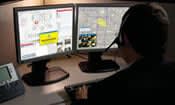
Upon system activation, audio and video alerts prompt command center operators to immediately evaluate the alarm and take action. The system’s user interface features a graphical map showing the location of the sensors, live video and sensor data.
“Information in an early warning is critical to contain the incident,” Edgar says. “[The system] literally takes the response time down from 30 minutes to five.”
Although it is a network-based system, first responders, such as police or fire departments, can log into the system and retrieve data from the transit command center. “Let’s say there is an incident in Washington, D.C., the fire department (if allowed) can plug into any callbox located around the city to get live information about what’s happening,” Edgar says.
Additional sensors and capabilities can be added onto the system, such as chemical warfare sensors, bomb detection and an X-ray system. “Next month we are probably adding radiation sensors,” Edgar says.
The systems will eventually become more affordable over time, according to Edgar. On the low end, estimated starting costs for the system range from $75,000 to $100,000.
Despite the ability to obtain the funding for these advanced systems, it is detrimental to maintain them so they function. “Transit systems will get funding to buy something, but maybe they won’t have funding for maintenance. And if you don’t have maintenance, the systems won’t work,” Edgar says.
Managing incident response
Post 9/11, the ability to provide interoperability and cross-agency information sharing is key — a function being made possible by Intergraph Corp., provider of spatial information management software.
Recently, Intergraph announced a contract to deploy its integrated emergency incident response, planning and reporting system for New Jersey Transit Corp. (NJ Transit). The new system will provide personnel, dispatchers and emergency responders with real-time intelligence to assist them in incident prevention and response efforts.
The system will feature integrated dispatch, records and mobile field reporting capabilities, which will enable NJ Transit police to respond more efficiently and effectively to emergency incidents. “They cross a lot of jurisdictions, so a lot of concern that they are trying to manage is if they had a rail crossing accident,” says Intergraph’s Robert Scott, industry manager, security solutions. “Sometimes, they are not always the first to know, because of the way the reporting works or the systems aren’t tied together.”
In the future, NJ Transit police will have the means for interoperability and cross-agency information sharing, a key initiative for homeland security efforts. “The future desire [for the agency] would be to have interoperability with other jurisdictions,” Scott says.
Because NJ Transit, Amtrak and New York MTA converge in downtown Manhattan, the potential for interoperability between the transit systems, as well as interoperability with neighboring police, fire and other EMS jurisdictions they travel through exists, according to Scott.
The essence of the incident management system involves a workstation (tied into a server) featuring a map of the area of responsibility, such as a rail system. “If somebody calls 911 to report something, then we would show where that call is coming from,” says Scott. The call-taker would ascertain the problem and select from a pull-down list what type of event it is. “Resources will be dispatched to handle the event, which will be monitored through its lifecycle,” he says. “This is all being managed within a database and utilizing a map to help them see what’s happening.”
In the security domain, the system can receive notifications from various detection devices, such as an access- control device on a door at a station, or it might be an intrusion detection alarm, when somebody goes through a door they shouldn’t. “This can also be tied into video analytics on a camera system, which may show that someone left a package behind or a suitcase that seems suspicious,” Scott says.
Integraph is building the capability to link its systems to other customers that use its system. In addition, it is also developing the option to interface with competitor companies’ CAD systems provided they work their side of the interface, Scott says.
Starting costs for this type of system, with a lot of functionality, for a small-sized agency, are estimated to fall in the $1 million to $1.5 million range, according to Scott.
Video surveillance
While incident management systems assist with prevention and response efforts, mobile video surveillance systems provide transit systems with real-time audio and video data onboard a vehicle.
Mobile video surveillance systems can be used by a transit property on many different fronts, typically safety and security. However, these systems also provide protection from litigation and wrongful lawsuits, says Chris Akiyama, transit and security division manager for Seon Design Inc.
Besides its basic function, video surveillance systems can have peripheral devices added on that supply various functions to the system, such as inertia sensors, which can monitor the G forces on various axes of the bus. “It will actually create an event and mark the video when the bus exceeds a predetermined parameter,” Akiyama says. “We also have the ability to record turn signals, brake lights and things of that nature, so that in the event of an accident, the entire incident can be rebuilt.” Another add-on device is a GPS module, which tracks the speed, position and location of the vehicle.
Gunnar Guenette, Radio Engineering Industries Inc. director of marketing, agrees the addition of GPS technology is a major trend that is growing in the transit market. “It adds another level of security to be able to see what’s happening on a vehicle, in real time, and be able to react to it,” he says.
Equipping vehicles with multiple cameras to record different views, such as both doors and aisle ways, is prevalent, Guenette says. Costs for a basic system can range from $1,200 to $2,500 per vehicle.
Customization of these systems is another growing trend on the horizon. “A transit property with ten buses is going to have different needs than one with 1,700 buses,” Akiyama says. “Because of this, systems need to be modular and customizable.”
Another important trend Akiyama sees in video surveillance is the need for integration and interoperability. Being able to tie the camera or security system in with other devices on the bus, such as CAD/AVL systems, passenger counting, etc., so they are able to communicate across one another is key.
Downloading data
Automation of these systems is also crucial. “The goal is to increase the efficiency of the organization. Video management of one bus is quite manageable, but when you span that across 1,500 buses, it becomes much more difficult to manage on a daily basis,” Akiyama says.
“Transit properties want easy access to high quality video,” says Mike Schwerman, mass transit, national sales manager for Safety Vision LP. “They want information coming to them so they can download it wirelessly, instead of having to get a laptop and plug it in to download the information or remove the hard drive from the vehicle to obtain the data.”
Firetide Inc., developer of wireless mesh networks, and Safety Vision, recently partnered to provide wireless surveillance and security applications for mass transit, law enforcement, and student transportation sectors.
The integrated wireless surveillance system is being implemented by the Massachusetts Bay Transportation Authority (MBTA), which will equip 155 new buses onboard video surveillance systems. The $1.4 million project, partially funded by a DHS grant, enables transmission of live video feeds to laptops in MBTA police officers’ networked vehicles, allowing first responders to view an onboard incident as it unfolds, in real time.
More Management

ENC Lands MATA Contract and More in Biz Briefs
In this edition of Biz Briefs, we spotlight the latest developments shaping the future of mobility.
Read More →
From Surviving to Thriving: Building Stronger Transportation Organizations
Bus Business Consultants founder Brian Dickson shares lessons on leadership, organizational health, and creating options for long-term success in a changing transportation industry.
Read More →
Everett Transit, Community Transit Outline Consolidation Agreement
The proposed agreement calls for a 50% increase in bus service in Everett, a new microtransit zone, continued paratransit service, and the transfer of Everett Transit operations to Community Transit.
Read More →

Strada360’s Steve Lassey on Turning Transit Data Into Better Decisions
From breaking down data silos to preparing for AI, Strada360 CEO Steve Lassey discusses how transit agencies can use technology to improve operations, customer information, and long-term decision-making.
Read More →
People Movement: Phil Washington Joins HNTB, Denver RTD Launches CEO Search, and More
In this edition, we also spotlight recent personnel moves at STV, the Eno Center for Transportation, and more, highlighting the people taking on new roles across the transportation industry.
Read More →
SEPTA Details Accelerate Vision for Transit System
The plan outlines investments in trolley modernization, new Metro and Regional Rail vehicles, accessible stations, and more frequent bus and rail service.
Read More →
FTA Ends Direct Oversight of MBTA Safety Actions
The federal agency closed its remaining special directive to the Massachusetts Department of Public Utilities following a safety review that began in 2022.
Read More →
Report: Transit Bus Manufacturing Supports 34,100 Jobs, $5.1B in GDP
The “Buses Mean Business” report examines the transit bus manufacturing industry’s economic footprint, supply chain, and rising demand for vehicle replacements.
Read More →
LIT Marks 10-Year Milestone at Annual Summit
Hosted by the COTA from September 10 to 13, the Summit carried the theme “Celebrating 10 Years of Excellence, Leadership, and Impact,” with every part of the program honoring the people, agencies, and partners who built LIT over its first decade.
Read More →
People Movement: Dan Dipert Coaches Adds Third-Generation Leader, Keolis Names New Valley Metro VP/GM, and More
In this edition, we also cover recent appointments and announcements at the Wabtec, SilverRide, HNTB, and more, showcasing the individuals helping to shape the future of transportation.
Read More →