



The Expertise Behind Constructing the San Diego Mid-Coast Trolley
WSP USA representatives discuss the behind-the-scenes of The Mid-Coast Trolley Project’s completion, the role of a consultant, and the overall benefits of the project itself.
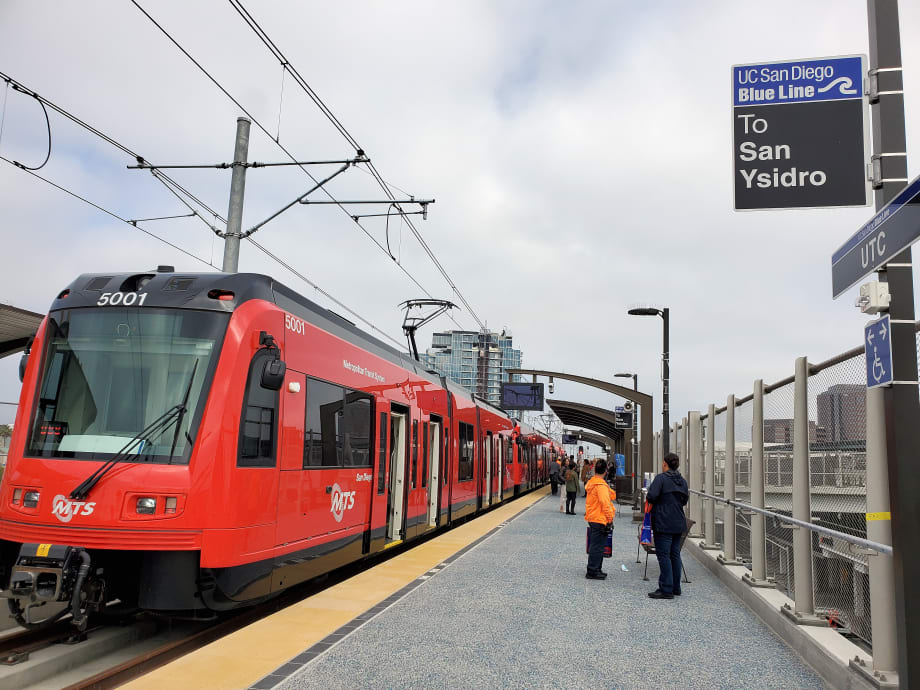
The UC San Diego Blue Line now provides a one-seat connection from UTC to downtown San Diego, and south to the U.S.-Mexico border.
Photos courtesy WSP USA
The Mid-Coast Trolley Project, an 11-mile light rail extension of the University of California (UC) San Diego Trolley Blue Line, celebrated its official opening in November 2021.
The extension provides a critical new connection for San Diego, extending the light rail line from the Old Town Transit Center north to the University Towne Center (UTC) Transit Center in University City.
The UC San Diego Blue Line now provides a one-seat connection from UTC to downtown San Diego, and south to the U.S.-Mexico border.
What Makes This Project Unique
In addition to 11 miles of new double tracks, the project included the design and construction of eight bridge crossings, nearly seven miles of at-grade alignment in or near existing railroad right- of-way, more than four miles of aerial viaduct structures, and nine stations — five at-grade and four aerial.
WSP representatives, including Project Managers Kristin Carlson and Kimberly Jaskot, Area Manager/VP Patti Boekamp, and Sr. Manager Vladimir Kanevskiy discuss just how much went into completing this extension.
“The Mid-Coast project is one of very few major rail transit projects successfully delivered via alternative delivery methods, such as construction manager/general contractor (CM/GC),” say WSP representatives. “The project had numerous technical challenges associated with difficult geologic conditions.”
According to WSP, there were challenges of active fault lines; major utility relocations involving local and federal owners such as the U.S. Navy aviation fuel line; and construction along the Los Angeles-San Diego-San Luis Obispo (LOSSAN) rail corridor.
Other challenges included construction on the University of California, (UC) San Diego campus with a student and faculty population of over 35,000 and bringing an electrified transit system in close proximity to major health care facilities with sensitive medical equipment.
The Impact Of COVID-19
The COVID-19 pandemic provided another challenge for The Mid-Coast project.
“The project has been a major boost to the local economy since construction began in the fall of 2016, employing over 5,200 on-site workers,” say WSP representatives. “There were some shortages or extended procurement times associated with certain materials as a result of the COVID-19 pandemic, but these challenges did not effect on-time opening of the project.”
The firm managed a safe construction process and was able to provide employment during the pandemic, benefiting the local economy.
Now open for service, the trolley extension will offer alternatives to commuters while also improving public transportation services and further enhancing access to jobs, schools, and hospitals.
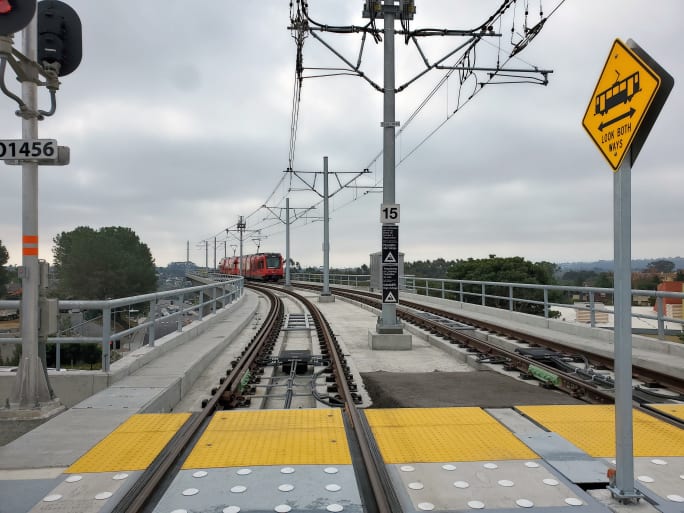
The extension provides a critical new connection for San Diego, extending the light rail line from the Old Town Transit Center north to the University Towne Center Transit Center in University City.
Behind the Funding
WSP USA was responsible for environmental, planning, preliminary, and final engineering; New Starts funding advisory services; and design services during construction of the light rail extension operated by the San Diego Metropolitan Transit System.
“The Mid-Coast project is particularly complex and required a wide range of planning and design capability, as well as flexibility, to address the needs of two rail operators and various stakeholders including the City of San Diego, UC San Diego, Caltrans, Veterans Affairs San Diego Healthcare System, and several private property owners,” says WSP representatives.
As the designer of record, WSP was charged with advancing the $2.1 billion project from environmental clearance and conceptual engineering through construction, including track and systems design and operations analysis, station design, traffic engineering, civil and utilities design, and structures design.
WSP also provided grant procurement services that led to a $1 billion Federal Transit Administration Full Funding Grant Agreement in 2016, clearing the way for construction to begin. The project was completed on time and on budget.
“WSP played a key role on the project starting as the environmental and preliminary engineering consultant by getting the project environmentally cleared in late 2014 from the San Diego Association of Governments (SANDAG) board of directors and the Federal Transit Administration (FTA), while simultaneously proceeding with advanced preliminary engineering,” WSP representatives say.
This allowed SANDAG to proceed with selection of the CM/GC, bringing the entity early in the final design phase, and allowing for a collaboration between the design team and CM/GC contractor. It also optimizes the design and reduces risk of change orders during construction.
The Importance of a Consultant
The Mid-Coast project was the largest program undertaken in the region’s history, according to WSP USA.
WSP brought together and managed a team of sub-consultants, closely coordinating with SANDAG’s team and consultant partners to advance and deliver this project.
The team included TYLin International in partnership with HDR, program management; Jacobs and PGH Wong, construction management; and the Mid-Coast Transit Constructors CM/GC team, a joint venture of Stacy and Witbeck, Herzog, and Skanska.
“The ability to ramp up and down and utilize technical specialists was also critical during construction when responding to Requests for Information and working with the contractor,” says WSP representatives. “WSP and the rest of the consultant team on the project management consultant and construction manager side were key in supporting SANDAG with on time and on budget delivery of the project.”
The firm says it required expertise and resources to deliver over 30,000 pages of the environmental documentation and nearly 7,000 pages of drawings in a short period of time.
Mid-Coast Trolley Project Benefits
In addition to the 1,170 new parking spaces at five of the new stations, the Mid-Coast Trolley Project’s benefits have a bigger impact within the community.
“Transportation capacity expansion was needed along the corridor to accommodate existing and future travel demand resulting from the expected growth in population and job opportunities,” says WSP representatives. “Additionally, there was increasing residential development in the university community, considered to be San Diego’s second downtown.”
The Mid-Coast Light Rail Transit (LRT) Extension has connected the densely populated University City community of San Diego with the rest of the LRT system, while also providing direct access to the UC San Diego campus and major medical facilities serving the broader county population, according to WSP USA.
The project also provides a connection with the City’s “Golden Triangle” situated between three freeways, I-5 on the West, I-805 on the West, and SR-52 on the South.
“This trolley extension will transform regional transit connectivity and enhance cross-border opportunities,” WSP representatives say. “The main need for the project was to help address the increase in regional growth by providing improved access to growing employment, education, and residential areas.”
More Rail

New York MTA Advances Final Contract for Second Avenue Subway Expansion
Contract Four is the largest in the Second Avenue Subway Phase 2 project and includes construction of station infrastructure, tracks, and signals for the subway expansion, MTA officials said. Work on Contract Four will begin in 2027.
Read More →
San Diego MTS Breaks Monthly Trolley Ridership Record
Agency officials said July’s ridership indicates MTS’s continued recovery from the pandemic.
Read More →
Report Examines NJ TRANSIT Reliability, Funding Challenges
The Garden State Initiative analysis examines the roles of Amtrak infrastructure, fleet management, and agency operations while recommending a more performance-based approach to improving reliability.
Read More →
Stadler, CapMetro Sign Long-Term Rail Fleet Support Agreement
Beginning in 2027, Stadler will provide on-site technical expertise, spare parts support, training, and obsolescence management to help extend the reliability and longevity of CapMetro’s GTW fleet.
Read More →
Biz Briefs: Alstom Lands Canadian Contract, LYT to Supply California TSP, and More
In METRO's latest installment, we take a look at recent news from Complete Coach Works, Beep, FlixBus, and more partnerships making headlines across the transportation sector.
Read More →
CATS Gold Line Marks 5 Years of Service, 2.8M Passenger Trips
With a six-mile expansion planned, the Charlotte streetcar is positioned to connect more neighborhoods and major transit hubs across the region.
Read More →
Why Simulating Pedestrian Movement Has Become Essential for Modern Rail Stations
Pedestrian microsimulation is helping rail planners identify bottlenecks, test station designs, and prepare complex transit hubs for growing passenger volumes.
Read More →
Amtrak Begins Major Construction at New York’s Sunnyside Yard
The new maintenance facility will support Amtrak’s Airo trainsets while improving maintenance efficiency and turnaround times in New York.
Read More →
Chicago Leaders Unveil Plans for O’Hare Airport Express Train
The privately developed project would offer a 15-minute trip between downtown and O’Hare’s Terminal 2, with trains operating every 15 minutes on a dedicated track. The service would use battery-electric trains and three existing freight rail rights-of-way.
Read More →
OCTA Maps Out 30-Year Strategy to Protect Coastal Rail Corridor
The draft feasibility report identifies strategies to protect the coastal rail line for decades as the agency continues near-term stabilization and sand placement efforts.
Read More →