



Time to turn up the volume
Adequate transit funding must become a squeaky wheel in the eyes of elected officials.
Everyone knows that the squeaky wheel gets the grease. In our hectic jobs in public transit, we all spend time, possibly too much time, on issues that are the loudest, but possibly not the most important. The same is true with elected officials. They spend most of their time dealing with the loudest issues, but not always the most important. Because of that, funding for public transit suffers.
For example, the state of Ohio ranks seventh in the nation in population and 10th in transit ridership but only 28th in transit funding per capita. This disparity doesn’t stop elected officials from making continuous requests to keep our fares low and to provide more service to underserved areas, more service for both senior citizens and the disabled and more service to assist in our job access or welfare-to-work efforts.
Elected officials hear from their constituents about service and fare-related issues, but do they hear from our customers about transit funding issues? I think not, or certainly, not enough.
The sad political reality
In many states, including Ohio, transit funding is not increasing at or near the rate of inflation; it’s actually heading the other way. As a matter of fact, Ohio has cut transit funding over the past five years by more than 60%, from $44 million in 2001 to $18 million in 2005.
Granted, Ohio has budget problems and needs to address funding crises in education, healthcare, Medicaid and several other politically fashionable concerns. When asked about the crisis in public transit funding, most elected officials say, “What crisis?” And that’s the problem.
In most state capitals across the nation, there
is not a perceived crisis in transit funding, although we all know that one exists. Elected officials may hear about funding issues from you and me, but that doesn’t count. They need to hear it from the hundreds and thousands who need and want public transit to meet their individual and community needs.
The good news is that we have recently witnessed examples of additional funding being provided for public transit in a few states. The bad news is that these funding increases have only been approved after countless damaging service cuts and widespread fare increases.
Lawmakers can often recognize a crisis when it reaches crisis proportions, but they are not always willing to take action to head off that crisis in the first place. I know that’s the way it works (or worked) in New York, where I spent most of my transit life. Every several years, we would create a crisis, or the illusion of a crisis, so that an elected official could call a press conference, ride in on a white horse with a six-foot (made for prime-time TV) check and save the day.
Elected officials, taxpayers, customers and public interest groups demand that we run our agencies like businesses. And we have. Businesses, however, must have adequate resources or supplies to enable them to produce a quality product or service. In public transit, our supply lines are being cut off and we must do something about it now.
Finding a silver lining
With the strong support and leadership of the American Public Transportation Association (APTA), we have done a great job of communicating the benefits of public transit, not just to those who use it, but also to those who don’t. We have mobilized the forces of transit agencies, suppliers and even the highway interests in pushing for a great reauthorization bill.
What we haven’t done, however, is figured out a way to adequately motivate riders on a local and statewide basis, to be loud and effective vocal advocates and demand more funding for public transit.
Many of our customers are outraged about perceived inadequate funding for education and healthcare, and others are passionate about the perception that there has been too much funding for the war against terror. Unfortunately, these same individuals appear to be mostly ignorant or totally apathetic when it comes to the public transit funding crisis.
Do our customers have too much confidence in transit managers? Do they think we can do it alone? After all, given the obstacles, we have done a great job. But it’s not getting easier.
As co-chair of APTA’s Coalition and Advocacy Committee, I know that our lack of success is not a function of our lack of will, or our lack of effort. So what do we need to do? I have an idea.
What if all the transit systems in the nation adopted a goal to create at least one funding crisis a month for the next year? Do you think that such activity would ignite advocacy for more transit funding, or just advocacy for the replacement of general managers? Whatever it takes, we must figure it out. Adequate transit funding must become a squeaky wheel in the eyes of elected officials. The quality of life of our customers and our nation depends upon it.
A call for beautiful music
We all know that an important skill for a general manager in the transit industry is the ability to pull the occasional “rabbit out of a hat” with regard to solving funding issues.
In an industry that has been striving to develop and operate quieter and quieter buses and trains, I think a new but equally important skill needs to be further developed.
Just as a conductor leads an orchestra to make beautiful music, we must learn to lead our customers and the public, through education and the building of coalitions, to make music as well. This music, however, although sounding beautiful to some, must sound to our elected officials like a squeaking wheel that just cannot be ignored.
More Management

ENC Lands MATA Contract and More in Biz Briefs
In this edition of Biz Briefs, we spotlight the latest developments shaping the future of mobility.
Read More →
From Surviving to Thriving: Building Stronger Transportation Organizations
Bus Business Consultants founder Brian Dickson shares lessons on leadership, organizational health, and creating options for long-term success in a changing transportation industry.
Read More →
Everett Transit, Community Transit Outline Consolidation Agreement
The proposed agreement calls for a 50% increase in bus service in Everett, a new microtransit zone, continued paratransit service, and the transfer of Everett Transit operations to Community Transit.
Read More →

Strada360’s Steve Lassey on Turning Transit Data Into Better Decisions
From breaking down data silos to preparing for AI, Strada360 CEO Steve Lassey discusses how transit agencies can use technology to improve operations, customer information, and long-term decision-making.
Read More →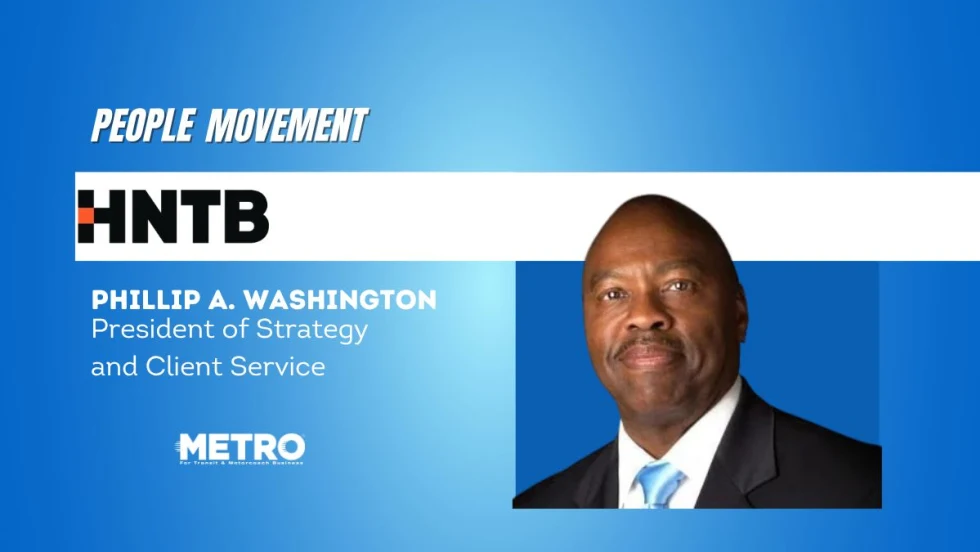
People Movement: Phil Washington Joins HNTB, Denver RTD Launches CEO Search, and More
In this edition, we also spotlight recent personnel moves at STV, the Eno Center for Transportation, and more, highlighting the people taking on new roles across the transportation industry.
Read More →
SEPTA Details Accelerate Vision for Transit System
The plan outlines investments in trolley modernization, new Metro and Regional Rail vehicles, accessible stations, and more frequent bus and rail service.
Read More →
FTA Ends Direct Oversight of MBTA Safety Actions
The federal agency closed its remaining special directive to the Massachusetts Department of Public Utilities following a safety review that began in 2022.
Read More →
Report: Transit Bus Manufacturing Supports 34,100 Jobs, $5.1B in GDP
The “Buses Mean Business” report examines the transit bus manufacturing industry’s economic footprint, supply chain, and rising demand for vehicle replacements.
Read More →
LIT Marks 10-Year Milestone at Annual Summit
Hosted by the COTA from September 10 to 13, the Summit carried the theme “Celebrating 10 Years of Excellence, Leadership, and Impact,” with every part of the program honoring the people, agencies, and partners who built LIT over its first decade.
Read More →
People Movement: Dan Dipert Coaches Adds Third-Generation Leader, Keolis Names New Valley Metro VP/GM, and More
In this edition, we also cover recent appointments and announcements at the Wabtec, SilverRide, HNTB, and more, showcasing the individuals helping to shape the future of transportation.
Read More →