



Transit Agencies Cultivate Customer Base to Grow Rail Ridership
As unemployment numbers grow in the midst of the recession, transit ridership numbers have dipped. To help boost ridership, transit agencies are developing marketing campaigns and promotions, partnering with local businesses and sports teams, and implementing employee discount programs, with much success.
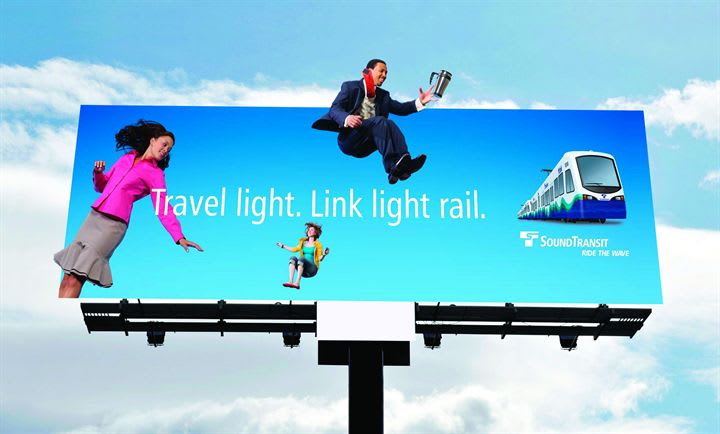
Seattle-based Sound Transit's 'Travel Light' campaign urged riders to fly out of their vehicles and onto its new light rail line system.
[IMAGE]MET11Ridership-Minnesota-2.jpg[/IMAGE]A couple of years back, rising fuel prices helped expand public transportation ridership to record levels. However, the balloon soon burst when those fuel prices inched down while unemployment numbers crept up.
"Like a lot of other systems around the country, our ridership had really fallen off when gas prices lowered and unemployment, which is about 12 percent down here, rose," explains Bonnie Arnold, director of marketing for the South Florida Regional Transportation Authority (SFRTA). "As a result, our ridership was actually falling off at about the same rate as unemployment."
Adds Bob Gibbons, director of customer services at Metro Transit in Minneapolis/St. Paul: "The unemployment rate here is better than national numbers, but the economy reduced our ridership last year to 76.3 million, compared to 81 million rides the year before."
Despite the dip, the good news is that public transportation ridership is still higher than it was before fuel prices escalated and, in the second quarter of 2010, more than 2.5 billion trips were taken on U.S. public transportation systems as ridership increased by 0.1 percent over the second quarter of 2009, according to a recent American Public Transportation Association (APTA) report.
The uptick in ridership is the first increase in six quarters.
So, how are public transportation systems succeeding in boosting ridership numbers? It seems to run the gamut from marketing to partnering with other organizations to in-depth studies of the services being provided. Whichever method an agency chooses, however, the important factor is knowing who your customers are.
Targeting Sports fans
This year's Major League Baseball season saw the opening of Target Field, the new home of the Minnesota Twins. While at the Twins' old ballpark, the Hubert H. Humphrey Metrodome, Metro Transit's Hiawatha light rail system carried approximately 12 percent of the fans attending games, even though overall attendance was down, according to Gibbons.
With the new ballpark set to open a mere 12 blocks from the old venue and attendance projected to hit 40,000 people per game, the Twins, City of Minnesota, Minnesota Department of Transportation and Metro Transit partnered to help fans find a way to get to Target Field.
"Even though the new park is only 12 blocks away from the Metrodome, it is across town in a place — the Warehouse District — that would have typically have been unfamiliar to most baseball fans," Gibbons explains. "Our partnership led to the creation of a special website called DestinationTargetField.com."
The new website outlined all of the various transportation options to get to the new ballpark, including public transportation, car, bicycle or walking, and became a focal point for the publicity leading up to its opening. The key message, Gibbons says, was to encourage people to use public transportation, especially since both Metro Transit's Hiawatha light rail and Northstar commuter rail lines have stations steps away from the left field foul pole. It turns out to have been a very successful campaign in its initial year.
"The [customer] base is a lot bigger, since the ballpark seats 40,000 and is sold out every game, but the Hiawatha line serves about 5,500 people, or 14 percent of the fans attending the game," Gibbons says. "If you add in commuter rail and a special bus route that we have created from the western suburbs that serves every Twins game, the market share is 20 percent of the people who attend Twins games."
Overall, Gibbons explains that Metro Transit, with its services to not only Twins games but also the National Football League's Minnesota Vikings games, plays a huge role in the Hiawatha and Northstar lines' 13 percent combined growth over the first eight months of 2010.
Focused Advertising
Seattle's Sound Transit is a firm believer in advertising, says Marketing and Creative Services Manager Tim Healy. To help boost ridership on its new light rail system from downtown Seattle to Seattle-Tacoma International Airport, Sound Transit used its advertising know-how to its advantage.
"To get ready for the light rail launch, we developed a campaign called 'Travel Light,'" Healy explains. "It was the first time we ventured into television advertising, rather than just public service announcements, and it was a fun campaign."
The commercials used to help spread the word about the new system featured a woman stuck in traffic who began floating up and out of her vehicle and into a light rail car. Following the system's launch, the campaign message switched to say the system was now open and featured outdoor advertising and extensive print magazine ads, with particular emphasis on inclusion in in-flight magazines. The campaign recently won an APTA Adwheel award.
Healy says that an important part of Sound Transit's advertising is targeting the right demographic. To do so, the agency used the market segmentation services of Nielsen Claritas, a company that provides syndicated surveys and databases on consumer behavior.
"You can actually target down to zip codes because, according to this research method, people of like minds tend to live in certain areas," Healy explains.
In general, Sound Transit's ads have targeted the "convertible rider" - people who aren't transit dependent, have more expendable income and are more likely to use transit if you give them a good reason, such as saving money or being more environmentally friendly.
"People who believe in being environmentally friendly can be convinced to use transit because it helps the environment but, in this economy, we are finding that saving money also really plays well," Healy says.
To help play up public transportation's money saving benefits touted by APTA, Sound Transit's 2009 advertising campaign featured messages including "Take This Bus to Hawaii" and "This Bus Pays for College."
Sound Transit's advertising campaigns have been successful in building ridership numbers from 14,000 to 25,000 per day. The "Take this bus to Hawaii" ads even spawned a partnering program with the Oahu Convention and Visitors Bureau, which donated two trips to Hawaii that the agency gave away through a promotion with two local radio stations. The success of that partnership has opened the door for Sound Transit to embark on promotions with other entities, including Hilton Hotels and the YMCA.
[PAGEBREAK][IMAGE]MET11Ridership-Sound2-2.jpg[/IMAGE]Outreach, rewards
To increase sales of its monthly passes, the SFRTA's Tri-Rail began its Rail Rewards program, which provides value-added special offers and coupons from South Florida-based restaurants, attractions and retailers with the purchase of a Tri-Rail Monthly Ticket.
"We keep it fresh by constantly adding partners so, when customers log on at the first of the month, they never know what they may find," Arnold explains. "In September, we had more than 2,000 hits on our Rail Rewards [website], so people are definitely interested and it's generating some talk and some ridership."
Like many agencies around the nation, SFRTA experienced a dip in ridership once the recession hit. The agency's inability to lock down a steady funding source for Tri-Rail made things more difficult, but, in December 2009, the Florida Legislature passed a bill for dedicated funding to the tune of $14.3 million per year, enabling the agency to maintain its services.
Turning its focus to the large population of senior citizens in South Florida, SFRTA also participates in trade fairs and outreach events that are geared toward seniors, to promote the system's services. For many of these fairs, SFRTA partners with pharmaceutical company Pfizer, which uses the same advertising firm.
One particularly successful partnership that has helped grow senior ridership is SFRTA's participation in Holy Cross Hospital's annual "Senior Idol" competition, which resembles the popular "American Idol" television show.
"You have to be 65 or older to participate. Out of those who audition, we pick our finalists and put on a program at one of the theaters in Ft. Lauderdale where our 'Senior Idol' winner is then crowned," Arnold explains. "It's great because people participating in the auditions come from all these senior citizen and assisted living communities throughout the area and they talk, so it really gets the word out."
Arnold adds that the program has sold out for each of the last five years, and that for a relatively small financial investment, SFRTA gets a ton of exposure from the media, especially during the auditions, which further helps generate tremendous word-of-mouth throughout the entire community.
Business programs
One steady yet still growing initiative for boosting ridership for many agencies around the nation is employer discount programs.
"[The program] has been the No. 1 ridership builder for us and that continues to be the case, particularly with the many state and city government employees here in Nashville," says Paul Ballard, CEO for Nashville Metropolitan Transportation Authority. "We have a staff member who is devoted pretty much full time to going out and visiting potential entities and employers to get them to participate in the program. That personal attention has helped generate a lot of interest."
Generally, employer discount programs see agencies offering monthly or yearly passes, usually at a discount, to businesses who in turn offer them to employees as an additional benefit. Employers can also choose to subsidize or pay for the entire pass outright for their employees and receive both federal and state tax credits. Many employers who offer the program to employees will also deduct the cost of the passes from the employees' checks pretax.
Minnesota's Metro Transit has had its employer discount program in place for about 10 years. Gibbons says that according to the agency's numbers, more than 40 percent of the people who work in downtown Minneapolis and 20 percent of the folks working in downtown St. Paul use public transportation.
"Because of those numbers, it has become a much sought after benefit," he says. "Additionally, we're taking cars off the road during rush hour and have become an important part of the business and economic infrastructure in the community, which has helped to raise our stature."
In addition to reaching out to companies throughout the area, SFRTA has also tied in its employer discount program with the aforementioned Rail Rewards program.
"We do sales initiatives to get the word out and use Rail Rewards as an additional perk," Arnold says. "Currently, we have about 2,700 companies enrolled - some may only have a couple of people using the program while others, such as American Airlines, have close to 1,400 employees taking advantage of the benefit."
[PAGEBREAK]Service revamps
In Pittsburgh, the Port Authority of Allegheny County, which is seeing a slight decrease in ridership, completed its first comprehensive overview of its entire system in more than 50 years to help boost its numbers.
"Dealing in an environment of constrained resources, we thought we had an obligation, both to our funders and customers, to deliver as good as service as we can," says Wendy Stern, assistant GM, service planning & development at the Port Authority. "Where people live, the number of jobs downtown — all of that has changed somewhat, so we knew we really needed to take a comprehensive look, figure out where our customer base was and how we could best serve the market."
As a result of its study, the Port Authority began implementing route changes, many of which were suggested by the customers themselves, in a phased approach beginning April 2010. As of September 2010, the Authority had implemented approximately 80 percent of the planned changes, with "simpler, better, faster" as its mantra, Stern says.
"We looked at how to make our services more efficient and eliminate duplication to make the experience better for our riders, which involves reducing the number of stops," Stern explains. "It's really not about downsizing the overall system; however, it's about reallocating the resources to put service where people are."
When the Port Authority's efforts are complete, it will reduce the number of routes on its services 35 percent, from 180 to 122, while increasing services in its primary markets and making services more efficient in others.
"We'll be providing better service to 75 percent of our existing riders, while also maintaining some level of service to the overwhelming majority of our riders — more than 99 percent," Stern says. "When everything is complete, we're hoping to attract 10 percent more riders within one to two years, as well as increase productivity by 10 percent and decrease our operating costs by 10 percent."
More Rail

New York MTA Advances Final Contract for Second Avenue Subway Expansion
Contract Four is the largest in the Second Avenue Subway Phase 2 project and includes construction of station infrastructure, tracks, and signals for the subway expansion, MTA officials said. Work on Contract Four will begin in 2027.
Read More →
San Diego MTS Breaks Monthly Trolley Ridership Record
Agency officials said July’s ridership indicates MTS’s continued recovery from the pandemic.
Read More →
Report Examines NJ TRANSIT Reliability, Funding Challenges
The Garden State Initiative analysis examines the roles of Amtrak infrastructure, fleet management, and agency operations while recommending a more performance-based approach to improving reliability.
Read More →
Stadler, CapMetro Sign Long-Term Rail Fleet Support Agreement
Beginning in 2027, Stadler will provide on-site technical expertise, spare parts support, training, and obsolescence management to help extend the reliability and longevity of CapMetro’s GTW fleet.
Read More →
Biz Briefs: Alstom Lands Canadian Contract, LYT to Supply California TSP, and More
In METRO's latest installment, we take a look at recent news from Complete Coach Works, Beep, FlixBus, and more partnerships making headlines across the transportation sector.
Read More →
CATS Gold Line Marks 5 Years of Service, 2.8M Passenger Trips
With a six-mile expansion planned, the Charlotte streetcar is positioned to connect more neighborhoods and major transit hubs across the region.
Read More →
Why Simulating Pedestrian Movement Has Become Essential for Modern Rail Stations
Pedestrian microsimulation is helping rail planners identify bottlenecks, test station designs, and prepare complex transit hubs for growing passenger volumes.
Read More →
Amtrak Begins Major Construction at New York’s Sunnyside Yard
The new maintenance facility will support Amtrak’s Airo trainsets while improving maintenance efficiency and turnaround times in New York.
Read More →
Chicago Leaders Unveil Plans for O’Hare Airport Express Train
The privately developed project would offer a 15-minute trip between downtown and O’Hare’s Terminal 2, with trains operating every 15 minutes on a dedicated track. The service would use battery-electric trains and three existing freight rail rights-of-way.
Read More →
OCTA Maps Out 30-Year Strategy to Protect Coastal Rail Corridor
The draft feasibility report identifies strategies to protect the coastal rail line for decades as the agency continues near-term stabilization and sand placement efforts.
Read More →