



Transit agencies partner to prevent sexual assault
Teaming with advocacy groups to empower riders to stop sexual assault and harassment, using new campaigns and communication tools.

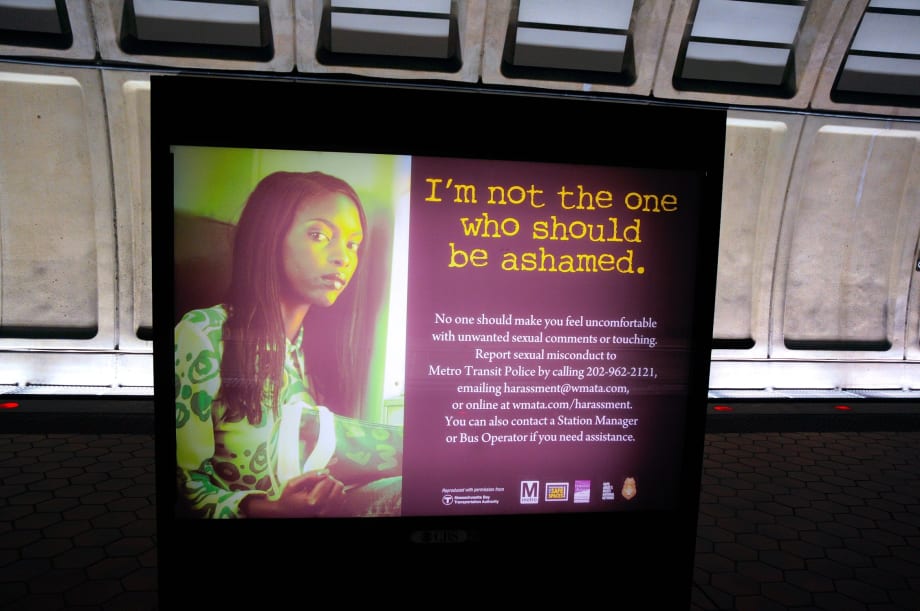
In the year ahead, Metro is also planning to implement a training program for front-facing employees, such as station managers and bus operators, for responding to victims.
In the year ahead, Metro is also planning to implement a training program for front-facing employees, such as station managers and bus operators, for responding to victims.
Transit systems and advocacy groups are teaming up to empower riders to stop sexual assault and harassment, using new campaigns and communication tools.
The anti-violence groups heard about incidents from passengers and advised transit operators, including the Massachusetts Bay Area Transportation Authority (MBTA), the Washington Metropolitan Area Transportation Authority (Metro) and Ottawa’s OC Transpo, on taking preventive steps. In response, MBTA provided an app and Metro created a Web portal for passengers to communicate with them about the incidents. The two systems also shared a Public Service Announcement (PSA) campaign.
The Boston Area Rape Crisis Center, Fenway Health and the MBTA formed a partnership to revive an initiative started in 2008 to combat sexual assault and harassment on the transit system.
The campaign puts across a clear, strong message that inappropriate behavior and illegal sexual touching will not be tolerated and urges riders to report these incidents and take action to prevent them.
MBTA put up posters in trains and buses that now feature QR codes that direct riders to a Web page with a downloadable “See Something, Say Something” app. The app allows riders to send a message and photo of the offender to transit police. As an added safety feature, the app automatically disables the phone’s flash.
“One of the suggestions we made to our passengers is if you can safely do so, take a photo with your phone of the offender and send it to us,” Chief Paul MacMillan, MBTA Transit Police, said. “If we don’t know the individual — [many] are chronic offenders — we will send that picture to the media and ask for the public’s help in identifying [them].”
MacMillan said that the campaign is now more diverse in its reach with the recent partnership with Fenway Health, an advocacy group for gay, lesbian, bisexual and transgendered communities. Posters also now convey that men as well as women may be victims of harassment or assault.
To empower passengers to respond to an incident when it happens to them, he added, the first thing they should do is tell their fellow passengers what is happening.
“We find that most of these types of offenders are non-violent and [will] be embarrassed by you calling them out,” MacMillan explained. “Most importantly, report it to the police. We take that information and target our resources to the areas where incidents are occurring.”
When MBTA first started the campaign, it saw a 58% increase in the number of sexual harassment and assault reports, showing that they are underreported crimes.
Meanwhile, last year when Metro was alerted by an advocacy group that its riders didn’t feel safe, the agency immediately licensed MBTA’s PSA campaign, which the Boston-based agency provided free of charge.
To develop its response, like MBTA, the transit system worked with local advocacy groups, including Collective Action for Safe Spaces (formerly
HollaBack DC!); DC Rape Crisis Center; and Rape, Abuse and Incest National Network.
The situation came to Metro’s attention after Collective Action advocates testified in front of the Washington, D.C. City Council early last year, sharing reports from its website of people who had been victimized on the system.
“They felt that there wasn’t enough being done,” Caroline Lukas, manager, media relations, said. “It was the first time it had been [brought] to our attention. We wanted to make sure we responded very quickly.”
Metro also launched a Web portal for riders to report sexual harassment and assault incidents. The report is emailed to Metro’s Chief of Police. Metro then tries to make initial contact with the victim within 48 hours.
The online reporting tool provides a new way for Metro to capture the information since it had never before recorded or kept track of cases of verbal harassment.
“Technically it’s not considered a crime to tell somebody something inappropriate, unfortunately,” Lukas said.
However, the Web portal gives riders a place to provide that information, whether the incident was illegal or not.
The portal also gives Metro more data to help identify problem spots on the system.
Another benefit of the portal is that riders can provide information without having to call transit police.
“Sometimes, somebody says or does something, and … we don’t think it warrants enough [for a] call to transit police,” Lukas said. “But perhaps you leave the system and are still upset. There’s no way to follow up with the [offender] but you want us to know about it.”
In the year ahead, Metro is also planning to implement a training program for front-facing employees, such as station managers and bus operators, for responding to victims.
Additionally, Hollaback!, an international advocacy group focused on ending street harassment against women, is partnering with OC Transpo to form a plan to increase public awareness of assaults and provide education on how to detect and respond to incidents.
Julie LaLonde, director, Ottawa Hollaback!, said the group scanned stories it received on its website, identifying harassment on transit as one of the main concerns.
“In particular, people don’t feel comfortable reporting it,” LaLonde said. “These things happen in plain sight of other people and there’s little to no bystander intervention. What we’re hearing is people don’t know what it is that they’re seeing. They know something is going on, but they’re not sure what it is or what they should do.”
John Manconi, GM, OC Transpo, said that in a recent meeting the transit system and advocacy group identified a common goal of educating the public that safety is everyone’s responsibility and discussed opportunities, such as ad campaigns on buses and promotional materials.
Hollaback also educated OC Transpo on Green Dot Strategy, a philosophy that directs bystanders to get involved. For example, if a rider sees someone moving around frequently on a bus, they should make people aware or speak to the driver when safe to do so.
More Rail

New York MTA Advances Final Contract for Second Avenue Subway Expansion
Contract Four is the largest in the Second Avenue Subway Phase 2 project and includes construction of station infrastructure, tracks, and signals for the subway expansion, MTA officials said. Work on Contract Four will begin in 2027.
Read More →
San Diego MTS Breaks Monthly Trolley Ridership Record
Agency officials said July’s ridership indicates MTS’s continued recovery from the pandemic.
Read More →
Report Examines NJ TRANSIT Reliability, Funding Challenges
The Garden State Initiative analysis examines the roles of Amtrak infrastructure, fleet management, and agency operations while recommending a more performance-based approach to improving reliability.
Read More →
Stadler, CapMetro Sign Long-Term Rail Fleet Support Agreement
Beginning in 2027, Stadler will provide on-site technical expertise, spare parts support, training, and obsolescence management to help extend the reliability and longevity of CapMetro’s GTW fleet.
Read More →
Biz Briefs: Alstom Lands Canadian Contract, LYT to Supply California TSP, and More
In METRO's latest installment, we take a look at recent news from Complete Coach Works, Beep, FlixBus, and more partnerships making headlines across the transportation sector.
Read More →
CATS Gold Line Marks 5 Years of Service, 2.8M Passenger Trips
With a six-mile expansion planned, the Charlotte streetcar is positioned to connect more neighborhoods and major transit hubs across the region.
Read More →
Why Simulating Pedestrian Movement Has Become Essential for Modern Rail Stations
Pedestrian microsimulation is helping rail planners identify bottlenecks, test station designs, and prepare complex transit hubs for growing passenger volumes.
Read More →
Amtrak Begins Major Construction at New York’s Sunnyside Yard
The new maintenance facility will support Amtrak’s Airo trainsets while improving maintenance efficiency and turnaround times in New York.
Read More →
Chicago Leaders Unveil Plans for O’Hare Airport Express Train
The privately developed project would offer a 15-minute trip between downtown and O’Hare’s Terminal 2, with trains operating every 15 minutes on a dedicated track. The service would use battery-electric trains and three existing freight rail rights-of-way.
Read More →
OCTA Maps Out 30-Year Strategy to Protect Coastal Rail Corridor
The draft feasibility report identifies strategies to protect the coastal rail line for decades as the agency continues near-term stabilization and sand placement efforts.
Read More →