




RELATED: A Creative Approach to Establishing a Transit System's Safety Culture
Bringing Life-Saving CPR Training to Transit Stations
There’s a lot to do to pass time waiting at the station for a train — read…listen to music…learn how to save a life? Yes, in the minutes it takes for a train to arrive, a person can learn Hands-Only CPR.
October 10, 2018
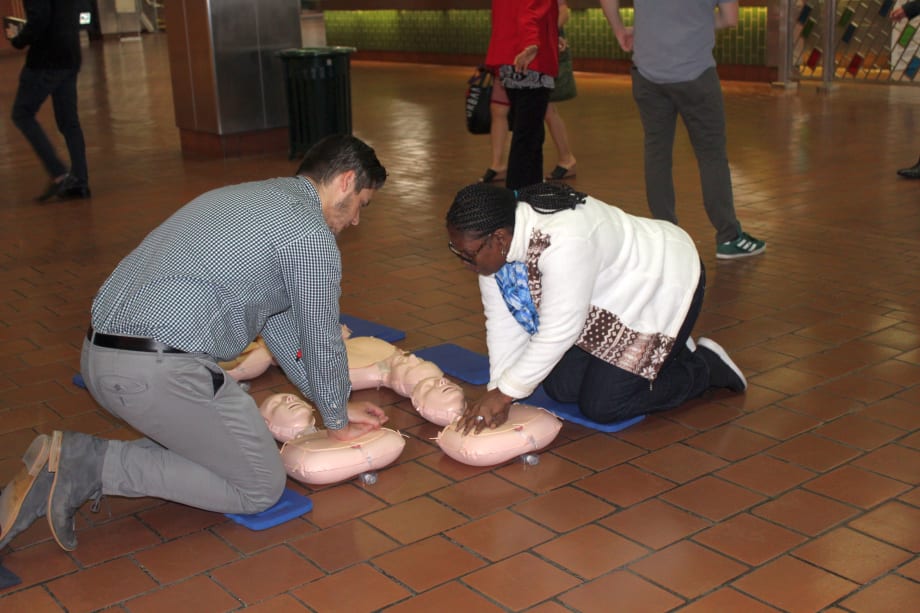
SEPTA’s System Safety Division partnered with The Mobile CPR Project to bring free hands-only CPR and Automated External Defibrillator (AED) instruction at two downtown Philadelphia commuter rail stations. Photo: SEPTA
3 min to read
SEPTA’s System Safety Division partnered with The Mobile CPR Project to bring free hands-only CPR and Automated External Defibrillator (AED) instruction at two downtown Philadelphia commuter rail stations. Photo: SEPTA
There’s a lot to do to pass time waiting at the station for a train — read…listen to music…learn how to save a life? Yes, in the minutes it takes for a train to arrive, a person can learn Hands-Only CPR (without rescue breaths), which, according to the American Red Cross, can be as effective as traditional CPR when administered immediately.
As part of its safety education outreach, SEPTA’s System Safety Division partnered with The Mobile CPR Project to bring free hands-only CPR and Automated External Defibrillator (AED) instruction at two downtown Philadelphia commuter rail stations. Through five sessions in August and September, almost 200 people were trained in the basic skills that could help them save someone suffering from cardiac arrest.
“We transport more than one million riders a day,” said Carrie Givhan, SEPTA safety training program specialist. “There is a real possibility of encountering someone experiencing cardiac arrest while riding on or waiting for a train, bus, or trolley to arrive. Knowing basic CPR compressions can help keep someone alive until an AED is retrieved and emergency personnel arrive on the scene.”
The Mobile CPR Project was created in June 2016, funded by a three-year grant from Independence Blue Cross Foundation. The organization is part of a collective effort to break down barriers, such as cost, time, and location. The Project provides access to CPR education in Philadelphia and its surrounding counties by traveling throughout the region to teach participants how to recognize cardiac arrest, how to perform proper chest compressions, and what steps to take as a bystander.
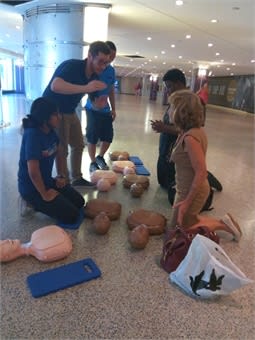
Through five sessions held at two SEPTA train stations in August and September, almost 200 people were trained in the basic skills that could help them save someone suffering from cardiac arrest. Photo: SEPTA
“Our goal is to teach 10,000 people Hands-Only CPR by June 2019 and to reduce the fear some have about performing CPR on someone in need,” said Gus Totolos, project coordinator for The Mobile CPR Project. Through September, the group had reached more than 7,300 individuals.
The Mobile CPR Project was scheduled to visit Amtrak’s 30th Street Station in Philadelphia in October and SEPTA was exploring the possibility of expanding its partnership with the organization to stations located near college campuses.
CPR training on transit is not unique to the Philadelphia region. The American Heart Association and Illinois Heart Rescue brought Hands-Only CPR training to Chicago-area Metra commuters in 2017, and in Mumbai, signs posted on trains show passengers the steps to take to administer CPR. “You never know when or where a medical emergency requiring CPR might happen,” said Givhan. “Our goal is to teach our customers skills that could not only be put into use when commuting on our system, but possibly at home, at work or even when walking down the street.”
Heather Redfern is the Public Information Manager for the Southeastern Pennsylvania Transportation Authority.
Subscribe to Our Newsletter
More Blog Posts
Improving Transit Accessibility by Offering Assistive Listening
Did you know that there are literally tens of millions of people worldwide with hearing loss, many of whom will use some form of public transit at some point?
Read More →
35 Years of the ADA, Making Travel Easier for Seniors
Thirty-five years after the passage of the Americans with Disabilities Act of 1990 (ADA), the impact of this landmark piece of civil rights legislation cannot be overstated.
Read More →
Driving Performance with Purpose: How I Lead One of Greyhound’s Top Teams
Safety, on-time performance, and customer experience are critical elements in intercity bus operations. But getting them right doesn’t come down to plans or protocols alone. It comes down to execution. How well your team performs on the ground, in real time, is what defines success.
Read More →
Navigating Emerging Privacy Laws: A Call to Action for Service Providers in Mass Transit
With Data Privacy Day Jan. 28, I want to spotlight a critical challenge faced by service providers in the mass transit sector: managing personal information responsibly in an era of rapidly evolving privacy regulations.
Read More →
Human Trafficking Awareness: What Public Transportation Can Do?
January is National Slavery and Human Trafficking Prevention Month in the U.S., and January 11 is National Human Trafficking Awareness Day.
Read More →
Want to Improve Transit Safety and Operations? Break Down the Silos
Retrieving and reviewing data and video can be a cumbersome process for fleet managers. Each system or tool provides a piece of the puzzle, but seeing the complete picture requires tedious manual synchronization.
Read More →
Ensuring Public Transit Cybersecurity Through Robust Protective Measures
In today’s highly connected world, cybersecurity is of utmost importance, particularly for transportation agencies overseeing transit bus systems that rely increasingly on sophisticated technologies, including the use of data analytics in traffic signal networks, to manage and operate their systems.
Read More →
How Advances in Thermal Management Revolutionize Urban Mobility
In the daily hustle and bustle of city life, transit buses serve as the backbone of urban transportation, allowing millions of city dwellers to get from point A to point B each day reliably.
Read More →
The Evolution of Bus Design
Thirty years ago, drivers not only had to drive the bus and navigate heavy traffic, but they were also responsible for tasks like supervising passenger loading and unloading, selling tickets, and providing passengers with various kinds of information, all while sitting in an often ill-fitting workstation.
Read More →
What 'Transit Safety 101' Really Means
Safety, Safety, Safety. This word is used repeatedly, and in many contexts, without most people understanding what it actually means.
Read More →