




RELATED: Addressing Sleep Apnea in Public Transit Operations
Danger Ahead: Sleep Loss, Safety, and You
Sleep loss leading to human fatigue is a serious issue affecting the safety of the traveling public in all modes of transportation. Simply defined, sleep loss is an inability to receive a proper amount and quality of sleep on a regular basis.
February 13, 2018

5 min to read

Sleep loss leading to human fatigue is a serious issue affecting the safety of the traveling public in all modes of transportation. “Nearly 20% of the 182 major National Transportation Safety Board (NTSB) investigations completed between Jan. 1, 2001 to Dec. 31, 2012, identified fatigue as a probable cause, contributing factor, or a finding” (Reduce Fatigue-Related Accidents, 2016, p. 1).
Sleep Loss
Simply defined, sleep loss is an inability to receive a proper amount and quality of sleep on a regular basis. There are many contributing sources to sleep loss. They include: mental or emotional stress, medications, short or long-term medical conditions, work induced factors (shiftwork, long hours or weeks), and lifestyle choices. These can exist in combination with others.
54% of transportation workers receive less than seven hours of sleep as reported in a Centers of Disease Control and Prevention survey of 180,000 participants. (Shockey & Wheaton, 2017).
The Necessity of Sleep
To prevent sleep loss, the National Sleep Foundation (NSF) recommendations that adults ages 18 through 64 receive at least seven- to nine-hours of sleep. Sleep is a biological necessity. You may be able to go without water or food for days, but you cannot go without sleep for days. Sleep is a time reserved for the body to perform a host of vital physical and mental maintenance functions. Upon completion of sleep, the body produces a fully physically-rested and mentally alert person.
When the proper amount or quality of sleep is not obtained, the body responds by sending out a number of different warning signals to alert us that more sleep is needed. These warnings produce noticeable increases and decreases in physical and mental capabilities as well as behavioral changes (Figure 1).
Increased | Decreased |
Drowsiness | Judgement |
Risk taking | Motivation |
Irritability | Reaction times |
Poor concentration | Hand-eye coordination |
Poor attention span | Communication |
Figure 1. Sleep Loss Warning Signals
Our View of Sleep
Unfortunately, we do not place the same importance on sleep as our body does. We are very comfortable with getting less sleep, whether it’s per day, per week, or per month. The thought of making up for lost sleep or establishing a regular sleep schedule is not a priority. This inaccurate view of sleep results in a haphazard sleep pattern and an acceptance of tiredness as being a normal condition.
Safety Hazard? What Hazard?
We rarely think of sleep loss as a safety hazard. Instead, we understand safety as a set of rules or practices of do’s and don’ts while at work. So, sleep loss does not seem to qualify or fit in what we know about safety. However, when coming to work tired, sleep loss becomes a legitimate safety hazard.
Consider this. How many times have you felt fully rested and mentally alert after getting less sleep? Thinking everything is fine, you start your shift only to realize a short time later how tired you really are. You are forgetful; moving slow; and your concentration is hindered. It’s only then that you realize you should have gotten more sleep.
This example shows how very inadequate we are in assessing our own level of tiredness or its severity. Even when we realize our tiredness, we tend to ignore it. It’s our acceptance of tiredness and a reluctance to prevent or remedy this situation that makes sleep loss a safety hazard.
Sleep Loss Rx
To understand how much sleep you are losing, you can do this simple self-check by recording your sleep hours and pattern. The sleep debt bar graph shows how this can be done (Figure 2).
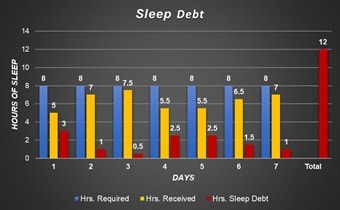
Figure 2. Sleep Debt Bar Graph
Record the number of hours of sleep you should get versus the hours you actually get each day. The difference in these hours is your sleep debt. You can also record how tired or refreshed you are after each day. As you keep track, pay particular attention to the number of sleep debt hours you accumulate over a given period. If your sleep debt seems to be adding up on a regular basis, chances are you are more tired than you think and you may a potential safety risk.
Most Fatigue Scientists agree that “if an individual has greater than 10 hours of … sleep debt, then mental fatigue is likely to have reached a point where cognitive performance will be degraded (Miller, 2017, p. 35).
To recover from sleep loss, it is very important to pay back the hours of sleep that were missed or lost. The way in which you repay sleep debt hours will vary widely from person to person (Miller, 2017).
One way is to extend your sleep hours. The best time may be on your days off. For example, on the weekend you may sleep 10 to 14 hours, rather than the usual five to six hours you would get on a workday. A second way is to add a portion of your sleep debt hours to the hours you are supposed to get each night. For instance, you would add perhaps an hour or two over a seven-day period. So, if your sleep debt was 12 hours total, you could repay two hours of additional sleep each night over a six-day period. Whichever way you choose or works best for you, the extra sleep you decide to get must consist of a proper amount and quality and occur at nighttime.
What Will You Do?
Sleep loss is a hidden safety hazard waiting to happen. It does not care whether you are a worker, supervisor, or manager. The root cause lies in deciding how much or how little sleep you get and how rested you are on a consistent basis. We must constantly remind ourselves that we are charged with our own personal safety and the safety of the travelling public.
Joe Balas is principal at Human Factors Safety LLC.
References
Miller, J. C. (2017). Anatomy of a Fatigue-Related Accident. CreateSpace.
Reduce Fatigue-Related Accidents. (2016). Retrieved from National Transporation Safety Board: https://www.ntsb.gov/safety/mwl/Pages/mwl1-2016.aspx
Shockey, T. M., & Wheaton, A. G. (2017, March 3). Short Sleep Duration by Occupation Group — 29 States, 2013–2014. Morbidity and Mortality Report (MMWR). Atlanta: Center for Disease Control and Prevention. Retrieved from Centers for Disease Control and Prevention: https://www.cdc.gov/mmwr/volumes/66/wr/mm6608a2.htm?s_cid=mm6608a2_e
Subscribe to Our Newsletter
More Blog Posts
Improving Transit Accessibility by Offering Assistive Listening
Did you know that there are literally tens of millions of people worldwide with hearing loss, many of whom will use some form of public transit at some point?
Read More →
35 Years of the ADA, Making Travel Easier for Seniors
Thirty-five years after the passage of the Americans with Disabilities Act of 1990 (ADA), the impact of this landmark piece of civil rights legislation cannot be overstated.
Read More →
Driving Performance with Purpose: How I Lead One of Greyhound’s Top Teams
Safety, on-time performance, and customer experience are critical elements in intercity bus operations. But getting them right doesn’t come down to plans or protocols alone. It comes down to execution. How well your team performs on the ground, in real time, is what defines success.
Read More →
Navigating Emerging Privacy Laws: A Call to Action for Service Providers in Mass Transit
With Data Privacy Day Jan. 28, I want to spotlight a critical challenge faced by service providers in the mass transit sector: managing personal information responsibly in an era of rapidly evolving privacy regulations.
Read More →
Human Trafficking Awareness: What Public Transportation Can Do?
January is National Slavery and Human Trafficking Prevention Month in the U.S., and January 11 is National Human Trafficking Awareness Day.
Read More →
Want to Improve Transit Safety and Operations? Break Down the Silos
Retrieving and reviewing data and video can be a cumbersome process for fleet managers. Each system or tool provides a piece of the puzzle, but seeing the complete picture requires tedious manual synchronization.
Read More →
Ensuring Public Transit Cybersecurity Through Robust Protective Measures
In today’s highly connected world, cybersecurity is of utmost importance, particularly for transportation agencies overseeing transit bus systems that rely increasingly on sophisticated technologies, including the use of data analytics in traffic signal networks, to manage and operate their systems.
Read More →
How Advances in Thermal Management Revolutionize Urban Mobility
In the daily hustle and bustle of city life, transit buses serve as the backbone of urban transportation, allowing millions of city dwellers to get from point A to point B each day reliably.
Read More →
The Evolution of Bus Design
Thirty years ago, drivers not only had to drive the bus and navigate heavy traffic, but they were also responsible for tasks like supervising passenger loading and unloading, selling tickets, and providing passengers with various kinds of information, all while sitting in an often ill-fitting workstation.
Read More →
What 'Transit Safety 101' Really Means
Safety, Safety, Safety. This word is used repeatedly, and in many contexts, without most people understanding what it actually means.
Read More →