



Keeping Old School Practices in New Bus Operating Training
Today I’d like to mention a few effective policies that were routinely utilized in the past, which were (and for the few agencies that still practice them) very effective in producing safe bus operators, including covering your right, terminal checks and company vehicles.


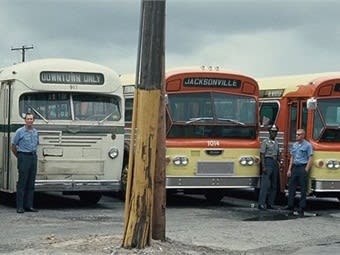
Today I’d like to mention a few effective policies that were routinely utilized in the past, which were (and for the few agencies that still practice them) very effective in producing safe bus operators.
Cover Your Right: I can still hear my instructor urging me to “cover my right.” I don’t hear these words today being utilized in my conversations with instructors. Contact occurring on the right side of the bus due to “sending an invitation” to a motorist to proceed with their vehicles along the bus’s unprotected right side was considered a preventable collision. “Covering the right” should be standard operating procedure. Remember, one factor utilized in determining whether a collision is preventable or non-preventable is determining if a standard operating procedure was violated. An exception to proceeding in the right lane would be due to overhead clearance issues where available overhead clearance may be reduced due to tree branches, etc… When adequate clearance is again available, the bus should immediately be returned to the right lane. There are many collisions occurring on the right side of the bus due to the bus operating in the middle lane. Last time I checked, bus stops were on the “right” side of the street. Having to deal with traffic on the left side of the bus is difficult enough. Having both the left and right sides occupied by traffic is a collision waiting to happen. Watch your collisions drop by simply establishing a “cover your right policy” and making a conscious effort to keep all moving traffic on the left/strong side of the bus.
Terminal Checks: With regard to road supervision duties, terminal checks of whether bus mirrors are set up properly should be a regular occurrence. Don’t be surprised to discover that there is no consistency in mirror positioning and utilization. It’s more like a “do your own thing” philosophy. If you are the person that instructors report to, or if you are an instructor yourself, simply ask other instructors to show/describe to you what they are teaching bus operators with regard to mirrors. You might be surprised with what you receive back. I’ve felt that some would be more effective being employed as air traffic controllers, based on their teachings with regard to the proper height positioning of the true view non-convex rearview mirrors. Most flat-view mirrors are set so high today they encourage nose bleeds. The operator can clearly see local aircraft beginning their decent as they prepare for landing. Sadly, in many instances today a search party is required to locate what should be shown — the pivot point.
Company Vehicles: Being assigned a company vehicle as part of your tour of duty is a pretty nice perk; however this perk can easily be abused. Sitting in your vehicle can compromise your effectiveness. At no time would I expect road supervisors to be in their vehicle attempting to regulate service during peak hours. Responding to incidents, ensuring personal safety, or if part or all of your duties require you to be in a vehicle, then your presence in the vehicle will be justified. Regulating service should require you to be out of the vehicle. Simply recording bus numbers can be done by anyone. Adjusting headways, being available to the public’s inquiries and establishing presence for your route operators will require you to be out of your vehicle. You reap what you sow. Show respect towards your operators and it will come right back to you. You need them as much as they need you.
In closing, I feel the need to commiserate with Steve Mentzer. Steve, I read your blog on nutrition and feel your pain with regard to your caffeine issues as I contemplate surrendering my “Oreo Dunking” in a frosted glass of milk. For me, giving up this sacred ritual would be just as painful. Having the skill to know just when to remove a “Double Stuff” cookie before it breaks apart in your fingers, is something I mastered many years ago at breakfast preparing for a game of stickball.
Louie is the former director of training for the New York City Transit Dept. of Buses Safety & Training Division and 2003 NTI Fellow. Currently, he is sr. consultant/SME in transit training & bus simulation at L-3 D.P. Associates and independent consultant at "Bus Talk" Surface Transit Solutions.
More Blog Posts
Improving Transit Accessibility by Offering Assistive Listening
Did you know that there are literally tens of millions of people worldwide with hearing loss, many of whom will use some form of public transit at some point?
Read More →
35 Years of the ADA, Making Travel Easier for Seniors
Thirty-five years after the passage of the Americans with Disabilities Act of 1990 (ADA), the impact of this landmark piece of civil rights legislation cannot be overstated.
Read More →
Driving Performance with Purpose: How I Lead One of Greyhound’s Top Teams
Safety, on-time performance, and customer experience are critical elements in intercity bus operations. But getting them right doesn’t come down to plans or protocols alone. It comes down to execution. How well your team performs on the ground, in real time, is what defines success.
Read More →
Navigating Emerging Privacy Laws: A Call to Action for Service Providers in Mass Transit
With Data Privacy Day Jan. 28, I want to spotlight a critical challenge faced by service providers in the mass transit sector: managing personal information responsibly in an era of rapidly evolving privacy regulations.
Read More →
Human Trafficking Awareness: What Public Transportation Can Do?
January is National Slavery and Human Trafficking Prevention Month in the U.S., and January 11 is National Human Trafficking Awareness Day.
Read More →
Want to Improve Transit Safety and Operations? Break Down the Silos
Retrieving and reviewing data and video can be a cumbersome process for fleet managers. Each system or tool provides a piece of the puzzle, but seeing the complete picture requires tedious manual synchronization.
Read More →
Ensuring Public Transit Cybersecurity Through Robust Protective Measures
In today’s highly connected world, cybersecurity is of utmost importance, particularly for transportation agencies overseeing transit bus systems that rely increasingly on sophisticated technologies, including the use of data analytics in traffic signal networks, to manage and operate their systems.
Read More →
How Advances in Thermal Management Revolutionize Urban Mobility
In the daily hustle and bustle of city life, transit buses serve as the backbone of urban transportation, allowing millions of city dwellers to get from point A to point B each day reliably.
Read More →
The Evolution of Bus Design
Thirty years ago, drivers not only had to drive the bus and navigate heavy traffic, but they were also responsible for tasks like supervising passenger loading and unloading, selling tickets, and providing passengers with various kinds of information, all while sitting in an often ill-fitting workstation.
Read More →
What 'Transit Safety 101' Really Means
Safety, Safety, Safety. This word is used repeatedly, and in many contexts, without most people understanding what it actually means.
Read More →