



BCI Opens Chinese Facility, Focuses on North American Growth
While buses for all its worldwide subsidiaries will be built in China, the Australian-based bus manufacturer plans on completing Altoona testing and opening a final assembly plant in the U.S. to meet Buy America requirements.
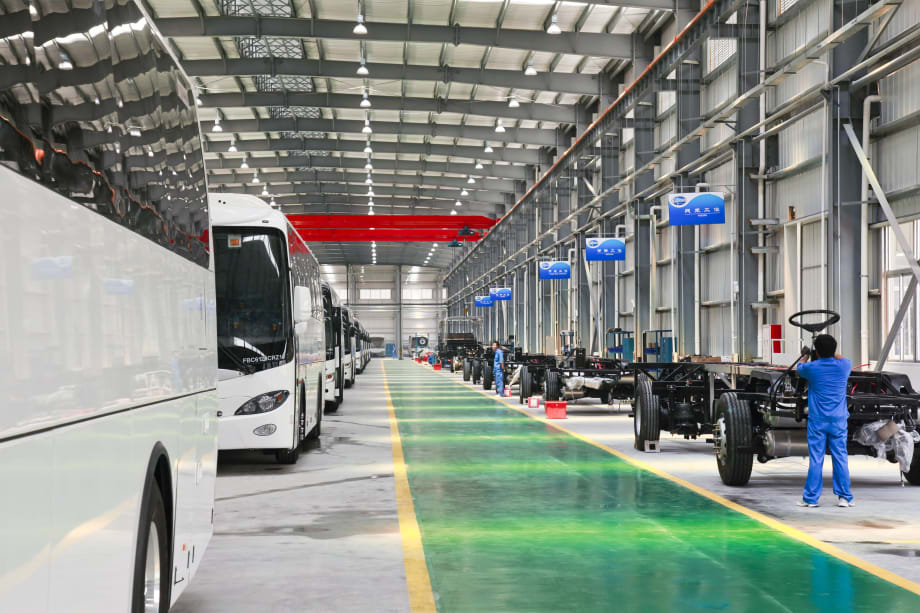
In May, Australia-based Bus and Coach International (BCI) celebrated the opening of its new state-of-the art facility in China with an event that included company staff and more than 150 invited guests from Australia, New Zealand, Canada and the U.S., including customers, vendor partners, press, and both Australian and Chinese dignitaries.
Modern, safe and environmentally friendly, the new facility, located in Xiamen's Haicang special economic zone, spans more than one million square feet and is fully ISO 9001-compliant. BCI and its joint venture partner Fengtai invested more than $62 million in the innovative facility, which only produces vehicles for export from Xiamen's special economic zone.
In addition to building vehicles for the Australian and New Zealand markets, manufacturing for the recently launched BCI America subsidiary, as well as emerging markets, including the Middle East and Asia, will also take place in Xiamen.
"The company has become, in the last 20 years, truly an international company," says Larry Brennan, president of BCI America. "It's a global brand that has Australian roots and now a production facility in China, but we're really competing in various markets around the world."
In fact, sales outside of home markets Australia and New Zealand are spearheaded from BCI America's Southern California offices by Sharad Agarwal, global sales director for BCI. Agarwal, who just returned from meeting with prospective customers at the World Bus Expo in Belgium, points out "we are now marketing to and designing product for customers in the Middle East, Asia, and Central and South America."
Brennan adds that the new BCI America is not to be confused with the company that existed a few years ago and carried the BCI name. The owners of that Nevada-based company had struck a deal with BCI Founder Ron Nazzari in 2006 to use the BCI name on buses built by Chinese manufacturers Wuxi Anyuan and Bonluck Bus in 2007, resulting in the Falcon 45 bus, which was designed and manufactured by those Chinese manufacturers and bore a Chinese Vehicle Identification Number (VIN).
Because that American company almost immediately elected to simply work directly with those Chinese manufacturers, BCI ended up having no involvement in, and could provide no support for, the Falcon 45 sold by the company, which is subsequently no longer in operation.
Vehicle production
BCI believes that its new facility will help it achieve key strategic objectives and create better value for its customers.
The company's manufacturing processes are overseen by a dedicated team of quality control professionals, including engineers educated, trained and experienced in each specific geographic area into which BCI markets its products. Production dedicated to North America is overseen by a team of engineers with decades of experience manufacturing vehicles to meet U.S. Federal Motor Vehicle Safety Standards and other applicable U.S. and Canadian laws and regulations. This team is led by Andrew Fung, who has two decades of coachbuilding experience with major North American manufacturers and distributors. As executive VP, Fung oversees a production, quality assurance and customer care team that also includes Jacques Gagne, an engineer with four decades of motorcoach experience.
While the vehicles are being built in China and will have Australian VINs, BCI has created North American-only models that will use stainless steel construction, and in the U.S., will eventually meet Buy America requirements. To do so, BCI plans on sending its vehicles to Pennsylvania for Altoona testing, beginning with its prototype Explorer 45, following the United Motorcoach Association's (UMA) Motorcoach Expo in February 2012 and will open a U.S.-based final assembly location. It plans to have completed both of these tasks by the fourth quarter of 2012, according to Brennan.
"We're very close to settling on a location for a U.S. facility," he says. "We are already very close to meeting the 60 percent U.S. content requirement with our Cummins engines, Allison transmissions and other componentry, even without using American stainless steel, which we plan to do, as well as U.S.-sourced seats and glass. To facilitate final assembly in the U.S., we will ship the vehicle componentry manufactured in Xiamen in kits designed to facilitate final assembly."
Originally formed in 1991, BCI's current market share places it in the top two or three manufacturers in both the Australian and New Zealand markets. Brennan sees BCI's international network as well as BCI America's entrance to the market as a positive for all of its subsidiaries worldwide.
"While we may be smaller than our more established competitors, our size enables us to be very responsive to market and customer demands and to be agile enough to execute those responses very quickly," he says. "We have the ability to design, for example, units for specific applications customers may have, and then, benefit from having that platform in service for our other markets."
[PAGEBREAK]
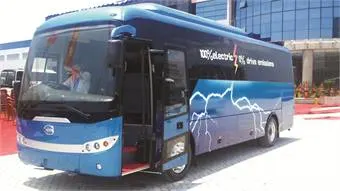
At February's UMA EXPO 2012 in Long Beach, Calif., BCI plans on unveiling the PROMA battery-powered electric bus. Following the show, the company plans on sending its vehicles for Altoona Testing.
Model debuts
BCI America's flagship product, the Explorer 45, made its debut at BusCon last October in Chicago. Exclusively built for North America, the 45-foot stainless steel constructed bus includes a unique monocoque design and features an ergonomically designed dash, comfort focused seating for 56, a wide and spacious layout, and three-point seat belts, as well as a range of optional extras including a 660 lb.-rated wheelchair lift that fits above the drive axle with no loss of baggage space.
The Explorer 45 is powered by a Cummins ISX 11.9L, 425 hp EPA 2010 emission compliant engine that includes a "clean sheet design" as well as the XPI common rail fuel system, which brings significant advantages over previous products in terms of fuel economy, performance and noise levels. Cummins uses Selective Catalytic Reduction (SCR), which uses diesel exhaust fluid and a catalytic converter to significantly reduce oxides of nitrogen (NOx) emissions. The engine is paired to an Allison B500 transmission.
In early 2012, BCI America will roll out the 39-foot, two-axle Cruiser 40, which seats as many as 51 passengers with three-point seat belts; zoned climate control; and an audio visual system with AM/FM/CD/DVD, a 17-inch widescreen front monitor and four fixed monitors below the parcel rack.
Like the Explorer 45, the Cruiser 40 conforms to Australia Design Rules and European rollover compliance, but features a Cummins ISB 6.7L, 300hp EPA 2010-compliant engine to an Allison B400 transmission.
At the UMA EXPO 2012 in Long Beach, Calif., in February, BCI will showcase its battery-powered electric adaptation of its PROMA bus. Built with both sustainability and serviceability in mind, the cutting-edge electric technology runs completely on battery power and regenerative braking, with no other onboard power generation. The PROMA electric features an ultra-low noise air compressor, integrated controls and easily replaceable modular designed batteries, while its 100 percent electric, zero percent drive emissions brings the possibility of large scale carbon emission reductions to the marketplace.
The 27-foot PROMA is also expected to seat up to 28 passengers and feature 60KW continuous or 150KW peak power, with up to 120 miles of range.
All of BCI America's offerings will take from 90 to 120 days from order to arrival and will be sold through a nationwide dealership network, says Brennan.
"We are very excited to be working through a dealership network that includes some of the most successful and innovative industry professionals in the market today," he explains.
BCI's initial dealers include Matthews Buses Inc. in the Northeast and Southeast U.S., Schetky Northwest Sales in the Northwest and Illinois Bus in the Midwest. Brennan expects to name agreements with more dealers who are close to finalizing agreements prior to or at UMA Expo.
More Bus

People Movement: Holly Arnold Joins Transdev and More
In this edition, we also cover recent appointments and announcements at Pace, CamTran, MCI, and more, showcasing the individuals helping to shape the future of transportation.
Read More →
The High Cost of Transit Buses: Industry Leaders Look to Procurement Reform
Transit leaders and policymakers examine how standardized bus designs, streamlined procurement, and predictable funding could help agencies stretch budgets and deliver better service.
Read More →
The Business Voice Behind Public Transportation
As chair of APTA’s Business Members Board of Governors, Ray Melleady explains how more than 850 business members are partnering with transit agencies to advance funding, innovation, and industry-wide collaboration.
Read More →
From Surviving to Thriving: Building Stronger Transportation Organizations
Bus Business Consultants founder Brian Dickson shares lessons on leadership, organizational health, and creating options for long-term success in a changing transportation industry.
Read More →
Finding the ‘Happy Medium’: Optimizing Maintenance Without Sacrificing Reliability
The key to maintenance optimization isn’t doing less work—it’s doing the right work at the right time on the right assets.
Read More →
LA Metro, City of West Hollywood, and Partners Advance Smarter Bus Lane Enforcement
The award-winning partnership combines AI-powered detection with human oversight to improve bus reliability, accessibility, and enforcement efficiency.
Read More →
PSTA Modernizes Workforce Management with Digital Bidding System
The award-winning Workforce Transit Modernization project replaced paper bidding with a transparent digital platform, cutting administrative effort while improving access for operators.
Read More →
Washington's Community Transit Sets Six-Year Roadmap for Growth, Expansion
Approved TDP targets more bus service, new mobility options, Swift BRT expansion, and a potential Everett Transit annexation.
Read More →
DART Customer Satisfaction Reaches Six-Year High
Overall satisfaction rose to 74.9%, while the agency’s Net Promoter Score reached a record 33.7.
Read More →
How DART's GoPass Is Redefining Regional Mobility
Serving 14 transit agencies, GoPass simplifies multimodal travel by allowing riders to plan, pay for, and manage an entire trip through one app.
Read More →