



L.A. Metro completes Blue Line improvements, rebrands as A Line
The agency's board approved a new line naming convention citing the need for more consistency as the system grows.

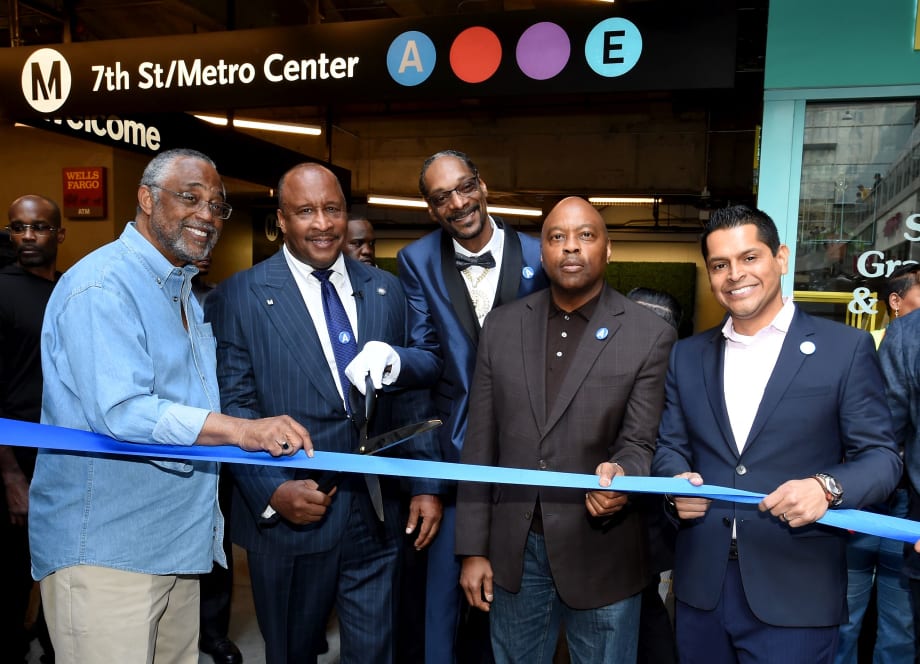
Rapper and entertainer Snoop Dogg (center) joined Metro CEO Phillip A. Washington in cutting the ribbon for the new A Line during an event.
LA Metro
Rapper and entertainer Snoop Dogg (center) joined Metro CEO Phillip A. Washington in cutting the ribbon for the new A Line during an event.
LA Metro
With the completion of the New Blue Improvement Project, L.A. Metro’s new rail and bus rapid transit (BRT) line renaming convention will go into effect with Metro’s Blue line now being referred to as the A Line. This begins a three-year process to rename all Metro Rail and BRT lines by 2022.
Under the new system, each Metro Rail and BRT line will be designated by a letter and color. The Metro board approved a new line naming convention in November 2018, citing the need for more consistency as the system grows.
The new naming convention helps alleviate several issues. In the past, most Metro Rail lines were named after colors except for the Expo Line and the Crenshaw/LAX Line that are named after street names and places — which riders may find confusing. Metro’s system map has also been reliant on colors and can be difficult to read for those who are color blind. Adding letters will help avoid this problem.
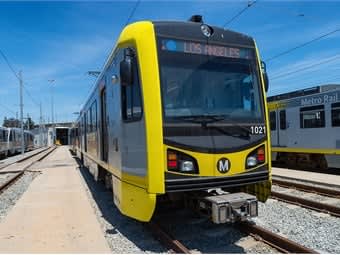
The rest of Metro Rail and the Silver Line and Orange Line will transition to the new naming convention when the Crenshaw/LAX line opens.
L.A. Metro
Starting with the A Line, most station signage will simply show the letter A within a colored dot. The rest of Metro Rail and the Silver Line and Orange Line will transition to the new naming convention when the Crenshaw/LAX line opens. The Crenshaw/LAX Line currently does not have a letter name as Metro’s operation staff is still working on finalizing the line’s operational plan.
“We believe this is great news for the region because we have big plans for new rail and bus rapid transit lines in the years to come,” said Metro CEO Phillip A. Washington. “This new naming convention will help keep our system easy to navigate and make it more user friendly — and, thus, improve the customer experience.”
Under the new naming convention, the Red Line will eventually become the B Line, the Green Line will be the C Line, the Purple Line the D Line, and the Expo Line the E Line, to name a few examples. The Gold Line will become the J Line until the Regional Connector opens and ties together the Blue, Expo, and Gold Lines. The eventual Azusa to Long Beach line created by the Connector will be known as the A Line, while the East Los Angeles to Santa Monica line will be the E Line.
More Management

METRO Opens Submissions for 2026 Motorcoach Awards
Nominations are now being accepted for METRO Magazine’s Operator of the Year and Innovative Operator of the Year awards.
Read More →
New York MTA Advances Final Contract for Second Avenue Subway Expansion
Contract Four is the largest in the Second Avenue Subway Phase 2 project and includes construction of station infrastructure, tracks, and signals for the subway expansion, MTA officials said. Work on Contract Four will begin in 2027.
Read More →
Transit Agencies Highlight Safety Gains at National Summit
Leaders from 15 major transit systems shared crime-reduction results and safety initiatives while discussing the role of continued federal support.
Read More →

NITA Names New Leadership, Expands Reduced-Fare Program at First Board Meeting
The new regional transit authority appointed its first board chair and interim executive director while extending reduced fares across CTA, Metra, and Pace for eligible riders.
Read More →
Beyond the Checklist: A Structured Approach to Transit Maintenance
Reliability-Centered Maintenance helps transit agencies move beyond routine checklists to focus limited resources on the assets and failures that have the greatest impact on safety, reliability, and service.
Read More →
APTA 2026 Nominating Committee Selects Leadership Slate, Names Chair and Vice Chair Nominees
Leadership changes will help shape the association’s priorities and its representation of the transportation industry during the 2026–2027 term.
Read More →
DART Launches Major Security, Fare Enforcement Initiative
The 90-day demonstration will deploy coordinated security teams at five light rail stations while testing controlled access and gathering data to guide future investments.
Read More →
Advancing Fare Collection Through Technology and Innovation
Learn about delivering 1300 gates at 91 stations while managing fare evasion. Explore the large scale deployment, solution customization and real-world results that affect the region. Prepare for deployment in your region now.
Read More →
Game Day in Motion: Moving Millions During the 2026 World Cup
Between packed transit stations and team motorcoaches, see how agencies and operators across North America tackled the transportation demands of the 2026 FIFA World Cup.
Read More →
Surface Transportation Extension Averts Shutdown, Leaves Transit Funding Gap
The stopgap keeps federal transportation programs moving, but missing advance funding could complicate the transit and rail projects agencies are planning next.
Read More →