




RELATED: Takeaways from Denver's driverless shuttle deployment
Local Motors' AV shuttle to serve Army, Marine Corp. base near D.C.
Joint Base Myer-Henderson Hall won a regional fleet challenge, which asked entrants to propose use-case scenarios for the shuttle.
June 21, 2019
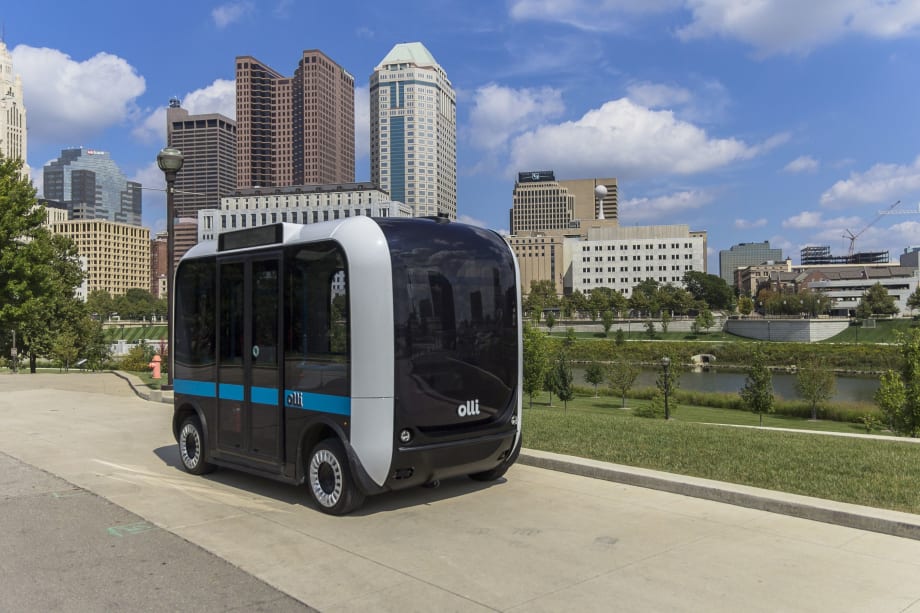
Local Motors' self-driving, cognitive, 3D-printed shuttle will serve a military base near Washington, D.C.
Local Motors
2 min to read
Local Motors' self-driving, cognitive, 3D-printed shuttle will serve a military base near Washington, D.C.
Local Motors
Local Motors, by LM Industries Group Inc., known for 3D-printed mobility solutions, will deploy a fleet of autonomous shuttles, known as Olli, at Joint Base Myer-Henderson Hall near Washington, D.C.
The deployment is months in the making and comes as the result of Joint Base Myer-Henderson Hall winning a regional fleet challenge, which asked entrants to propose use-case scenarios for the electric, self-driving shuttle. A panel of judges, including Jason Miller, CEO of Greater Washington Partnership; Shailen Bhatt, president and CEO of ITS America; and Scott Frisch, COO and executive VP at AARP, evaluated all of the submissions for the challenge.
Joint Base Myer-Henderson Hall, an Army and Marine Corps joint base adjacent to Arlington National Cemetery, plans to use the shuttles to transport base personnel to a variety of stops, including the community center, dining options, a health clinic, and barracks. Engineers from Local Motors have been working with base personnel over the past few weeks to map the route that Olli will use.
The Olli Fleet Challenge is part of an ongoing, first-of-its-kind global initiative in which Local Motors has invited municipalities, campuses and designated districts to propose a short-term, local use for Olli, the world's first co-created, self-driving electric shuttle. Olli shuttles have already been deployed to Sacramento State's campus and to a busy thoroughfare in Australia, and they are operating at the California State Exposition.
Additional fleet challenges are in progress in Atlanta, Georgia, and in Southern California.
All of the deployments are designed to introduce new landscapes and use possibilities for self-driving technology in a way that illustrates to riders that autonomous vehicles are safe and easy to use, according to the company. Unlike vehicles similar to it, Olli uses obstacle-avoidance technology to find routes around objects that block its path.
Olli, which employs a responsive-cognitive function, is an environmentally-friendly vehicle designed to change the future of mobility. A safe and efficient shuttle, Olli is a viable and sustainable transportation option for cities, companies, hospitals, campuses, stadiums, entertainment districts, and any other location where people need to move from one place to another, the company said.
More New Mobility

From Hardware to Digital Partner: Luminator Charts Its Next Chapter
CEO Magnus Friberg discusses Luminator’s shift toward becoming a digital partner, the growing importance of software and interoperability, and how AI can help agencies improve operations and passenger experience.
Read More →
Biz Briefs: Alstom Lands Canadian Contract, LYT to Supply California TSP, and More
In METRO's latest installment, we take a look at recent news from Complete Coach Works, Beep, FlixBus, and more partnerships making headlines across the transportation sector.
Read More →
CharterUP’s Armir Harris on Technology, AI, and the Future of Group Mobility
In a recent episode of METROspectives, CharterUP Founder/CEO Armir Harris discussed the company’s evolution from an online charter bus marketplace into a technology platform supporting public- and private-sector mobility and much more.
Read More →
Jacksonville’s NAVI Project Charts a New Course for Autonomous Public Transportation
Through its NAVI program, JTA is showing how autonomous vehicles, intelligent infrastructure, and coordinated operations can work together to deliver everyday public transportation.
Read More →
Biz Briefs: Luminator Marks Milestone and More
From manufacturers and suppliers to transit agencies and motorcoach operators, these updates offer a snapshot of the projects, partnerships and business moves driving the industry forward.
Read More →
New Tricks for Old Bureaucracies: Joshua Schank on Making Transit Innovation Stick
Former LA Metro Chief Innovation Officer Joshua Schank discusses why good ideas aren't enough, how transit agencies can overcome resistance to change, and why today's challenges demand more innovation.
Read More →
How DART's GoPass Is Redefining Regional Mobility
Serving 14 transit agencies, GoPass simplifies multimodal travel by allowing riders to plan, pay for, and manage an entire trip through one app.
Read More →
Biz Briefs: OCTA Taps Clean Energy for Hydrogen Station, Stadler to Supply Via Rail Vehicles, and More
From manufacturers and suppliers to transit agencies and motorcoach operators, these updates offer a snapshot of the projects, partnerships and business moves driving the industry forward.
Read More →CharterUP Expands Into New Mobility and Autonomous Transportation
Vice President of New Mobility Stephen Joos discusses how CharterUP is leveraging its nationwide transportation network, technology platform, and autonomous vehicle partnerships to expand into workforce mobility, campus shuttles, and transit solutions.
Read More →
METRO Magazine Announces 2026 Innovative Solutions Awards Winners
Projects Recognized for Advancing Mobility Through Technology, Accessibility, Workforce Innovation, and Operational Excellence
Read More →