



$200 billion of public transportation ballot initiatives at stake
Public transit leaders came together to discuss ballot measures across the country.The press conference was held at the APTA 2016 Annual Meeting held in Los Angeles.


Key leaders in attendance for the press conference included: (shown L to R) Phillip A. Washington (L.A. Metro); Curtis Stitt (COTA); Jeannie Bruins (VTA); Doran Barnes (Foothill Transit); Richard A. White (APTA); Keith Parker (MARTA); Peter Rogoff (Sound Transit) and Grace Crunican (BART).
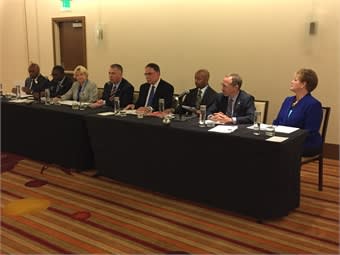
Key leaders in attendance for the press conference included: (shown L to R) Phillip A. Washington (L.A. Metro); Curtis Stitt (COTA); Jeannie Bruins (VTA); Doran Barnes (Foothill Transit); Richard A. White (APTA); Keith Parker (MARTA); Peter Rogoff (Sound Transit) and Grace Crunican (BART).
November 8 will be an important Election Day as $200 billion in public transportation ballot initiatives are at stake. Thirty-one communities, counties, and states are asking voters to pass public transit ballot measures that will help to create a future with better transportation options. If passed, ballot initiatives will allow communities to expand and increase service and to address infrastructure needs.
"Communities of all sizes are asking citizens to vote for initiatives that will determine their future," said APTA Chair and Foothill Transit Executive Director Doran J. Barnes. "These initiatives and referenda are critical to expanding mobility options and to increasing the economic vitality of their communities."
Some of the areas where ballot initiatives are up for a vote include: Los Angeles ($120 billion), Seattle ($54 billion), San Diego ($7.5 billion); San Francisco ($3.5 billion), Santa Clara County, Calif. ($3 billion); Atlanta ($2.5 billion), and Columbus, Ohio ($620 million). APTA estimates that on a national level these public transit ballot initiatives will total nearly $200 billion. Click here to see a list of the public transit ballot initiatives.
"With more than thirty local referendums on public transportation on the ballot on November 8, voters across the country will have the opportunity to make a big difference in their communities," said APTA Acting President/CEO Richard A. White. "With approximately $200 billion in funding for public transportation, this is a game-changer for people and the communities they live in."
If a local public transit measure is on the ballot in your community, it is vitally important that you come out to vote for it," said White. "When people vote to improve or expand the local public transit system, they are voting for an improved quality of life and for the economic vitality of their region."
Public transportation offers people access to jobs as nearly 60 percent of the trips taken on public transit are for work commutes. At the same time, people are able to save money. APTA's latest Transit Savings Report says that on the average nationally, a person who switches his or her daily commute from driving a car to taking public transit can save more than $9,600.
Public transit also contributes to economic prosperity in a community as every one dollar invested in public transportation generates approximately $4 in economic returns. Public transportation also helps to reduce traffic congestion and improves air quality. Additionally, a new study just released by APTA shows public transit can make your community safer since it dramatically reduces auto crash risk.
White notes that since 2000, public transit ballot initiatives have passed by an average of more than 70 percent, showing how important public transportation is to people and to communities of all sizes. Local and state funding are critical revenue streams for public transportation. Governments at all levels — federal, state, and local — fund public transportation.
"When people understand how a ballot initiative will improve their community's transportation network, they overwhelmingly vote to support the suggested funding," said White.
A national media conference call was held in Los Angeles at the APTA Annual Meeting on September 12 to discuss public transit ballot initiatives across the country. Click here for a summary of the ballot measures that were discussed.
Press conference participants included public transit agency leadership representives an area with a significant public transit ballot initiative.
Phillip A. Washington, CEO, LA Metro, Los Angeles
"If we are to create modern mobility and provide transportation options for ourselves and for future generations, we must remain fiscally responsible. That's why Measure M – the Los Angeles County Traffic Improvement Plan – will appear on the Nov. 8 ballot. This bold plan came from the people, for the people, through a collaborative process where our partners across the county, and the general public, helped craft the way we position the region for current and future transportation needs. We know Measure M will be a game changer for Los Angeles and we're excited about its potential to enhance quality of life for the people of our region."
Peter Rogoff, CEO, Sound Transit, Seattle
"Fast-growing regions like the Puget Sound have only two choices when facing dramatic population growth and rapidly worsening congestion -- they can plan and build for it or be completely overwhelmed by it. The ST3 ballot initiative gives the people of this region the opportunity to reclaim control of their commutes, their quality of life, and their economic future by building a 116-mile light rail network along with other key investments including bus rapid transit and expanded commuter rail."
Keith Parker, GM/CEO, MARTA, Atlanta
"With this referendum, MARTA has a wonderful opportunity to increase mobility, create new jobs and spur economic opportunity across the city. We have worked diligently with city officials, as well as the public, to provide the voters as many options as possible for expanding MARTA in a robust way should the referendum be successful."
Curtis Stitt, president/CEO, COTA, Columbus, Ohio
"During the ten years since the ¼% sales tax was approved, the Central Ohio Transit Authority (COTA) has increased its service hours by 80%; ridership has reached levels not seen in 30 years; COTA has managed our financial resources soundly and prudently; and we are providing and developing new and innovative public transportation services in our region. It is unfortunate that every few years COTA has to go back to the voters to maintain its local resources. However, I believe that COTA's financial and operational performance throughout the ten-year period since this ¼% sales tax was approved warrants its renewal by central Ohio voters. With the renewal, COTA will be able to continue to expand and improve service, implement the CMAX Bus Rapid Transit planned to begin January 1, 2018 and deploy new technologies that will make riding public transit easier and more convenient for residents and visitors in Columbus and central Ohio, the fastest growing region in the Midwest."
Los Altos Mayor and VTA Vice Chairperson Jeannie Bruins
"Forty years ago, Santa Clara County was one of the first "self-help" counties in the U.S., where voters stepped up to the plate and helped provide the funding for needed transportation projects and services. To date, County voters have supported six ballot measures bringing in more than $8 billion dollars for services and a $21 billion capital program.
"Polling seems to suggest strong support for a 30-year, half-cent sales tax on the November ballot. The measure would raise over $6 billion to help fund an extension of the regional rail system, transit operations, and improvements to bike and pedestrian facilities, local streets and roads, expressways and interchanges and commuter rail capacity and safety. "
Grace Crunican, GM, San Francisco Bay Area Rapid Transit District, Oakland, Calif.
"For the past 44 years, BART has been the back bone of the region's growth– connecting people to opportunities every single day. But the system is aging and cannot support the 364,000 added jobs and 210,000 new homes the region expects within one-half mile of our stations by 2040 unless we reinvest in the BART system. Thanks to the enormous amount of input from local leaders and residents, we now have a strong plan funded by a proposed $3.5 billion bond to make BART safer and more reliable, which will in turn reduce traffic in the decades to come."
More Management

METRO Opens Submissions for 2026 Motorcoach Awards
Nominations are now being accepted for METRO Magazine’s Operator of the Year and Innovative Operator of the Year awards.
Read More →
New York MTA Advances Final Contract for Second Avenue Subway Expansion
Contract Four is the largest in the Second Avenue Subway Phase 2 project and includes construction of station infrastructure, tracks, and signals for the subway expansion, MTA officials said. Work on Contract Four will begin in 2027.
Read More →
Transit Agencies Highlight Safety Gains at National Summit
Leaders from 15 major transit systems shared crime-reduction results and safety initiatives while discussing the role of continued federal support.
Read More →

NITA Names New Leadership, Expands Reduced-Fare Program at First Board Meeting
The new regional transit authority appointed its first board chair and interim executive director while extending reduced fares across CTA, Metra, and Pace for eligible riders.
Read More →
Beyond the Checklist: A Structured Approach to Transit Maintenance
Reliability-Centered Maintenance helps transit agencies move beyond routine checklists to focus limited resources on the assets and failures that have the greatest impact on safety, reliability, and service.
Read More →
APTA 2026 Nominating Committee Selects Leadership Slate, Names Chair and Vice Chair Nominees
Leadership changes will help shape the association’s priorities and its representation of the transportation industry during the 2026–2027 term.
Read More →
DART Launches Major Security, Fare Enforcement Initiative
The 90-day demonstration will deploy coordinated security teams at five light rail stations while testing controlled access and gathering data to guide future investments.
Read More →
Advancing Fare Collection Through Technology and Innovation
Learn about delivering 1300 gates at 91 stations while managing fare evasion. Explore the large scale deployment, solution customization and real-world results that affect the region. Prepare for deployment in your region now.
Read More →
Game Day in Motion: Moving Millions During the 2026 World Cup
Between packed transit stations and team motorcoaches, see how agencies and operators across North America tackled the transportation demands of the 2026 FIFA World Cup.
Read More →
Surface Transportation Extension Averts Shutdown, Leaves Transit Funding Gap
The stopgap keeps federal transportation programs moving, but missing advance funding could complicate the transit and rail projects agencies are planning next.
Read More →