



Alstom's hydrogen fuel-cell train approved for German commercial ops
Two Coradia iLint prototypes will enter pilot operation in the Elbe-Weser network, with passenger service scheduled for late summer.

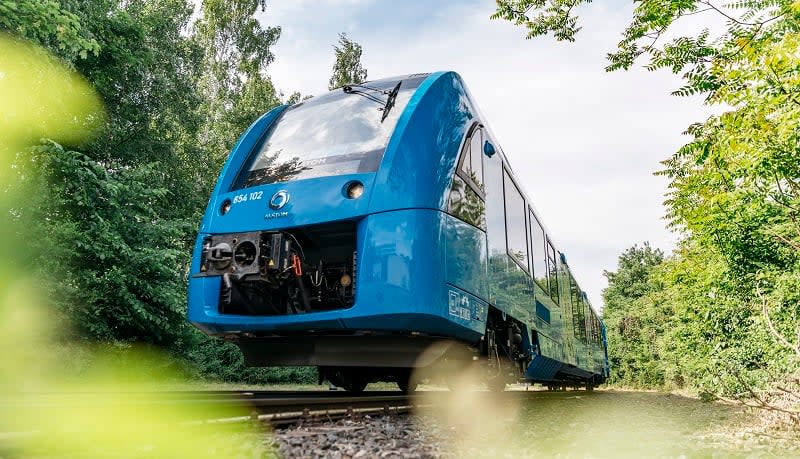
Coradia iLint is the world’s first passenger train powered by a hydrogen fuel cell, which produces electrical power for traction.
Alstom/Rene Frampe
Coradia iLint is the world’s first passenger train powered by a hydrogen fuel cell, which produces electrical power for traction.
Alstom/Rene Frampe
Alstom’s Coradia iLint, the world’s first hydrogen fuel-cell passenger train, was granted approval by the German Railway Office (EBA) for passenger service in Germany.
“This approval is a major milestone for the Coradia iLint and a decisive step towards clean and future-oriented mobility. Alstom is immensely proud of this hydrogen-powered regional train, a breakthrough in emission-free mobility, and the fact that it will now go into regular passenger operation,” said Wolfram Schwab, Alstom VP, R&D and Innovation.
In November 2017, Alstom and the local transport authority of Lower Saxony (LNVG) signed a contract for the delivery of 14 hydrogen fuel-cell trains, along with 30 years of maintenance and energy supply. The 14 trains will be produced by Alstom for LNVG's vehicle pool and will transport passengers between Cuxhaven, Bremerhaven, Bremervörde, and Buxtehude from Dec. 2021. Following this approval granted by EBA, the two Coradia iLint prototypes will enter pilot operation in the Elbe-Weser network. Passenger service is scheduled for late summer.
Coradia iLint is the world’s first passenger train powered by a hydrogen fuel cell, which produces electrical power for traction. This zero-emission train emits low levels of noise, with exhaust being only steam and condensed water. The Coradia iLint is special for its combination of different innovative elements: clean energy conversion, flexible energy storage in batteries, and smart management of traction power and available energy. Specifically designed for operation on non-electrified lines, it enables clean, sustainable train operation while ensuring high levels of performance.
The Coradia iLint was designed by Alstom teams in Salzgitter (Germany), center of excellence for regional trains, and in Tarbes (France), center of excellence for traction systems. This project benefits from the support of the German ministry of economy and mobility. Alstom‘s development of the Coradia iLint was funded with $9.3 million from the German government as part of the National Innovation Program for Hydrogen and Fuel Cell Technology.
More Technology
Almaviva Looks to Open Architecture to Advance Transit Technology
Eric Reese discusses how interoperability, open architecture, and modular design can help transit agencies control costs, reduce vendor lock-in, and upgrade technology without starting over.
Read More →
Driving Smarter Paratransit
John Hanlon shares how AlphaRoute is leveraging AI-powered technology to help paratransit providers optimize operations, support frontline staff, and enhance the rider experience.
Read More →
From Hardware to Digital Partner: Luminator Charts Its Next Chapter
CEO Magnus Friberg discusses Luminator’s shift toward becoming a digital partner, the growing importance of software and interoperability, and how AI can help agencies improve operations and passenger experience.
Read More →

Beyond the Checklist: A Structured Approach to Transit Maintenance
Reliability-Centered Maintenance helps transit agencies move beyond routine checklists to focus limited resources on the assets and failures that have the greatest impact on safety, reliability, and service.
Read More →
NJ TRANSIT Advances Bus Technology Upgrades Across Statewide Fleet
More than 1,500 buses now feature upgraded technology designed to improve arrival predictions and provide free Wi-Fi, with deployment expected to reach nearly 2,000 buses by the end of 2026.
Read More →
Building a Flexible Path to Transit Electrification
John Hroncich discusses BAE Systems’ modular and scalable approach, lessons learned from decades of real-world operations, and how agencies can identify electrification strategies that fit their fleets.
Read More →
Biz Briefs: Alstom Lands Canadian Contract, LYT to Supply California TSP, and More
In METRO's latest installment, we take a look at recent news from Complete Coach Works, Beep, FlixBus, and more partnerships making headlines across the transportation sector.
Read More →
From Legacy Silos to Conversational Intelligence
What if transit leaders could ask any operational question and get a trusted answer in seconds? Conversational AI is transforming how agencies use their data.
Read More →
USDOT Announces Rail Vehicle Replacement Grants, Chattanooga AV Shuttle Funding
More than $191 million in federal funding will help three transit agencies replace aging rail vehicles and support a new autonomous shuttle service in Chattanooga.
Read More →
Bus Tech Talk: Keeping Transit Technicians Ahead of the Technology Curve
LA Metro’s Obed Mejia discusses technician training, evolving maintenance technology, fleet replacement, and strategies for getting the most out of today’s transit fleets.
Read More →