




RELATED: Alstom delivers last vehicle for SBB Pendolino contract
Alstom's hydrogen train successfully completes 1st test run
The four-week test runs currently undergoing in Salzgitter aim at confirming the stability of the energy supply system based on coordinated interaction between the drive, the fuel cell, and the battery of the vehicle.
March 14, 2017
Alstom
2 min to read
Alstom
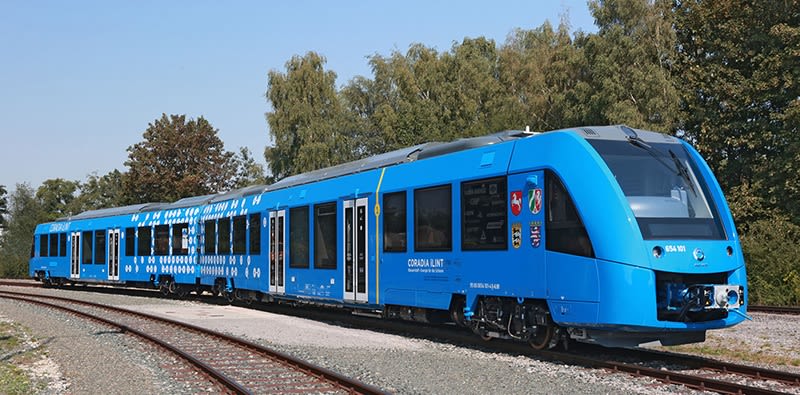
Alstom successfully performed the first test run at approximately 50 mph of the world’s only fuel-cell passenger train Coradia iLint on its own test track in Salzgitter, Lower Saxony (Germany). An extensive test campaign will be conducted in Germany and Czech Republic in the coming months before the Coradia iLint performs its first passenger test runs on the Buxtehude–Bremervörde–Bremerhaven–Cuxhaven (Germany) route beginning of 2018.
The four-week test runs currently undergoing in Salzgitter aim at confirming the stability of the energy supply system based on coordinated interaction between the drive, the fuel cell, and the battery of the vehicle. The braking power is also being tested to check the interface between the pneumatic and the electric brake.
The Coradia iLint is the first low-floor passenger train worldwide powered by a hydrogen fuel cell, which produces electrical power for the traction. This zero-emission train is silent and only emits steam and condensed water. Coradia iLint is special for its combination of different innovative elements: a clean energy conversion, flexible energy storage in batteries, and a smart management of the traction power and available energy. Based on Alstom’s flagship Coradia Lint diesel train, Coradia iLint is particularly suited for operation on non-electrified networks. It enables sustainable train operation while maintaining high train performance.
“This test run is a significant milestone in environmental protection and technical innovation. With the Coradia iLint and its fuel cell technology, Alstom is the first railway manufacturer to offer a zero-emission alternative for mass transit trains. Today our new traction system, so far successfully proved on the test ring, is used on a train for the first time – a major step towards cleaner mobility in Europe,“ said Didier Pfleger, VP, Alstom Germany and Austria.
The dynamic tests are performed at Salzgitter plant at approximately 50 mph and in Velim (Czech Republic) at up to approximately 87 mph, the maximum speed of the Coradia iLint. For the purpose of the tests, a mobile filling station has been erected in Salzgitter to pump gaseous hydrogen into the pressure tank of the Coradia iLint. The hydrogen used for the test runs is the by-product of an industrial process, which is reasonably reused as a waste product. In the long term, Alstom aims to support the hydrogen production from wind energy.
The vehicle has already successfully completed the static commissioning process. All electrical and pneumatic functions of the trains have been tested and verified at standstill. TÜV Süd has certified the safety of the battery, the pressure tank system, and the fuel cell for the coming test phases.
More Technology

From Hardware to Digital Partner: Luminator Charts Its Next Chapter
CEO Magnus Friberg discusses Luminator’s shift toward becoming a digital partner, the growing importance of software and interoperability, and how AI can help agencies improve operations and passenger experience.
Read More →
Beyond the Checklist: A Structured Approach to Transit Maintenance
Reliability-Centered Maintenance helps transit agencies move beyond routine checklists to focus limited resources on the assets and failures that have the greatest impact on safety, reliability, and service.
Read More →
NJ TRANSIT Advances Bus Technology Upgrades Across Statewide Fleet
More than 1,500 buses now feature upgraded technology designed to improve arrival predictions and provide free Wi-Fi, with deployment expected to reach nearly 2,000 buses by the end of 2026.
Read More →

Building a Flexible Path to Transit Electrification
John Hroncich discusses BAE Systems’ modular and scalable approach, lessons learned from decades of real-world operations, and how agencies can identify electrification strategies that fit their fleets.
Read More →
Biz Briefs: Alstom Lands Canadian Contract, LYT to Supply California TSP, and More
In METRO's latest installment, we take a look at recent news from Complete Coach Works, Beep, FlixBus, and more partnerships making headlines across the transportation sector.
Read More →
Sponsored•September 8, 2026
From Legacy Silos to Conversational Intelligence
What if transit leaders could ask any operational question and get a trusted answer in seconds? Conversational AI is transforming how agencies use their data.
Read More →
USDOT Announces Rail Vehicle Replacement Grants, Chattanooga AV Shuttle Funding
More than $191 million in federal funding will help three transit agencies replace aging rail vehicles and support a new autonomous shuttle service in Chattanooga.
Read More →
Bus Tech Talk: Keeping Transit Technicians Ahead of the Technology Curve
LA Metro’s Obed Mejia discusses technician training, evolving maintenance technology, fleet replacement, and strategies for getting the most out of today’s transit fleets.
Read More →
Biz Briefs: RIPTA Unveils New Frontrunners, Clevland RTA Adds New Siemens, and More
In METRO's latest installment, we take a look at recent news from Siemens, Prevost, Dodge, and more partnerships making headlines across the transportation sector.
Read More →
Why Simulating Pedestrian Movement Has Become Essential for Modern Rail Stations
Pedestrian microsimulation is helping rail planners identify bottlenecks, test station designs, and prepare complex transit hubs for growing passenger volumes.
Read More →