



Amtrak designates developer for $1 billion Chicago Union Station revamp
Approximately 7,500 construction jobs are expected to be developed over the life of the more than $1 billion project, as well as an additional 7,000 to 8,000 permanent jobs.

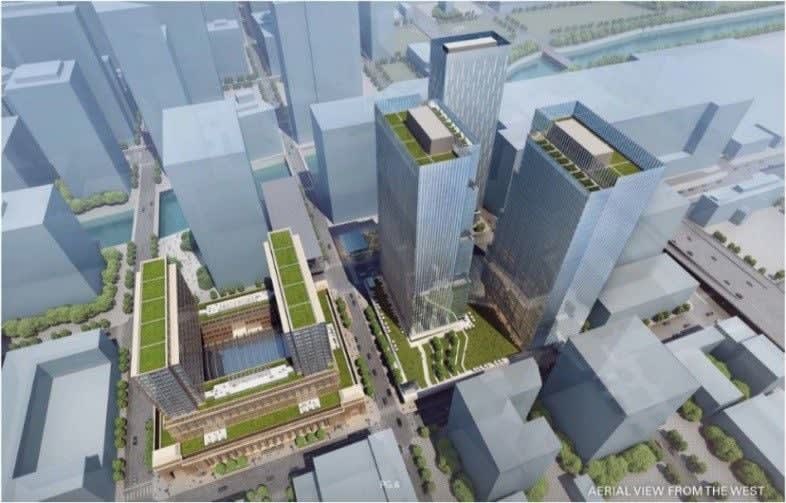
Rendering shows aerial view from of the west of the reimagined Union Station development in Chicago. Courtesy Amtrak
Rendering shows aerial view from of the west of the reimagined Union Station development in Chicago. Courtesy Amtrak
Amtrak has designated a team lead by Riverside Investment & Development Co. as the Master Developer for commercial elements of Chicago Union Station (CUS) and neighboring Amtrak-owned properties.
The initial conceptual design proposed by Riverside, in conjunction with co-developer and co-venture partner Convexity Properties – a DRW Co., includes three phases projected to be completed in about six years. Key project priorities include improved street entrances and pedestrian traffic flow entering and leaving Union Station, as well as improved pedestrian-friendly landscaping and open spaces.
The proposed commercial development will total approximately 3.1 million square feet at full build-out. The developer expects to create approximately 7,500 construction jobs over the life of the more than $1 billion project, as well as an additional 7,000 to 8,000 permanent jobs:
Phase One – Union Station Headhouse and Concourse Improvements
110,000 square feet of new and reconfigured retail with a new food hall
Street level retail to be added to enhance the pedestrian experience
Renovation of the Headhouse and Great Hall
100,000 square feet of office space and a new proposed hotel above the Great Hall
Two new 12-story residential towers above the Headhouse
Phase Two – New Office Towers with Retail and Parking (currently parking garage)
Two new 750,000 square foot office towers with ground floor retail and approximately 800 parking spaces
Ample publicly-accessible green spaces including terraces and plazas, including above the current Union Station Transit Center
Phase Three – Plaza and Tower on Southeast Corner of Jackson and Canal
Approximately 500,000-square-foot retail and residential tower developed over active rail lines with open space and plazas at street level
“This building was envisioned by Daniel Burnham in the 1909 Plan for Chicago as the city’s primary rail station. It is in that spirit, we have big plans for both this Headhouse building and nearby properties owned by Amtrak,” said Moorman. “We have initiated real estate developments such as this to create revenue streams to invest in our core business, to improve facilities, to provide amenities to all users of the station – and to attract new ones. We are certain we will do that here in Chicago.”
The Amtrak Board of Directors this week approved the designation of a master development team led by Riverside. This designation is based on a staff recommendation and follows a rigorous technical and financial review, assisted by KPMG, AECOM and Savills Studley.
The Board also approved finalizing financial negotiations with this developer by the end of the year.
In addition to a competitive review process, Riverside and its partners were selected due to their extensive experience in successfully developing complex, transportation-oriented, mixed-use properties. The team includes: Riverside Investment & Development; Convexity Properties; Architect Goettsch Partners; Structural Engineer Magnusson Klemencic Associates; Rail Operations Interface Manager & Civil Engineer WSP; Construction Manager Clark Construction Group; Operations, Maintenance and Retail Concession Manager CBRE Inc.; and Mechanical, Electrical, Plumbing and Technology Engineer ESD Global. This team was chosen from a pre-qualified field of four following a Request for Qualification.
The designated developer will harmonize commercial development with the need to address growing passenger volumes at CUS, and to successfully integrate the station into the surrounding West Loop neighborhood. The Master Developer will also engage the community and incorporate feedback from West Loop stakeholders into any development plan.
The Master Development process in Chicago is part of a larger corporate program to leverage the substantial Amtrak asset portfolio and also includes stations in New York City, Philadelphia, Baltimore and Washington D.C.
More Rail

New York MTA Advances Final Contract for Second Avenue Subway Expansion
Contract Four is the largest in the Second Avenue Subway Phase 2 project and includes construction of station infrastructure, tracks, and signals for the subway expansion, MTA officials said. Work on Contract Four will begin in 2027.
Read More →
San Diego MTS Breaks Monthly Trolley Ridership Record
Agency officials said July’s ridership indicates MTS’s continued recovery from the pandemic.
Read More →
Report Examines NJ TRANSIT Reliability, Funding Challenges
The Garden State Initiative analysis examines the roles of Amtrak infrastructure, fleet management, and agency operations while recommending a more performance-based approach to improving reliability.
Read More →
Stadler, CapMetro Sign Long-Term Rail Fleet Support Agreement
Beginning in 2027, Stadler will provide on-site technical expertise, spare parts support, training, and obsolescence management to help extend the reliability and longevity of CapMetro’s GTW fleet.
Read More →
Biz Briefs: Alstom Lands Canadian Contract, LYT to Supply California TSP, and More
In METRO's latest installment, we take a look at recent news from Complete Coach Works, Beep, FlixBus, and more partnerships making headlines across the transportation sector.
Read More →
CATS Gold Line Marks 5 Years of Service, 2.8M Passenger Trips
With a six-mile expansion planned, the Charlotte streetcar is positioned to connect more neighborhoods and major transit hubs across the region.
Read More →
Why Simulating Pedestrian Movement Has Become Essential for Modern Rail Stations
Pedestrian microsimulation is helping rail planners identify bottlenecks, test station designs, and prepare complex transit hubs for growing passenger volumes.
Read More →
Amtrak Begins Major Construction at New York’s Sunnyside Yard
The new maintenance facility will support Amtrak’s Airo trainsets while improving maintenance efficiency and turnaround times in New York.
Read More →
Chicago Leaders Unveil Plans for O’Hare Airport Express Train
The privately developed project would offer a 15-minute trip between downtown and O’Hare’s Terminal 2, with trains operating every 15 minutes on a dedicated track. The service would use battery-electric trains and three existing freight rail rights-of-way.
Read More →
OCTA Maps Out 30-Year Strategy to Protect Coastal Rail Corridor
The draft feasibility report identifies strategies to protect the coastal rail line for decades as the agency continues near-term stabilization and sand placement efforts.
Read More →