




RELATED: [Video] TfL's Elizabeth Line train build time lapse
Bespoke maintenance trains to help keep London line running
The 160-foot-long rail milling train is the first of its kind to be used in the UK rail industry.
July 3, 2018

Engineering train with on-off loading device for gantries. Photo: Transport for London
2 min to read
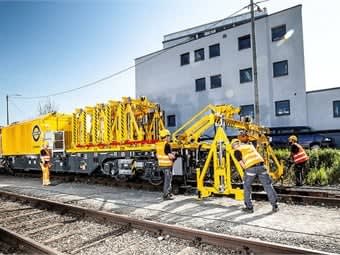
Engineering train with on-off loading device for gantries. Photo: Transport for London
New state-of-the-art maintenance trains that will be used on the London Underground are being tested in Europe ahead of delivery to London later this year.
A new rail milling train and two multi-purpose engineering trains with bespoke machinery attachments will be delivered ahead of the Elizabeth line opening in December.
The 160-foot-long rail milling train is the first of its kind to be used in the UK rail industry. It is able to scan the rails using electromagnetic crack detection, looking for any defects. If it identifies any issues with the track, it can mill the surface of the rail to remove defects and cracks, reducing wear on the new Elizabeth line train wheels and the tracks. Metal chips will be collected in a container on the train and later recycled as high-quality scrap metal.
The milling process eliminates the problems of sparks, fire and dust created by traditional rail grinding trains, leaving a smoother surface that will provide a quieter, more comfortable ride for passengers. Using this state-of-the-art technology will reduce the need for major track maintenance, meaning less disruption for customers. Manufactured by Austrian company Linsinger in Steyrermühl in Austria, it has two drivers' cabs and space for up to four members of staff as well as a welfare facility.
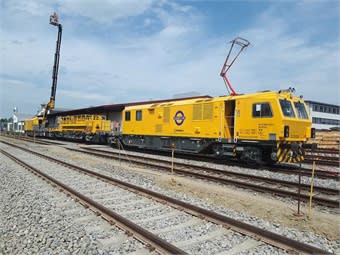
Robel Engineering Train testing in Germany provided by Plasser. Photo: Transport for London
The two multi-purpose engineering trains, supplied by Plasser UK, have been manufactured by ROBEL Bahnbaumaschinen in Freilassing in Germany. They can be configured to be between 130 and 260 feet long, depending on the task, with a number of modular attachments. The trains' unique gantry system, provides the capability to change a five ton, 115-foot switch rail within the short overnight engineering hours. The trains can also be configured for different purposes using cranes, a scissor lift for working on overhead line equipment or cabling, and a water tank and jet for drainage clearance and tunnel cleaning.
These trains will also be the main way to transport new rail, platform screen doors, station transformers and more, through the central section of the Elizabeth line once stations are complete.
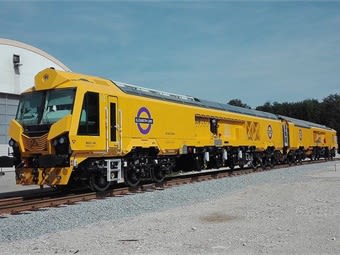
Linsinger MG 31 rail milling machine. Photo: Transport for London
All three maintenance trains are fitted with the Elizabeth line's new central section signalling system, enabling them to move around the railway while passenger trains are still running to maximise the time spent working during the night.
The three trains are designed specifically for the Elizabeth line and are gauged to fit inside the new tunnels and on the central section of the route. The operation and maintenance of the trains will be carried out by GB Rail freight Limited (GBRf). TfL has awarded this contract for a period of five years.
More Rail

New York MTA Advances Final Contract for Second Avenue Subway Expansion
Contract Four is the largest in the Second Avenue Subway Phase 2 project and includes construction of station infrastructure, tracks, and signals for the subway expansion, MTA officials said. Work on Contract Four will begin in 2027.
Read More →
San Diego MTS Breaks Monthly Trolley Ridership Record
Agency officials said July’s ridership indicates MTS’s continued recovery from the pandemic.
Read More →
Report Examines NJ TRANSIT Reliability, Funding Challenges
The Garden State Initiative analysis examines the roles of Amtrak infrastructure, fleet management, and agency operations while recommending a more performance-based approach to improving reliability.
Read More →
Stadler, CapMetro Sign Long-Term Rail Fleet Support Agreement
Beginning in 2027, Stadler will provide on-site technical expertise, spare parts support, training, and obsolescence management to help extend the reliability and longevity of CapMetro’s GTW fleet.
Read More →
Biz Briefs: Alstom Lands Canadian Contract, LYT to Supply California TSP, and More
In METRO's latest installment, we take a look at recent news from Complete Coach Works, Beep, FlixBus, and more partnerships making headlines across the transportation sector.
Read More →
CATS Gold Line Marks 5 Years of Service, 2.8M Passenger Trips
With a six-mile expansion planned, the Charlotte streetcar is positioned to connect more neighborhoods and major transit hubs across the region.
Read More →
Why Simulating Pedestrian Movement Has Become Essential for Modern Rail Stations
Pedestrian microsimulation is helping rail planners identify bottlenecks, test station designs, and prepare complex transit hubs for growing passenger volumes.
Read More →
Amtrak Begins Major Construction at New York’s Sunnyside Yard
The new maintenance facility will support Amtrak’s Airo trainsets while improving maintenance efficiency and turnaround times in New York.
Read More →
Chicago Leaders Unveil Plans for O’Hare Airport Express Train
The privately developed project would offer a 15-minute trip between downtown and O’Hare’s Terminal 2, with trains operating every 15 minutes on a dedicated track. The service would use battery-electric trains and three existing freight rail rights-of-way.
Read More →
OCTA Maps Out 30-Year Strategy to Protect Coastal Rail Corridor
The draft feasibility report identifies strategies to protect the coastal rail line for decades as the agency continues near-term stabilization and sand placement efforts.
Read More →