



Why Simulating Pedestrian Movement Has Become Essential for Modern Rail Stations
Pedestrian microsimulation is helping rail planners identify bottlenecks, test station designs, and prepare complex transit hubs for growing passenger volumes.
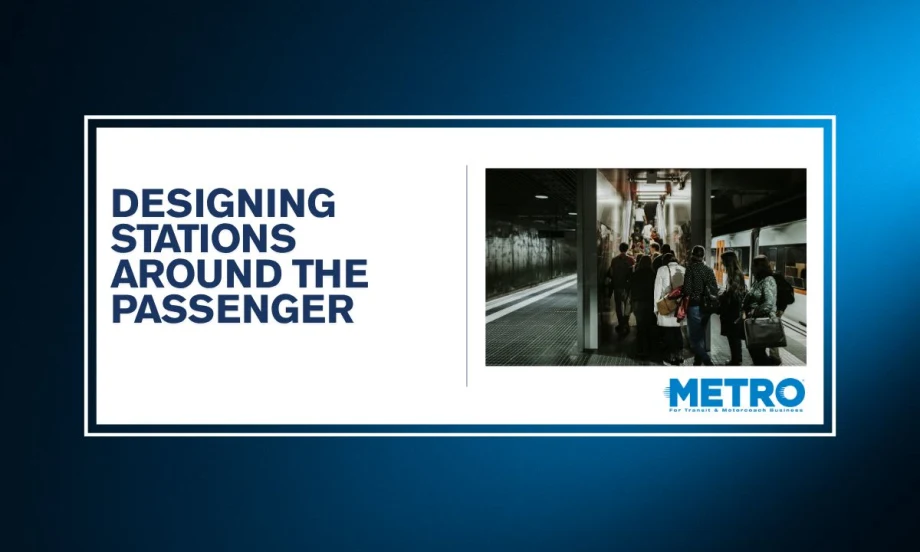
As cities continue to invest in public transit as the backbone of sustainable mobility, stations are becoming increasingly complex environments where passenger movement is just as important as train operations.
METRO
- Pedestrian microsimulation aids rail planners in identifying potential bottlenecks in transit systems.
- Simulations enable the testing of various station designs to optimize passenger flow and efficiency.
- Preparing complex transit hubs for increasing passenger volumes is made more effective through these simulations.
*Summarized by AI
Train stations are among the busiest public spaces in the world.
Major hubs such as Shinjuku Station in Tokyo accommodate millions of passengers every year, while even medium-sized commuter stations must safely handle thousands of people every day.
As cities continue to invest in public transit as the backbone of sustainable mobility, stations are becoming increasingly complex environments where passenger movement is just as important as train operations.
Today's stations are no longer places to board or alight from a train. They have evolved into multimodal transport hubs, connecting commuter rail, metro systems, buses, trams, bicycles, ride-hailing services, and pedestrian networks. Many also incorporate retail, restaurants, and public amenities, transforming stations into destinations in their own right.
The growing complexity presents a significant challenge for planners. Passenger movement is constrained by platform capacity, the performance of escalators, stairways and elevators, the location of ticket gates, and the interaction between different passenger streams.
During peak periods, seemingly small changes in demand can trigger bottlenecks, increase transfer times, and reduce both passenger comfort and operational resilience.
Recognizing this complexity, the Transit Capacity and Quality of Service Manual, one of the industry's most widely used planning references, recommends evaluating passenger circulation from a systems perspective. Rather than assessing individual components in isolation, planners are encouraged to consider how platforms, stairs, escalators, ticket gates, corridors, and waiting areas interact as a single operational system.
This is precisely where pedestrian microsimulation has become an indispensable planning tool.
Small Design Decisions Can Have Major Operational Impacts
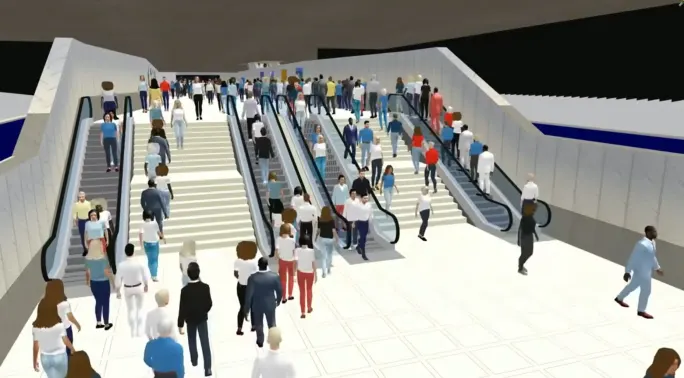
Pedestrian microsimulation captures this complexity by representing every traveler as an individual moving through a digital model of the station.
PTV
Unlike trains, pedestrians do not follow a timetable. They walk at different speeds, choose different routes, stop to orient themselves, travel in groups, carry luggage, or react to congestion around them. Thousands of these individual decisions collectively determine how efficiently a station functions.
Pedestrian microsimulation captures this complexity by representing every traveler as an individual moving through a digital model of the station.
Modern simulation tools rely on behavioral models, such as the Social Force Model, that reproduce how people navigate through crowds, avoid obstacles, and respond to their surroundings.
Rather than calculating average pedestrian flows, planners can observe how thousands of passengers interact with one another and with the station infrastructure under realistic operating conditions.
The technology can be applied throughout the passenger journey. Models simulate how passengers wait on platforms, board and alight from trains, move through concourses, transfer between services, and exit the station.
Because pedestrian movement is linked to rail operations, planners can also assess how delayed trains affect passenger circulation — or conversely, how prolonged boarding times influence train dwell times and network performance.
Beyond visualizing movement, simulation provides a wealth of operational data. Engineers can quantify walking and transfer times, identify areas where passengers experience unnecessary delays, measure pedestrian densities and levels of service, evaluate queue formation, and pinpoint locations where congestion is likely to occur.
Instead of relying on assumptions, planners can evaluate the operational consequences of design decisions before implementation.
Simulation enables engineers to answer practical questions long before construction begins. Would relocating ticket gates distribute passengers more evenly across the concourse? Could reversing the direction of an escalator reduce queues during the morning rush? Would additional signage encourage passengers to use less crowded exits? And how would revised train schedules or platform assignments affect transfers between different modes of transport?
Individually, these changes may appear minor. Together, they can substantially improve passenger comfort, reduce delays, and increase station capacity — often without requiring expensive structural modifications.
Perhaps most importantly, simulation allows planners to compare multiple design alternatives using identical demand scenarios. Decisions are therefore based on measurable performance rather than assumptions, reducing both planning risk and costly redesigns later in the project.
Planning for Tomorrow's Passenger Volumes
Passenger simulation becomes particularly valuable when stations are expected to experience significant growth.
A good example is San José Diridon Station in California, one of Silicon Valley's future transportation hubs. Daily ridership is projected to increase from approximately 16,000 passengers today to around 100,000 by 2050, driven by regional rail expansion and California's High-Speed Rail program.
To prepare for this growth, planners used pedestrian simulation during the early design stages to evaluate passenger circulation, transfers, and accessibility. Rather than simply testing whether future passenger volumes could be accommodated, the model examined how people would move throughout the station under different design concepts.
The analysis identified several operational challenges. Passenger flows converged in the existing pedestrian tunnel, resulting in sustained queues, limited resilience during demand surges, and heavy pressure on the stairs and escalators. By comparing alternative layouts, planners found that a three-level station design featuring larger concourses, a wider tunnel, and additional escalators significantly improved circulation throughout the station.
The redesigned layout is projected to save approximately 404,000 passenger-hours annually through reduced walking distances and shorter queues while improving transfers, accessibility, and overall operational resilience.
Designing Better Interchanges
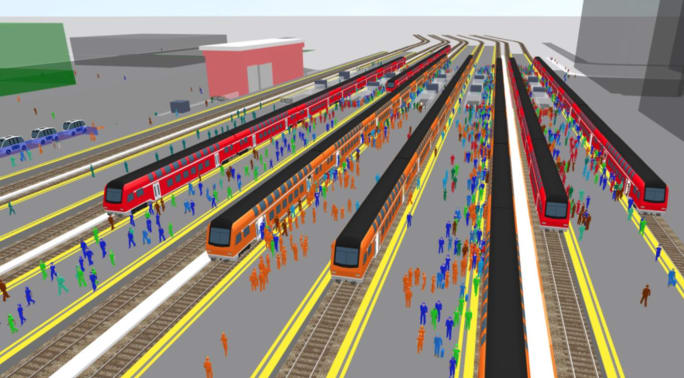
To support the design process, planners develop detailed pedestrian simulation models to evaluate passenger movement during peak operating conditions.
PTV
Simulation is equally valuable for entirely new stations, particularly those designed as multimodal interchange hubs.
One example comes from Tel Aviv, where Israel is developing an extensive underground metro system comprising three new lines and more than one hundred stations. Several of these stations will function as major interchange hubs, handling large passenger volumes moving simultaneously between metro lines, regional rail services, buses, and surrounding urban areas.
To support the design process, planners developed detailed pedestrian simulation models to evaluate passenger movement during peak operating conditions. The objective was not simply to verify capacity but to optimize the passenger experience at the station.
The simulations examined interactions among staircases, escalators, elevators, fare gates, and connecting corridors across multiple levels. Engineers tested different staircase configurations, circulation patterns, and obstacle placements to determine which layouts minimized conflicts between opposing passenger flows.
For example, simulations showed that groups of three parallel staircases generally performed most efficiently when two staircases were configured for ascending passengers and one for descending traffic. In areas where staircases connected floors at different angles, the models helped identify locations where opposing passenger streams were likely to create conflicts. Design adjustments, including modified circulation patterns and strategically placed guidance elements, significantly reduced these bottlenecks before construction.
Because these insights were generated during the planning phase, architects and engineers can refine the station layout while changes were still relatively inexpensive, avoiding costly redesigns later in the project.
From Infrastructure Design to Passenger Experience
Traditionally, station planning focused on physical capacity and how many people could theoretically occupy a platform or pass through a corridor within a given period. Today, the focus is shifting toward passenger safety and experience.
A station that technically meets capacity requirements may still feel crowded, confusing, or stressful if passengers encounter unnecessary conflicts, long queues, or poor wayfinding. Likewise, improving pedestrian circulation often increases operational efficiency without adding physical infrastructure.
Crowd simulation provides planners with a way to understand these dynamics before stations are built or modernized. Visualizing how thousands of people move through increasingly complex transport hubs helps agencies create stations that are not only capable of handling future demand but also safer, more resilient, and easier to navigate.
As rail networks continue to expand and cities place greater emphasis on public transportation, designing stations around passenger movement, not just train movement, will become an increasingly important part of successful transit planning.
About the Author: Hilary Aylesworth is Chief Product & Technology Officer at PTV Group, part of Umovity. She leads the product and technology strategy for the company's mobility planning and simulation solutions, including PTV Vissim, helping planners and engineers model traffic, public transport and pedestrian movements for complex mobility projects worldwide.
Quick Answers
Pedestrian microsimulation is a technique used to model and analyze the movement of pedestrians within a specific environment, such as a rail station, to improve infrastructure planning and management.
*Summarized by AI
More Rail
CSA Group Releases Climate Resilience Standard for Transit, Passenger Rail
Developed with support from the Standards Council of Canada, CSA D700 guides assessing climate-related risks and planning adaptation measures for transit and passenger rail systems.
Read More →
LA Metro September Ridership Climbs 3.9%, Led by Rail Growth
The agency recorded more than 27.2 million boardings, with rail ridership increasing 12.4% year over year and the D Line posting the largest gains.
Read More →
First Full MetroLink Rail Expansion Completed in 20 Years with $192M Airport Project
The project links two St. Louis-area airports by light rail while adding roadway and bike trail connections to improve regional access and mobility.
Read More →
Utilimarc Launches SmartReplace to Optimize Fleet Replacement Decisions
AI-powered SmartReplace helps fleets prioritize vehicle replacements, model budget scenarios, and build more defensible long-term strategies.
Read More →
Scenes from APTA TRANSform & EXPO 2026
Transit leaders, manufacturers, and industry professionals gathered in Chicago to explore new technologies, share ideas, and discuss the future of public transportation.
Read More →
USDOT Awards $416 Million for Florida Rail Crossing Safety Upgrades, New Brightline Station
The projects aim to reduce risks for motorists and pedestrians at rail crossings while expanding passenger rail access along Florida’s Space Coast.
Read More →
OCTA Declares Emergency to Protect Rail Corridor From Coastal Erosion
The California agency is accelerating shoreline protection and plans to place approximately 690,000 cubic yards of sand along the San Clemente coast to protect a key passenger and freight rail link.
Read More →
More Than a Summer Job: Building the Next Generation of Transit Talent
The Delaware River Port Authority and PATCO have transformed their internship program into a hands-on professional development experience that introduces students to the breadth of transportation careers — and creates a pipeline for future employees.
Read More →
Airo Trains Make Their Amtrak Cascades Debut in the Pacific Northwest
Effective immediately, two cutting-edge Airo trainsets will join the Amtrak Cascades route, operating four daily trips between Vancouver, B.C., Seattle, Portland, and Eugene, Oregon, marking the first introduction of Airo trains into passenger service anywhere in the country.
Read More →
Florida's Brightline Announces Financial Restructuring
Brightline Florida says train operations will continue as normal as certain parent entities enter Chapter 11 and financial stakeholders provide $490 million in new long-term capital.
Read More →