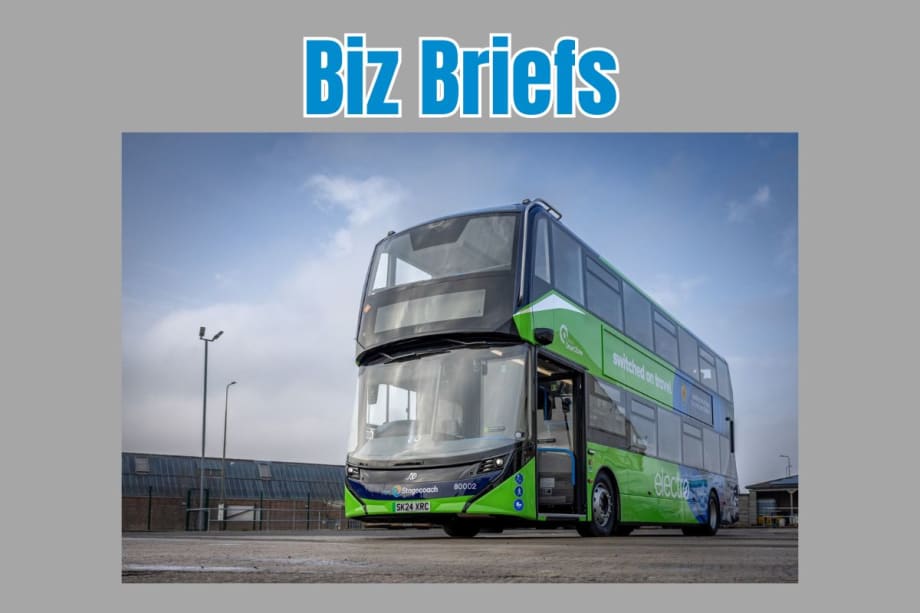
One hundred-eighty new Enviro400EV double deckers will join similar vehicles bought by Stagecoach with earlier ZEBRA 1 funding that are currently being delivered and commissioned for service.
Photo: Alexander Dennis
3 min to read
Biz Briefs covers the latest supplier/provider news in the industry.
Our latest installment includes a rebrand for Phoenix, a California contract for Transdev, and much more.
Ad Loading...
Alexander Dennis Lands UK Order for 244 Zero-Emission Buses
Alexander Dennis received a firm order from transport group Stagecoach for 244 of its next-generation zero-emission buses.
One hundred-eighty new Enviro400EV double deckers will join similar vehicles bought by Stagecoach with earlier ZEBRA 1 funding that are currently being delivered and commissioned for service.
The Enviro400EV combines a benchmark energy efficiency of just 0.67kWh/km over the UK Bus Cycle with 472kWh batteries and class-leading warrantable energy throughput of up to 1.6GWh to deliver an attractive total cost of ownership proposition.
In addition, there will also be 54 Enviro200EV 35- and 38-foot buses. This is the first order for Alexander Dennis’s new integral single decker, which will be launched next year to complement the current range of next-generation electric buses.
Transdev Extended in Northern California
Transdev is continuing its Modoc Transportation Agency partnership with the operation and management of Sage Stage.
Ad Loading...
Sage Stage provides more than 10,000 passenger trips per year and offers local demand response and intercity regional service connecting Alturas, Calif., with Redding, Klamath Falls, and Reno, Nev.
The new PhoenixEV brand epitomizes the synergies harnessed from decades of pioneering electric vehicle development, united by a shared commitment to delivering top-quality products across various transportation and mobility sectors.
Photo: PhoenixEV
Post-Proterra Acquisition Yields New Rebrand: PhoenixEV
Phoenix Motor Inc. announced the integration of the recently acquired Proterra transit bus division into its existing medium-duty business, heralding the birth of a new brand: PhoenixEV.
The strategic amalgamation combines the expertise and innovation of two industry players, cementing PhoenixEV's position as an “impactful market force in sustainable transportation solutions across North America,” according to a company press release.
The new PhoenixEV brand epitomizes the synergies harnessed from decades of pioneering electric vehicle development, united by a shared commitment to delivering top-quality products across various transportation and mobility sectors.
With collective expertise spanning engineering, development, production, and service, PhoenixEV said it is poised to maintain its leadership in commercial vehicle electrification and is committed to supporting the legacy of its existing transit customers with renewed vigor and ongoing service and part support.
Ad Loading...
Indiana U. Taps ETA Transit to Enhance Shuttle Bus Service
The collaboration strengthens IU's commitment to providing a diverse range of sustainable transportation options for students and staff.
Previously, IU relied on tablet-based MDTs (Mobile Data Terminals) that experienced reliability issues. This new system, implemented ahead of schedule in May 2024, features a core CAD/AVL (Computer-Aided Dispatch/Automatic Vehicle Location) platform with significant benefits, including:
CEO Magnus Friberg discusses Luminator’s shift toward becoming a digital partner, the growing importance of software and interoperability, and how AI can help agencies improve operations and passenger experience.
Reliability-Centered Maintenance helps transit agencies move beyond routine checklists to focus limited resources on the assets and failures that have the greatest impact on safety, reliability, and service.
More than 1,500 buses now feature upgraded technology designed to improve arrival predictions and provide free Wi-Fi, with deployment expected to reach nearly 2,000 buses by the end of 2026.
John Hroncich discusses BAE Systems’ modular and scalable approach, lessons learned from decades of real-world operations, and how agencies can identify electrification strategies that fit their fleets.
In METRO's latest installment, we take a look at recent news from Complete Coach Works, Beep, FlixBus, and more partnerships making headlines across the transportation sector.
What if transit leaders could ask any operational question and get a trusted answer in seconds? Conversational AI is transforming how agencies use their data.
More than $191 million in federal funding will help three transit agencies replace aging rail vehicles and support a new autonomous shuttle service in Chattanooga.
LA Metro’s Obed Mejia discusses technician training, evolving maintenance technology, fleet replacement, and strategies for getting the most out of today’s transit fleets.
In METRO's latest installment, we take a look at recent news from Siemens, Prevost, Dodge, and more partnerships making headlines across the transportation sector.
Pedestrian microsimulation is helping rail planners identify bottlenecks, test station designs, and prepare complex transit hubs for growing passenger volumes.