



Bluetooth, Wi-Fi sensing from mobile devices may help improve bus service
University of Washington researchers have developed an inexpensive system that uses Wi-Fi and Bluetooth signals from passengers’ mobile phones and devices to collect better data about where bus riders get on and off, how many people use a given stop and even how long they wait to transfer to another bus.

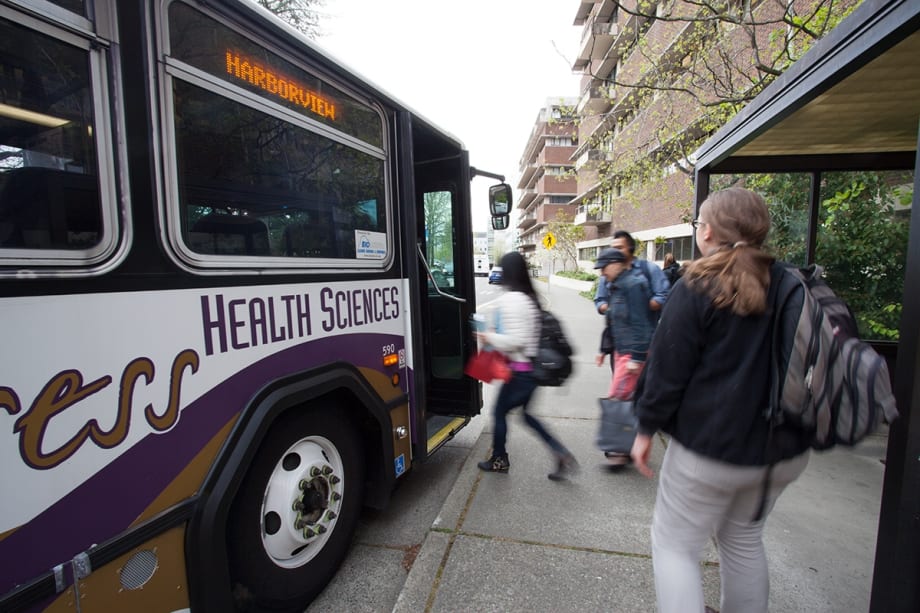
UW transportation engineers have developed an inexpensive system to sense Wi-Fi and Bluetooth signals from bus passengers’ mobile devices and collect data to build better transit systems. They tested it on UW shuttle buses last spring. University of Washington
UW transportation engineers have developed an inexpensive system to sense Wi-Fi and Bluetooth signals from bus passengers’ mobile devices and collect data to build better transit systems. They tested it on UW shuttle buses last spring. University of Washington
On any given bus ride, a good share of passengers are reading, texting or rocking out to music on their phones or tablets. In the future, those mobile devices may add more value to our transit commutes than simply filling time.
University of Washington researchers have developed an inexpensive system that uses Wi-Fi and Bluetooth signals from passengers’ mobile phones and devices to collect better data about where bus riders get on and off, how many people use a given stop and even how long they wait to transfer to another bus.
The system — described in a paper that was presented at the 2016 Transportation Research Board annual meeting in Washington, D.C. on Jan. 11 — could help transit agencies collect valuable real-time data to provide better service.
To improve efficiency and ensure that buses are meeting the greatest needs in a community, transit agencies today typically rely on passenger surveys, head counts and smart card swipes that may only offer partial information about how people are using the transit network.
The UW transportation engineers developed sensors — which cost about $60 per bus — that can detect a unique identifier called a Media Access Control (MAC) address associated with a particular mobile device as it boards and leaves the bus to offer complete and real-time travel data. The system only collects MAC addresses and the time and location they are detected from Bluetooth or Wi-Fi signals, and each address is anonymized for privacy protection.
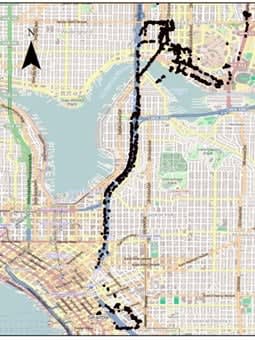
This map shows Bluetooth detections recorded on a single shuttle bus during the testing window last spring. University of Washington
The technology has been used to estimate vehicle travel times on highways and roads, but this is among the earliest attempts to investigate its possible use for collecting passenger origin and destination data on a transit system, researchers said.
“Let’s say you have a Husky game or Seahawks game and you want to know how much demand changes so you can offer the right level of bus service for this special event,” said senior author Yinhai Wang, a UW professor of civil and environmental engineering and director of the Pacific Northwest Transportation Consortium, or PacTrans.
“If you can gather enough data from these real-time sensing systems, that’s going to offer very valuable information,” he said.
The research team tested the system in May 2015 by installing sensors on the South Lake Union Shuttle and Health Sciences Express buses operated by UW Transportation Services, which run from the university’s main campus to South Lake Union and Harborview Medical Center.
Because the system only senses addresses from mobile devices that have Wi-Fi enabled or whose Bluetooth is in discoverable mode — which wouldn’t be the case for everyone riding a bus — the transportation engineers wanted to know whether they could collect enough data to yield an accurate picture of travel behavior.
Map of WiFi detections
This map shows Bluetooth detections recorded on a single shuttle bus during the testing window last spring.University of Washington
Another challenge was developing processing algorithms to filter out all the signals from mobile devices running Wi-Fi or Bluetooth carried by people who were near the bus but not actually riding on it.
“That’s probably the hardest part of the whole thing,” said co-author Kristian Henrickson, a UW civil and environmental engineering doctoral student and research assistant who manages the UW’s Smart Transportation Application and Research (STAR) Lab.
“The big things we’re concerned with are pedestrians and cyclists or people in cars or buildings that have their Wi-Fi and Bluetooth devices on and are close enough to have the sensors on the bus pick up those signals,” he said. “So we have to make sure we filter out those addresses.”
For instance, the sensors mounted inside the buses initially picked up more than 20,000 unique addresses from mobile devices, the time of detection and GPS locations during the test period. After weeding out signals that were unreasonably long or short, or that appeared or vanished far from a bus stop, the researchers wound up with 2,800 “trips” that they are confident were taken by passengers on the bus.
The origin and destination data from the remote sensing system matched information that the researchers collected by riding buses and tracking how many people got on and off at various stops.
Transit agencies are perennially seeking that type of information to inform decisions about changing routes or service levels, or to determine how frequently buses should run, whether they need larger buses at certain times of day, and how to meet demand and operate the transit system most effectively.
“We were able to prove the concept and demonstrate that it’s much cheaper to collect data this way,” Wang said. “This is really just at the beginning stage, but this technology is going to become more universal in the age of smart cities.”
One open question is whether data collection that relies on Wi-Fi and Bluetooth signals could leave out certain segments of the population — such as the elderly or low-income who may not carry mobile devices or use wireless networks. That’s why UW researchers are also interested in investigating how people use different technologies during their commutes.
Given the penetration of cell phone ownership, though, Henrickson said the technology’s potential to improve equity in the transit system arguably outweighs possible drawbacks.
“Think about understanding how long and disconnected a route may be from some less-privileged neighborhoods to an employment center. This technology provides a much better way of assessing that and possibly improving upon that,” Henrickson said.
Funding for the research came from PacTrans and Washington State Department of Transportation.
Co-authors include UW Department of Civil and Environmental Engineering doctoral student Matthew Dunlap and research associate Zhibin Li. For more information, contact Wang at yinhai@uw.edu and Henrickson at henr2237@uw.edu.
More Bus

New York MTA Plans Largest Bus Fleet Upgrade in More Than a Decade
The agency is seeking manufacturers for 650 new CNG buses to replace aging vehicles, improve reliability, and advance its broader fleet modernization strategy.
Read More →
Building a Flexible Path to Transit Electrification
John Hroncich discusses BAE Systems’ modular and scalable approach, lessons learned from decades of real-world operations, and how agencies can identify electrification strategies that fit their fleets.
Read More →
Bus Tech Talk: Keeping Transit Technicians Ahead of the Technology Curve
LA Metro’s Obed Mejia discusses technician training, evolving maintenance technology, fleet replacement, and strategies for getting the most out of today’s transit fleets.
Read More →
Biz Briefs: RIPTA Unveils New Frontrunners, Clevland RTA Adds New Siemens, and More
In METRO's latest installment, we take a look at recent news from Siemens, Prevost, Dodge, and more partnerships making headlines across the transportation sector.
Read More →
People Movement: Holly Arnold Joins Transdev and More
In this edition, we also cover recent appointments and announcements at Pace, CamTran, MCI, and more, showcasing the individuals helping to shape the future of transportation.
Read More →
The High Cost of Transit Buses: Industry Leaders Look to Procurement Reform
Transit leaders and policymakers examine how standardized bus designs, streamlined procurement, and predictable funding could help agencies stretch budgets and deliver better service.
Read More →
The Business Voice Behind Public Transportation
As chair of APTA’s Business Members Board of Governors, Ray Melleady explains how more than 850 business members are partnering with transit agencies to advance funding, innovation, and industry-wide collaboration.
Read More →
From Surviving to Thriving: Building Stronger Transportation Organizations
Bus Business Consultants founder Brian Dickson shares lessons on leadership, organizational health, and creating options for long-term success in a changing transportation industry.
Read More →
Finding the ‘Happy Medium’: Optimizing Maintenance Without Sacrificing Reliability
The key to maintenance optimization isn’t doing less work—it’s doing the right work at the right time on the right assets.
Read More →
LA Metro, City of West Hollywood, and Partners Advance Smarter Bus Lane Enforcement
The award-winning partnership combines AI-powered detection with human oversight to improve bus reliability, accessibility, and enforcement efficiency.
Read More →