



Capital Metro awarded $50 Million MetroRail improvements
The funding includes $28 million for the purchase of four rail cars, which will double the capacity of the Red Line, allowing up to 2,400 additional passenger trips during morning and afternoon peak travel times.

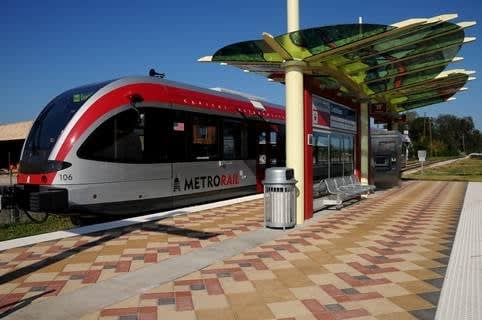
The Texas Department of Transportation (TxDOT) yesterday voted to award Capital Metro $50 million for the purchase of new rail cars for the agency’s MetroRail service, and the construction of a permanent and larger rail station in downtown Austin.
The funding includes $28 million for the purchase of four rail cars, which will double the capacity of the Red Line, allowing up to 2,400 additional passenger trips during morning and afternoon peak travel times. Capital Metro will also be able to increase frequency during peak periods from 34 to 15 minutes, and add an extra train after 7 p.m. to give commuters another alternative to driving during rush hour.
In addition to the rail cars, the agency will allocate $22 million to construct a permanent and enhanced MetroRail station downtown, transforming the facility into a multimodal terminal that connects with local bus service and a potential future urban rail system. The new station is expected to include up to three tracks and two platforms to accommodate future system expansion, and better serve crowds during special events. The new station configuration is estimated to cost between $30 million and $35 million, part of which will come from local partners.
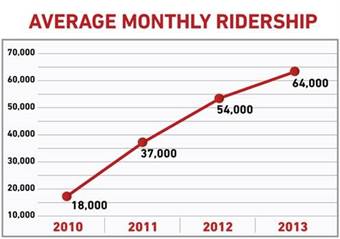
MetroRail currently provides over 15,000 trips a week, with the majority of passengers passing through the downtown station. Ridership has increased 258 percent since service began in March 2010, with more than 2.3 million trips taken overall during that time. Currently, trains are at capacity weekdays during peak periods, and are heavily used during the many special events held in Austin each year, including SXSW and Formula 1.
In 2013, Capital Metro was awarded an $11.3 million federal TIGER grant through a highly competitive process that involved nearly 600 applicants. Transportation Secretary Anthony Foxx traveled to Austin from Washington D.C. to personally announce the grant award last September.
While the TIGER grant has allowed Capital Metro to proceed with projects to increase capacity on the 32-mile commuter line, including laying double track at strategic points, the funding did not cover additional rail cars needed to take advantage of the new capacity, or include money to replace the temporary Downtown Station with a more permanent terminal.
Austin is the 11th largest city in the country, however traffic congestion is worse in Austin than cities with greater populations, including New York City, Chicago, Houston, Philadelphia, San Antonio, San Diego, Dallas and San Jose, Calif.
More Management

LIT Marks 10-Year Milestone at Annual Summit
Hosted by the COTA from September 10 to 13, the Summit carried the theme “Celebrating 10 Years of Excellence, Leadership, and Impact,” with every part of the program honoring the people, agencies, and partners who built LIT over its first decade.
Read More →
People Movement: Dan Dipert Coaches Adds Third-Generation Leader, Keolis Names New Valley Metro VP/GM, and More
In this edition, we also cover recent appointments and announcements at the Wabtec, SilverRide, HNTB, and more, showcasing the individuals helping to shape the future of transportation.
Read More →
METRO Opens Submissions for 2026 Motorcoach Awards
Nominations are now being accepted for METRO Magazine’s Operator of the Year and Innovative Operator of the Year awards.
Read More →

New York MTA Advances Final Contract for Second Avenue Subway Expansion
Contract Four is the largest in the Second Avenue Subway Phase 2 project and includes construction of station infrastructure, tracks, and signals for the subway expansion, MTA officials said. Work on Contract Four will begin in 2027.
Read More →
Transit Agencies Highlight Safety Gains at National Summit
Leaders from 15 major transit systems shared crime-reduction results and safety initiatives while discussing the role of continued federal support.
Read More →
NITA Names New Leadership, Expands Reduced-Fare Program at First Board Meeting
The new regional transit authority appointed its first board chair and interim executive director while extending reduced fares across CTA, Metra, and Pace for eligible riders.
Read More →
Beyond the Checklist: A Structured Approach to Transit Maintenance
Reliability-Centered Maintenance helps transit agencies move beyond routine checklists to focus limited resources on the assets and failures that have the greatest impact on safety, reliability, and service.
Read More →
APTA 2026 Nominating Committee Selects Leadership Slate, Names Chair and Vice Chair Nominees
Leadership changes will help shape the association’s priorities and its representation of the transportation industry during the 2026–2027 term.
Read More →
DART Launches Major Security, Fare Enforcement Initiative
The 90-day demonstration will deploy coordinated security teams at five light rail stations while testing controlled access and gathering data to guide future investments.
Read More →
Advancing Fare Collection Through Technology and Innovation
Learn about delivering 1300 gates at 91 stations while managing fare evasion. Explore the large scale deployment, solution customization and real-world results that affect the region. Prepare for deployment in your region now.
Read More →