



Chicago Transit: Crime down 34% compared to 2013
Since May 2011, the CTA has taken a number of steps to improve efforts in tackling crime on the bus and rail systems, including expanding police patrols and rail saturation missions on the CTA system and increasing undercover operations targeting pick-pocket theft rings and other crimes.

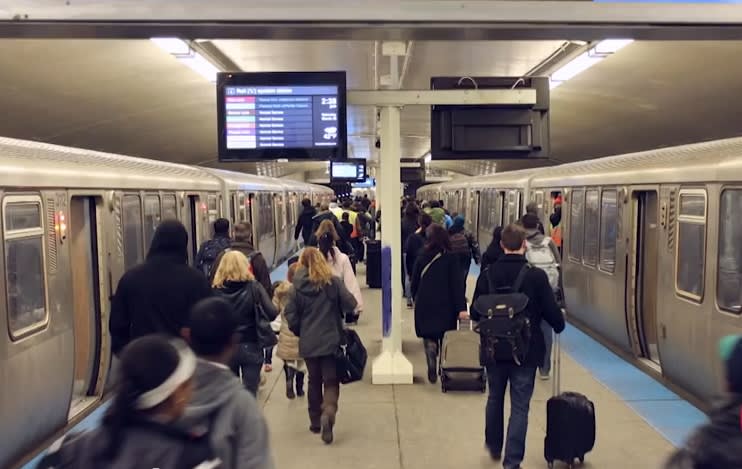
The total number of violent crimes and thefts reported on Chicago Transit Authority (CTA) buses, trains, and rail stations and platforms for the first half of the 2014 declined from a year ago, continuing a downward trend in overall crime on the system.
Since May 2011, Mayor Rahm Emanuel, the Chicago Police Department and the CTA have taken a number of steps to improve efforts in tackling crime on the bus and rail systems. Those initiatives have included expanding police patrols and rail saturation missions on the CTA system; increased undercover operations targeting pick-pocket theft rings, vandalism and other crimes; and the huge expansion of CTA’s bus and rail surveillance camera network to more than 23,000 cameras, which have significantly aided in making arrests and securing convictions.
During the first six months of 2014, violent crimes on buses, trains and at stations/platforms declined more than 34% compared with the first half of 2013. Robberies and thefts, which are the most common crimes on the CTA, also had double-digit declines with 83 and 179 fewer incidents respectively, compared to last year. Other crime categories that also saw decreases the first half of 2014:
Robbery down 35%.
Aggravated assault down 6.3%.
Aggravated battery down 48.3%.
Larceny–theft down 18.4%.
Overall serious personal and property crimes down 21.9%.
Across the rail system, serious personal and property crimes are down 22% for the first half of 2014 and the lowest compared to the last three years. Robberies on trains are down 35%, with 33 fewer incidents. At stations and on platforms, robberies decreased 43% with 28 fewer incidents. Collectively, rail system robberies are down 39% from last year.
Theft decreased across the rail system, with the number of incidents down 13% on platforms and down 19% on trains.
RELATED:Mobile Surveillance Helping Transit Agencies Operate More Efficiently
On buses, overall incidents of violent crimes during the first six months this year are down nearly 30%. Robbery and theft, which are the most common crimes committed on buses, are down nearly 28% and 20%, respectively.
Images pulled from CTA cameras have aided police in the identification, investigation and apprehension of at least 128 individuals involved in at least 116 reported cases of crime that occurred either on or near CTA properties in the first half of 2014.
Since Mayor Emanuel took office in 2011, the CTA has dramatically expanded the number of security cameras on its bus and rail system to more than 23,000, including the completion of a $13.9 million program in December 2013 to install multiple cameras on 834 older CTA railcars with more than 3,300 360-degree cameras. That was in addition to thousands of cameras that are already installed on the CTA’s newest generation of railcars, the 5000-Series, which are currently being added to CTA’s rail fleet.
More Rail

New York MTA Advances Final Contract for Second Avenue Subway Expansion
Contract Four is the largest in the Second Avenue Subway Phase 2 project and includes construction of station infrastructure, tracks, and signals for the subway expansion, MTA officials said. Work on Contract Four will begin in 2027.
Read More →
San Diego MTS Breaks Monthly Trolley Ridership Record
Agency officials said July’s ridership indicates MTS’s continued recovery from the pandemic.
Read More →
Report Examines NJ TRANSIT Reliability, Funding Challenges
The Garden State Initiative analysis examines the roles of Amtrak infrastructure, fleet management, and agency operations while recommending a more performance-based approach to improving reliability.
Read More →
Stadler, CapMetro Sign Long-Term Rail Fleet Support Agreement
Beginning in 2027, Stadler will provide on-site technical expertise, spare parts support, training, and obsolescence management to help extend the reliability and longevity of CapMetro’s GTW fleet.
Read More →
Biz Briefs: Alstom Lands Canadian Contract, LYT to Supply California TSP, and More
In METRO's latest installment, we take a look at recent news from Complete Coach Works, Beep, FlixBus, and more partnerships making headlines across the transportation sector.
Read More →
CATS Gold Line Marks 5 Years of Service, 2.8M Passenger Trips
With a six-mile expansion planned, the Charlotte streetcar is positioned to connect more neighborhoods and major transit hubs across the region.
Read More →
Why Simulating Pedestrian Movement Has Become Essential for Modern Rail Stations
Pedestrian microsimulation is helping rail planners identify bottlenecks, test station designs, and prepare complex transit hubs for growing passenger volumes.
Read More →
Amtrak Begins Major Construction at New York’s Sunnyside Yard
The new maintenance facility will support Amtrak’s Airo trainsets while improving maintenance efficiency and turnaround times in New York.
Read More →
Chicago Leaders Unveil Plans for O’Hare Airport Express Train
The privately developed project would offer a 15-minute trip between downtown and O’Hare’s Terminal 2, with trains operating every 15 minutes on a dedicated track. The service would use battery-electric trains and three existing freight rail rights-of-way.
Read More →
OCTA Maps Out 30-Year Strategy to Protect Coastal Rail Corridor
The draft feasibility report identifies strategies to protect the coastal rail line for decades as the agency continues near-term stabilization and sand placement efforts.
Read More →