



Chicago Transit unveils newly modernized Blue Line station
In addition to accessibility upgrades, the project improved station and platform lighting, installed new security cameras, and provided new CTA Bus and Train Tracker displays.

Chicago Mayor Rahm Emanuel and CTA President Dorval R. Carter Jr. opened the new Illinois Medical District (IMD) Blue Line station following a $23 million renovation and modernization project. The two-year project delivered improvements to the stationhouse and its concourse, along with upgrades to the station-to-platform ramp, meaning this vital transit center now offers increased accessibility and a better customer experience for area residents and visitors to one of the nation’s largest medical districts.
In addition to accessibility upgrades, the project improved station and platform lighting, installed new security cameras, and provided new CTA Bus and Train Tracker displays. Both auxiliary entrances received new flooring, wall, and ceiling finishes, along with the latest fare-payment equipment and customer assistant kiosks.
“Under Mayor Emanuel, the improvements like those made at our IMD station — including safer, cleaner, and more modern facilities — will better link thousands of riders to work, school, and leisure,” Carter said. “CTA remains committed to providing our customers with a world-class transit system, which is why we continue to improve accessibility systemwide for our customers and strengthen the vital transit connections to this busy medical district.”
The IMD station is also home to new, one-of-a-kind artwork created by Chicago-based artist Jason Messinger. A series of five hand-carved porcelain ceramic tile murals titled Vacation were created for each of the three stationhouse entrances and feature designs influenced by the natural world, but abstracted. Since the majority of those passing through the station are either employees, patients, or visitors to IMD, the artist’s goal was to create vacation-like imagery in an attempt to transport riders with a momentary joyful reverie from their routines and concerns.
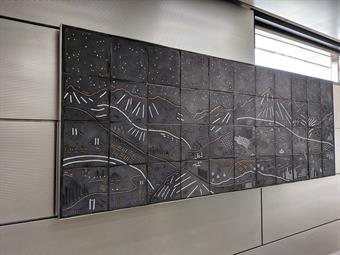
The IMD station is also home to new, one-of-a-kind artwork created by Chicago-based artist Jason Messinger.
CTA
The project was the largest renovation to the busy rail station since it opened more than 50 years ago. The IMD Station is the third-busiest station on the Blue Line Forest Park branch with three-quarters of a million entries last year. It provides key connections to four major hospital systems — the University of Illinois Hospital & Health Sciences System, the John H. Stroger Jr. Hospital of Cook County, Rush University Medical Center, and the Jesse Brown VA Medical Center. The station also serves Malcolm X College and the United Center.
With the exception of the Damen entrance, which was renovated in 1998, the station has received only minor patchwork repairs since it first opened in 1958, when Dwight Eisenhower was President.
The IMD work will join several other ongoing neighborhood station projects: Reconstruction of the 95th Street Terminal on the Red Line; the rehab of the Addison, Irving Park, Montrose, Jefferson Park, Harlem and Cumberland stations on the Blue Line as part of Your New Blue; and the renovated, modernized Quincy Station on the Brown Line.
More Rail

New York MTA Advances Final Contract for Second Avenue Subway Expansion
Contract Four is the largest in the Second Avenue Subway Phase 2 project and includes construction of station infrastructure, tracks, and signals for the subway expansion, MTA officials said. Work on Contract Four will begin in 2027.
Read More →
San Diego MTS Breaks Monthly Trolley Ridership Record
Agency officials said July’s ridership indicates MTS’s continued recovery from the pandemic.
Read More →
Report Examines NJ TRANSIT Reliability, Funding Challenges
The Garden State Initiative analysis examines the roles of Amtrak infrastructure, fleet management, and agency operations while recommending a more performance-based approach to improving reliability.
Read More →
Stadler, CapMetro Sign Long-Term Rail Fleet Support Agreement
Beginning in 2027, Stadler will provide on-site technical expertise, spare parts support, training, and obsolescence management to help extend the reliability and longevity of CapMetro’s GTW fleet.
Read More →
Biz Briefs: Alstom Lands Canadian Contract, LYT to Supply California TSP, and More
In METRO's latest installment, we take a look at recent news from Complete Coach Works, Beep, FlixBus, and more partnerships making headlines across the transportation sector.
Read More →
CATS Gold Line Marks 5 Years of Service, 2.8M Passenger Trips
With a six-mile expansion planned, the Charlotte streetcar is positioned to connect more neighborhoods and major transit hubs across the region.
Read More →
Why Simulating Pedestrian Movement Has Become Essential for Modern Rail Stations
Pedestrian microsimulation is helping rail planners identify bottlenecks, test station designs, and prepare complex transit hubs for growing passenger volumes.
Read More →
Amtrak Begins Major Construction at New York’s Sunnyside Yard
The new maintenance facility will support Amtrak’s Airo trainsets while improving maintenance efficiency and turnaround times in New York.
Read More →
Chicago Leaders Unveil Plans for O’Hare Airport Express Train
The privately developed project would offer a 15-minute trip between downtown and O’Hare’s Terminal 2, with trains operating every 15 minutes on a dedicated track. The service would use battery-electric trains and three existing freight rail rights-of-way.
Read More →
OCTA Maps Out 30-Year Strategy to Protect Coastal Rail Corridor
The draft feasibility report identifies strategies to protect the coastal rail line for decades as the agency continues near-term stabilization and sand placement efforts.
Read More →