




More News: Alstom to Overhaul, Modernize Commuter Railcars for Metrolinx
Chicago’s Metra Explores Financing Options to Fix Bridges
The railroad is considering applying for the Railroad Rehabilitation & Improvement Financing program as they face an estimated $5.4 billion in bridge projects.
January 23, 2025
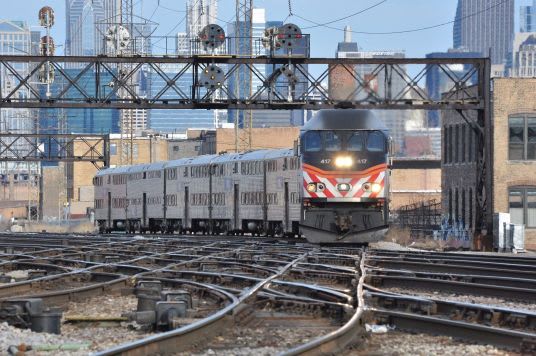
Metra owns 446 bridges with at least half of them sitting at 100 years old and in need of replacement.
Photo: Metra
3 min to read
Chicago’s Metra is exploring financing options to supplement their capital budget and tackle one of their most pressing needs, replacing scores of aging bridges.
The decision comes as the company is faced with a massive infrastructure backlog and a lack of adequate funding.
Bridges and Metra
Metra trains cross 926 bridges every weekday, and Metra owns 446 of those bridges.
At least half of the bridges Metra owns are more than 100 years old, with another 30% being more than 75 years old, which is the typical service life of a steel bridge.
The older bridges are currently safe but have surpassed their functional lifespan and are increasingly expensive to repair and maintain.
“There is no way around it — these bridges must be replaced, and they must be replaced soon, before our operations are impacted,” said Metra Executive Director/CEO Jim Derwinski. “Because this need is so urgent, we believe we must explore all our options, including financing, to address it.”
Needed Funding
Metra receives funding from local, state, and federal sources for capital needs such as bridges, however their needs are far greater than currently available funding.
During the development of its current five-year capital plan (2025-2029) Metra identified $5.4 billion in needs while only $2.1 billion is available in funding.
While Metra has the authority to issue revenue bonds, it is considering borrowing an estimated $230 million from the federal Railroad Rehabilitation & Improvement Financing (RRIF) program instead.
The program offers lower interest rates, a longer repayment period, no pre-payment penalty, and more flexible amortization.
Repayment is estimated at about $15 million to $20 million a year and would come from Metra’s normal operating fund sources, primarily fares and regional sales taxes.
The money would be used to complete funding for a major project to replace 11 bridges on the UP North Line between Fullerton and Addision on the North Side of Chicago.
It would also be used to rebuild the bridge over Grand Avenue on the Milwaukee District lines in Chicago, rebuild the bridge over the North Branch of the Chicago River on the Milwaukee District North Line in Northbrook, expand the bridge over North Branch of the Chicago River on the MD-N in Rondout, rehabilitate the bridge over Hickory Creek on the Rock Island Line between Mokena and New Lenox, and rebuild the bridge over 96th Avenue on the Rock Island Line in Mokena.
What’s Next?
The bridges were selected because the design process is or soon will be completed.
Metra expects the process for applying for and closing a RRIF loan to take about a year.
The first steps, expected to take about three months, are to submit and finalize a letter of interest with the U.S. Department of Transportation’s Build America Bureau and initiate an underwriting review.
Metra staff would then return to update the board of directors finance committee before the next step of engaging BAB advisors.
More Rail

New York MTA Advances Final Contract for Second Avenue Subway Expansion
Contract Four is the largest in the Second Avenue Subway Phase 2 project and includes construction of station infrastructure, tracks, and signals for the subway expansion, MTA officials said. Work on Contract Four will begin in 2027.
Read More →
San Diego MTS Breaks Monthly Trolley Ridership Record
Agency officials said July’s ridership indicates MTS’s continued recovery from the pandemic.
Read More →
Report Examines NJ TRANSIT Reliability, Funding Challenges
The Garden State Initiative analysis examines the roles of Amtrak infrastructure, fleet management, and agency operations while recommending a more performance-based approach to improving reliability.
Read More →
Stadler, CapMetro Sign Long-Term Rail Fleet Support Agreement
Beginning in 2027, Stadler will provide on-site technical expertise, spare parts support, training, and obsolescence management to help extend the reliability and longevity of CapMetro’s GTW fleet.
Read More →
Biz Briefs: Alstom Lands Canadian Contract, LYT to Supply California TSP, and More
In METRO's latest installment, we take a look at recent news from Complete Coach Works, Beep, FlixBus, and more partnerships making headlines across the transportation sector.
Read More →
CATS Gold Line Marks 5 Years of Service, 2.8M Passenger Trips
With a six-mile expansion planned, the Charlotte streetcar is positioned to connect more neighborhoods and major transit hubs across the region.
Read More →
Why Simulating Pedestrian Movement Has Become Essential for Modern Rail Stations
Pedestrian microsimulation is helping rail planners identify bottlenecks, test station designs, and prepare complex transit hubs for growing passenger volumes.
Read More →
Amtrak Begins Major Construction at New York’s Sunnyside Yard
The new maintenance facility will support Amtrak’s Airo trainsets while improving maintenance efficiency and turnaround times in New York.
Read More →
Chicago Leaders Unveil Plans for O’Hare Airport Express Train
The privately developed project would offer a 15-minute trip between downtown and O’Hare’s Terminal 2, with trains operating every 15 minutes on a dedicated track. The service would use battery-electric trains and three existing freight rail rights-of-way.
Read More →
OCTA Maps Out 30-Year Strategy to Protect Coastal Rail Corridor
The draft feasibility report identifies strategies to protect the coastal rail line for decades as the agency continues near-term stabilization and sand placement efforts.
Read More →